US Democrats give Israeli envoy earful over Netanyahu speech

Updated 05 February 2015
Follow

US Democrats give Israeli envoy earful over Netanyahu speech

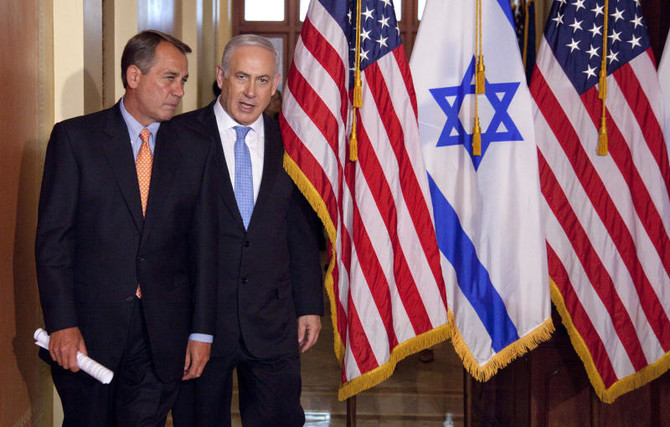
WASHINGTON: In a sometimes heated meeting with Israel’s ambassador to the US, several House Democrats expressed anger Wednesday over Prime Minister Benjamin Netanyahu’s acceptance of a Republican invitation to address Congress next month.
Some of the seven lawmakers — all of whom are Jewish and strong supporters of Israel — urged the prime minister to postpone the speech or hold it somewhere other than Congress, participants said. They told Ambassador Ron Dermer that Netanyahu was unwise to accept a Republican invitation that bypassed President Barack Obama, and to schedule the speech only two weeks before Netanyahu seeks another term in Israel’s elections.
The meeting’s purpose was “to try to defuse the optics” of the planned speech to Congress, and to return to substantive issues involving the two nations, said Rep. Steve Israel, a Democrat who hosted the gathering in his House office. Some attendees suggested a different time or venue for a Netanyahu speech, Israel told reporters, but “we have a while to go before we have to address whether or not he’s coming.”
Netanyahu’s March 3 speech would focus largely on Iran — and its nuclear program — amid delicate negotiations involving the United States, other Western powers and Tehran. Netanyahu’s acceptance of Republican House Speaker John Boehner’s invitation has infuriated the White House and many congressional Democrats.
Rep. Israel said the problem began when Boehner “decided that Israel would be a political football and he’d spike it in the end zone.”
Dermer asked for the Wednesday meeting in hopes of defusing some of the tension, lawmakers said.
Several Jewish House Democrats had met last week during the party’s retreat in Philadelphia to discuss what to do about the speech.
“I organized the meeting with Ambassador Dermer, and I invited key congressional Democratic supporters of Israel to attend,” Israel said in a statement. “There were a wide range of views that were discussed, but one thing we all agreed on emphatically is that Israel should never be used as a political football.”
Last Friday, House Democratic leader Nancy Pelosi was asked if Netanyahu would be well-advised to speak out in favor of heavier sanctions on Iran somewhere other than a joint meeting of Congress. She noted that the Israeli leader often appears on Sunday talk shows in the US.
Netanyahu has been an outspoken critic of the international efforts to negotiate a deal with Iran, which does not recognize the Jewish state, and which supports anti-Israeli militants like Lebanon’s Hezbollah and Palestinian Hamas.
He is sensitive, though, to Israel’s important relationship with the United States.
Last week, Netanyahu called Pelosi, Sen. Harry Reid, the Senate Democratic leader, and Sen. Chuck Schumer, the third-ranking Democrat in the Senate, in hopes of blunting their opposition to the invitation.
The issue has split many US Jewish organizations and communities, with some liberal groups criticizing the planned speech and others cheering it.
March 3 is 21 days before the US and its international partners are supposed to have reached a framework agreement with Iran — one that would provide an outline for a more comprehensive deal set to be finalized by the end of June.
The US and its allies want to prevent Iran from having the capability to develop a nuclear weapon. Iran denies any interest in nuclear weapons and says its program is for peaceful uses such as nuclear power and medical technology.


Palestinians attempt to use Gaza’s Rafah Border crossing amidst delays

Updated 58 min 22 sec ago
Follow

Palestinians attempt to use Gaza’s Rafah Border crossing amidst delays

  • The Rafah Crossing opened to a few Palestinians in each direction last week, after Israel retrieved the body of the last hostage held in Gaza and several American officials visited Israel to press for the opening

CAIRO: Palestinians on both sides of the crossing between Gaza and Egypt, which opened last week for the first time since 2024, were making their way to the border on Sunday in hopes of crossing, one of the main requirements for the US-backed ceasefire. The opening comes as Prime Minister Benjamin Netanyahu is expected to travel to Washington this week, though the major subject of discussion will be Iran, his office said.
The Rafah Crossing opened to a few Palestinians in each direction last week, after Israel retrieved the body of the last hostage held in Gaza and several American officials visited Israel to press for the opening. Over the first four days of the crossing’s opening, just 36 Palestinians requiring medical care were allowed to leave for Egypt, plus 62 companions, according to United Nations data.
Palestinian officials say nearly 20,000 people in Gaza are seeking to leave for medical care that they say is not available in the war-shattered territory. The few who have succeeded in crossing described delays and allegations of mistreatment by Israeli forces and other groups involved in the crossing, including and an Israeli-backed Palestinian armed group, Abu Shabab.
A group of Palestinian patients and wounded gathered Sunday morning in the courtyard of a Red Crescent hospital in Gaza’s southern city of Khan Younis, before making their way to the Rafah crossing with Egypt for treatment abroad, family members told The Associated Press.
Amjad Abu Jedian, who was injured in the war, was scheduled to leave Gaza for medical treatment on the first day of the crossing’s reopening, but only five patients were allowed to travel that day, his mother, Raja Abu Jedian, said. Abu Jedian was shot by an Israeli sniper while he was building traditional bathrooms in the central Bureij refugee camp in July 2024, she said.
On Saturday, his family received a call from the World Health Organization notifying them that he is included in the group that will travel on Sunday, she said.
“We want them to take care of the patients (during their evacuation),” she said. “We want the Israeli military not to burden them.”
The Israeli defense branch that oversees the operation of the crossing did not immediately confirm the opening.
A group of Palestinians also arrived Sunday morning at the Egyptian side of the Rafah crossing border to return to the Gaza Strip, Egypt’s state-run Al-Qahera News satellite television reported.
Palestinians who returned to Gaza in the first few days of the crossing’s operation described hours of delays and invasive searches by Israeli authorities and an Israeli-backed Palestinian armed group, Abu Shabab. A European Union mission and Palestinian officials run the border crossing, and Israel has its screening facility some distance away.
The crossing was reopened on Feb. 2 as part of a fragile ceasefire deal that stopped the war between Israel and Hamas. Amid confusion around the reopening, the Rafah crossing was closed Friday and Saturday.
The Rafah crossing, an essential lifeline for Palestinians in Gaza, was the only crossing not controlled by Israel prior to the war. Israel seized the Palestinian side of Rafah in May 2024, though traffic through the crossing was heavily restricted even before that.
Restrictions negotiated by Israeli, Egyptian, Palestinian and international officials meant that only 50 people would be allowed to return to Gaza each day and 50 medical patients — along with two companions for each — would be allowed to leave, but far fewer people than expected have crossed in both directions.