CANBERRA: Vladimir Putin faces an icy reception at the G20 summit with Britain’s David Cameron telling the Russian leader to stop bullying smaller states and Australia’s Tony Abbott accusing him of trying to relive the “lost glories of tsarism.”
The Russian president was due in Brisbane later Friday for the weekend summit of world powers at a time of heightened tension with host Australia, which has sent three ships to its northern coast after a flotilla of Russian navy vessels appeared there this week.
Prime Minister Abbott said the appearance of the four Russian vessels, which include a heavily armed cruiser and destroyer, were “part of a regrettable pattern” of growing Russian military bullishness.
Russia in turn on Friday warned France of “serious” consequences unless Paris this month delivers a warship whose handover has been delayed by the Ukraine crisis — setting the stage for confrontation with French President Francois Hollande in Brisbane.
Britain’s prime minister, speaking to the Australian parliament, warned Russia it faced further sanctions if it did not commit to resolving the conflict in Ukraine, calling Moscow’s actions “unacceptable.”
“It is a large state bullying a smaller state in Europe. We’ve seen the consequences of that in the past and we should learn the lessons of history and make sure we don’t let it happen again,” Cameron said.
Russia on Thursday dismissed the West’s claims that it has been sending fresh military hardware into eastern Ukraine, which could fuel a return to all-out conflict in place of an uneasy cease-fire.
The West’s relations with Moscow have grown increasingly tense since the downing of a Malaysia Airlines jet over territory controlled by pro-Russian separatists in eastern Ukraine in July, killing 298 passengers and crew including 38 Australian citizens and residents.
Kiev and the West claim the plane was blown out of the sky with a missile supplied by Russia, an allegation Moscow denies.
Abbott told Putin to “come clean and atone” for the shooting down of Flight MH17.
“Russian action in Ukraine is unacceptable,” Cameron told reporters in Canberra before heading to Brisbane.
“If Russia takes a positive approach toward Ukraine’s freedom and responsibility, we could see those sanctions removed. If Russia continues to make matters worse, we could see those sanctions increase. It’s as simple as that.”
The European Union, the United States and Australia are among those that have imposed sanctions on Russia for what they see as Moscow’s desire to redraw modern Europe’s borders.
Pro-Russian rebels have been fighting Ukrainian government forces since April in a war that has claimed more than 4,000 lives and driven hundreds of thousands of people from their homes.
The Australian navy said Friday it had sent a third ship to help monitor the Russian fleet that has appeared in international waters off its north coast, which also includes a tugboat and a refueling vessel.
Abbott said in a joint press conference with Cameron that Russia was “being much more assertive now than it has been for a very long time.”
“Whether it’s the bullying of Ukraine, whether it’s the increasing Russian military aircraft flying into the airspace of Japan, European countries, whether it’s the naval task group which is now in the south Pacific, Russia is being much more assertive now than it has been for a very long time,” Abbott said.
But he stressed: “Interestingly, Russia’s economy is declining even as Russia’s assertiveness is increasing.
“Russia would be so much more attractive if it was aspiring to be a superpower for peace and freedom and prosperity... instead of trying to recreate the lost glories of tsarism or the old Soviet Union.”
Abbott’s latest remarks come after a highly anticipated exchange between him and Putin at a trade summit in Beijing earlier this week.
Abbott had famously vowed to “shirtfront” Putin — an Australian football term in which a player charges an opponent — in Brisbane over the downing of MH17, but the Beijing encounter passed off without incident.
German Chancellor Angela Merkel said Friday during a visit to New Zealand ahead of going to Brisbane that she remained worried about “the violation of the territorial integrity of Ukraine.”
She reiterated that EU member states were considering adding pro-Russian separatists to existing sanction lists imposed on Moscow, but added that “beyond that, further economic sanctions are not planned at the moment.”


![]()
![]()
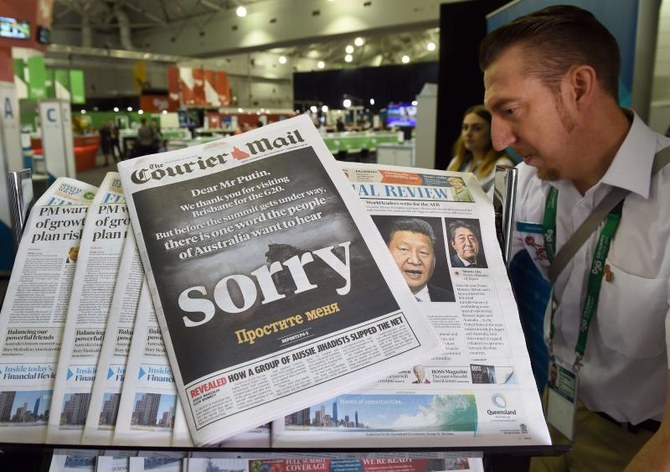
Australia, Britain tell Putin to stop being a bully

Australia, Britain tell Putin to stop being a bully
Latest updates


© 2026 SAUDI RESEARCH & PUBLISHING COMPANY, All Rights Reserved And subject to Terms of Use Agreement.