The Makkah Mashaer Metro (MMM), developed by the China Railway Construction Corporation (CRCC), recently disclosed to Arab News that 70 percent of its locally recruited staff are Saudi.
According to CRCC’s Operational Department data, the number of local staff at MMM in 2010 was approximately 1,000, and increased by 100 percent to 2,000 in 2011. There was also a cent percent increase in 2012, with the number rising to 4,000.
As per the requirements of the Saudi Ministry of Municipal and Rural Affairs (MOMRA), the number of Saudi employees continued to rise to 5,500 in 2013 and reached 6,000 in 2014.
Despite this, it has been revealed that fewer than 50 Saudi employees have taken high-level positions such as third party interface managers, deputy station manager, station master, assistant station master, station control room agent and other supervisory roles.
The SR6,600 billion project has now been operational for five years. During this period, it has transported a total of 26 million pilgrims from Arafat to Mina, a journey that only takes 13 minutes, while the route from Arafat to Muzdalifah is completed in just seven minutes.
This government service is available only for pilgrims and, due to this intent, the passenger ticket cost covers only one-third of the total operational expenses, according to Deputy Stations Manager Taher Baghdadi.
Baghdadi noted that since the opening of the MMM in November 2010, not a single accident has occurred anywhere on the metro route. Further, the travel time from Arafat to Muzdalifah has been reduced from its previous six to eight hours, to less than 20 minutes — a historic achievement in the history of transportation.
Regarding the role of Saudi employees in the MMM’s operation, Baghdadi said “There are 50 Saudis in senior positions who are supervising nine stations. We employ 6,000 people during Haj, some of whom work on contract only during Haj, after having been trained extensively."
About passenger ticketing and train access, he noted that the Ministry of Haj coordinates with Haj operating firms and sells around 400,000 train tickets to these agencies for pilgrims. According to Baghdadi, “the train staff won't stop pilgrims who insist on boarding the train as we treat them as guests of this country.” He added that only during the peak hours does the MMM insist that the pilgrims purchase tickets.
Last week, CRCC invited Arab News to discuss these matters with them exclusively. Arab News is the only Saudi media body to have gained first hand information about the MMM’s operation.
Authorities also allowed Arab News access to the restricted operational control areas in CRCC headquarters in Makkah. An additional visitation was also conducted in which Arab News representatives visited stations, monitoring and control centers, and met with top executives at the CRCC, including Saudi officials.


![]()
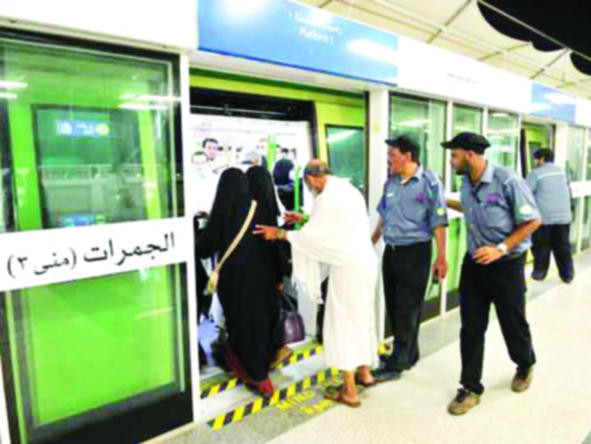
70% of Makkah Mashaer Metro staff are Saudi
70% of Makkah Mashaer Metro staff are Saudi
Latest updates


© 2026 SAUDI RESEARCH & PUBLISHING COMPANY, All Rights Reserved And subject to Terms of Use Agreement.