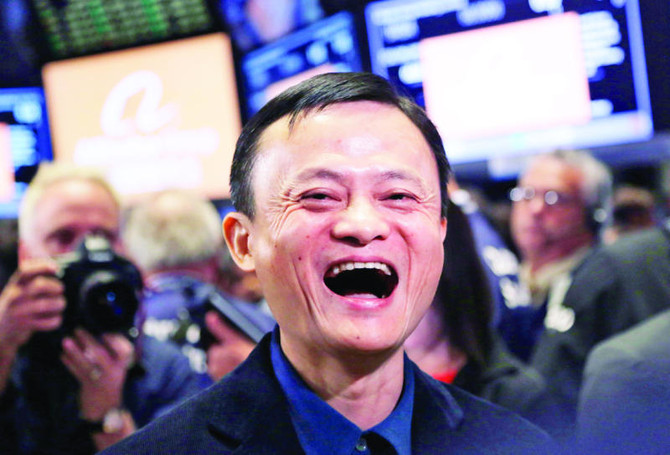
SHANGHAI: The largest stock offer in history has made Jack Ma, founder of e-commerce giant Alibaba, China’s richest person with a fortune of $25 billion, an annual wealth ranking for the country showed.
Ma, who had to persuade friends to give him $60,000 to start Alibaba just 15 years ago after being rejected by US venture capitalists, now leads a company valued at more than $200 billion after listing on the New York Stock Exchange Friday.
“It has been an amazing year for China’s best tycoons despite the jitters about the Chinese economy,” said China-based luxury magazine publisher Hurun Report in its annual rich list.
Ma reaped more than $800 million from selling shares through the initial public offering in Alibaba, based on company filings, with the value of his remaining stake of 7.8 percent surging to more than $17 billion by Monday.
Last year the estimated wealth of the former English teacher turned Internet entrepreneur was just over $4.0 billion, which did not even place him in the top 20, according to the 2013 survey.
Ma’s parents were poorly educated and his father depended on a monthly retirement allowance of just $40 to support the family, according to Chinese state media.
Alibaba’s listing raised a total of $25 billion.
Only one other of Alibaba’s 18 co-founders made the rich list this year, according to the Hurun Report. He is Simon Xie, now vice president of Alibaba’s China investment, with $1.6 billion.
Ma pushed property tycoon Wang Jianlin, whose Wanda company bought US cinema chain AMC Entertainment, into second place from first last year with a fortune of $24.2 billion. The bursting of China’s real estate bubble chased most developers out of the top 10, Hurun Report said.
A new face, Li Hejun of renewable energy firm Hanergy, tied for third place with $20.8 billion, alongside beverage magnate Zong Qinghou of Wahaha.
But technology commanded half of the top 10. Pony Ma of Tencent, operator of China’s most popular instant messaging application WeChat, was fifth with $18.1 billion.
Robin Li of China’s dominant search engine Baidu was sixth, Richard Liu of Alibaba competitor JD.com took ninth, and Lei Jun of upstart mobile phone producer Xiaomi was 10th.
Completing the top 10 were father and son team Yan Jiehe and Yan Hao of road-builder China Pacific Construction in seventh position and another real estate mogul, Yan Bin of Reignwood in eighth.
China’s real estate and infrastructure industries have been hit by the slowing economy.
It grew an annual 7.7 percent in 2013, the same as in 2012 — which was the slowest rate of expansion since 1999. Gross domestic product growth was 7.5 in the second quarter this year.
Still, Hurun Report said the number of US dollar billionaires in China hit 354 this year, up 39 from last year.
But a corruption crackdown and austerity program launched by leader Xi Jinping has taken its toll on current and former members of the rich list, with several facing criminal punishment or fleeing overseas.
They include Liu Han of conglomerate Hanlong, who was sentenced to death for “mafia” crimes, and Xu Ming of conglomerate Shide who is awaiting sentencing in a corruption case linked to disgraced politician Bo Xilai.
“The anti-corruption drive has a strong effect. We found 18 people from last year’s list in trouble with the authorities,” Rupert Hoogewerf, founder of the Hurun Report, told journalists in Beijing.

Alibaba’s Jack Ma is now China’s richest person
GCC growth set to accelerate to 4.4% in 2026 on non-oil strength: World Bank
RIYADH: Economies across the Gulf Cooperation Council are forecast to grow 4.4 percent in 2026, accelerating to 4.6 percent in 2027, driven by rising non-oil activity in countries including Saudi Arabia, according to an analysis.
In its Global Economic Prospects report, the World Bank said the Kingdom’s real gross domestic product is projected to grow 4.3 percent in 2026 and 4.4 percent in 2027, up from an expected 3.8 percent in 2025.
Earlier this month, a separate analysis by Standard Chartered echoed similar expectations, forecasting the Kingdom’s GDP to expand by 4.5 percent in 2026, outperforming the projected global growth average of 3.4 percent, supported by momentum in both hydrocarbon and non-oil sectors.
The World Bank’s latest forecast broadly aligns with the International Monetary Fund’s October outlook, which projects Saudi Arabia’s GDP to grow by about 4 percent in both 2025 and 2026.
In its latest report, the World Bank said: “Growth in GCC countries is forecast to increase to 4.4 percent in 2026 and 4.6 percent in 2027, mainly reflecting a steady expansion of non-hydrocarbon activity, in addition to a further rise in hydrocarbon production.”
It added: “The strengthening of non-hydrocarbon activity — accounting for more than 60 percent of GCC countries’ total GDP — is projected to be supported by expected large-scale investments, including in Kuwait and Saudi Arabia.”
Expanding the non-oil sector remains a core objective of Saudi Arabia’s Vision 2030 agenda, as the Kingdom continues efforts to reduce its long-standing reliance on crude revenues.
Highlighting the strength of Saudi Arabia’s non-oil momentum, S&P Global said the Kingdom recorded the highest purchasing managers’ index reading in the region in December, at 57.4, supported by rising new orders, continued growth in non-energy business activity, and expanding employment.
At the country level, the UAE’s economy is projected to grow by 5 percent in 2026, before accelerating to 5.1 percent in 2027.
Oman’s GDP is forecast to expand by 3.6 percent in 2026 and 4 percent in 2027, while Qatar is expected to record growth of 5.3 percent next year, rising sharply to 6.8 percent in 2027.
In Kuwait and Bahrain, GDP growth is projected at 2.6 percent and 3.5 percent, respectively, in 2026.
Across the broader Middle East, North Africa, Afghanistan and Pakistan region, growth is estimated to have reached 3.1 percent in 2025 and is projected to strengthen further to 3.6 percent in 2026 and 3.9 percent in 2027, largely driven by improving performance among oil-exporting economies.
Potential growth challenges
The World Bank also outlined several downside risks that could weigh on economic growth across the region.
These include a re-escalation of armed conflicts, heightened violence or social unrest, which could disrupt economic activity and weaken confidence.
Other risks include tighter global financial conditions, further increases in trade restrictions and tensions, greater uncertainty over global trade policies, and more frequent or severe natural disasters.
For oil exporters, lower-than-expected oil prices or heightened price volatility could also dampen growth.
“A re-escalation of armed conflicts in the region could cause a significant deterioration in consumer and business sentiment, not only in the economies directly affected but also in neighboring economies,” the World Bank said.
It added: “It could spill over into a broader increase in policy uncertainty and a tightening of financial conditions, dampening investment and economic activity.”
Global outlook
The World Bank said the global economy has proved more resilient than expected despite last year’s escalation in trade tensions and policy uncertainty.
Global economic growth is projected at 2.6 percent in 2026, easing from an estimated 2.7 percent in 2025.
“The modest slowdown comes on the heels of a post-pandemic rebound over 2021–25 that represented the strongest recovery from a global recession in more than six decades,” the World Bank said, adding that the rebound was uneven and came at the cost of higher inflation and rising debt.
Among advanced economies, US GDP is projected to grow by 1.6 percent in both 2026 and 2027.
China’s economy is expected to expand by 4.4 percent in 2026 before slowing to 4.2 percent in 2027, while India’s GDP is forecast to grow by 6.5 percent and 6.6 percent over the same period.