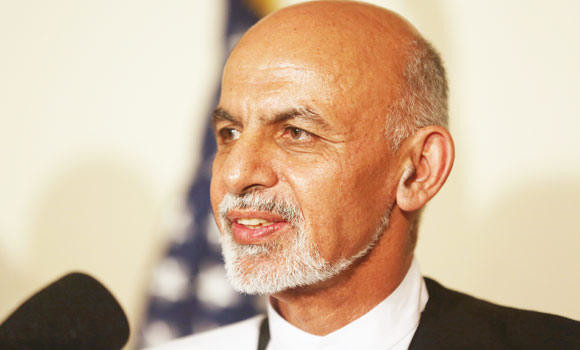
KABUL: Former Finance Minister Ashraf Ghani was declared Afghanistan’s next president on Sunday, hours after signing a power-sharing deal with his rival Abdullah Abdullah that ended a prolonged standoff over the disputed result.
The power-sharing deal makes one president and the other chief executive, ending months of political wrangling following a disputed runoff that threatened to plunge the country into turmoil and complicate the withdrawal of foreign troops.
The candidates signed the deal at the presidential palace, then exchanged a hug and a handshake.
“I am very happy today that both of my brothers, Dr. Ashraf Ghani and Dr. Abdullah Abdullah, in an Afghan agreement for the benefit of this country, for the progress and development of this country, that they agreed on the structure affirming the new government of Afghanistan,” said outgoing President Hamid Karzai after the signing.
The deal is a victory for US Secretary of State John Kerry, who first got the candidates to agree in principle to share power during a July visit to Afghanistan. Kerry returned to Kabul in August and has spent hours with the candidates, including in repeated phone calls, in an effort to seal the deal.
A White House statement lauded the two leaders, saying the agreement helps bring closure to Afghanistan’s political crisis.
“This agreement marks an important opportunity for unity and increased stability in Afghanistan. We continue to call on all Afghans — including political, religious, and civil society leaders — to support this agreement and to come together in calling for cooperation and calm,” the White House statement said.
Jan Kubis, the top UN official in Afghanistan, said the uncertainty of the past months took a heavy toll on Afghanistan’s security, economy and governance. NATO said in a statement that it hoped both leaders could move forward “in the spirit of genuine political partnership.”
The vote count has been plagued by setbacks amid allegations of massive fraud, emboldening the Taliban insurgents and further weakening the aid-dependent economy.
As tensions rose in Kabul, the UN and US pushed hard for a “national unity government” to avoid a return to the ethnic divisions of the 1990s civil war, which ended with the Taleban taking power in 1996.
Ghani Admadzai supporters and election commission reports circulating on social media said that the final vote gave Ghani Ahmadzai roughly 55 percent and Abdullah roughly 45 percent.
The four-page power sharing contract says the relationship between president and chief executive — a position akin to prime minister — must be defined by “partnership, collegiality, collaboration, and, most importantly, responsibility to the people of Afghanistan.”
It spells out the powers for the new chief executive position: participation with the president in bilateral meetings, carrying out administrative and executive affairs as determined by presidential decree, and parity in selection of key security and economic ministries.


![]()
![]()
![]()

Ashraf Ghani is new Afghan president

Ashraf Ghani is new Afghan president
Latest updates


© 2026 SAUDI RESEARCH & PUBLISHING COMPANY, All Rights Reserved And subject to Terms of Use Agreement.