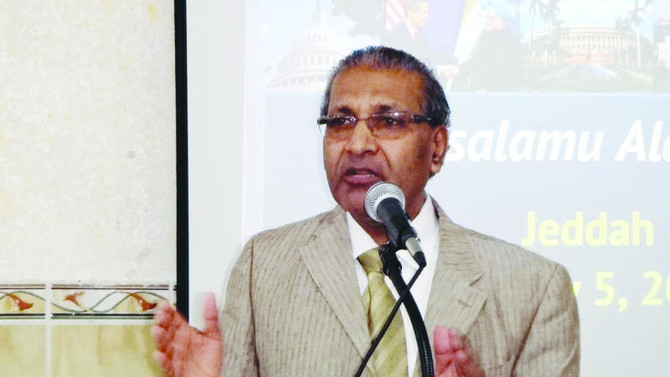
Seminar examines Muslims’ key role in Indian economy

Updated 13 January 2013
Follow

Seminar examines Muslims’ key role in Indian economy

In an attempt to educate local intellectuals on the state of the Indian economy and the role played by minorities in building it, The Socio Reforms Society conducted a seminar entitled “Growing Economy of India and the Minorities’ share" in Jeddah. The event was hosted by members of the society and was attended by members of the Indian community.
Speaking at the event were Abdul Saleh Shareef, a scholar and former adviser to the prime minister of India; Rasheed Ahmed Khan, president of the Indo-US Policy Institute; Aleem Khan Falaki, president of the Socio Reform Society, and Israrul Haq, an Islamic microfinance specialist at Batterjee Medical College.
Abdul Saleh Shareef set the tone for the meeting when he said, "Though Muslims have equal rights just like the other citizens of India they still savor the extra benefits of funds from the central government on the basis of being a minority community."
He added that these funds barely reached the common man and according to the Sachar Committee report, the infrastructure, including roads, hospitals and other facilities, lacks in amenities for Muslims. During the event, Shareef pointed out that Muslim leaders have yet to develop the art of representation and they do not have a clear picture of the government plans related to budgetary allocations, and so the community is not able to utilize the funds effectively.
Ahmed said all the efforts of Muslims are concentrated at the micro level like buildings, madrasas and colleges but there is no attention given to the macro level.
He added that New Delhi-based Center for Research and Debates in Development Policy (CRDDP) is working on establishing offices in every city to facilitate proper representation of Muslims.
Commenting on this, Aleem Khan said that to work on a macro level, the thought process should start soon rather than depending on parties or leaders to lead the way. The people should move forward and realize their needs accordingly.
He urged the community to invest in sensible ventures in order to eradicate poverty among its members.
Israrul Haq said that most of the damage done to Muslim merchants is from Foreign Direct Investments (FDI).
Since small businesses are in the hands of Muslims in most cities, business giants like Walmart will sweep away the small businesses run by poor merchants and traders. "The solution to all the problems faced by Muslims lies in adopting Islamic microfinance," he said.
Abdul Qader Maiman, a businessman and economist, commented, "As India's economy is booming now, Muslims should enter into small scale businesses and make them productive."


Riyadh Ramadan tents illuminate festive traditions

Updated 5 sec ago
Follow

Riyadh Ramadan tents illuminate festive traditions

  • As the sun sets, Ramadan tents open for guests to enjoy sumptuous meals

Riyadh: The much-anticipated tradition of Ramadan tents in Riyadh draws hundreds of daily for lavish iftar and suhoor menus, surrounded by sophisticated and luxurious decor.

One of the largest Ramadan gatherings in the capital, Fawanees at Mandarin Oriental Al Faisaliah, has over the years become a benchmark for the seasonal experience.

Named after the traditional lantern used to decorate homes during the holy month, Fawanees immerses guests in a traditional Saudi iftar, attracting people from around the Kingdom and abroad.

“Like the glow of fawanees lighting the night, Ramadan is the time to share our blessings with others. This year’s Fawanees brings togetherness and generosity,” Andrew Abram, general manager of Mandarin Oriental Al Faisaliah, told Arab News.

“May we carry this light in our hearts throughout the holy month and extend it to everyone around us.”

The buffet comprises a wide variety of dishes and beverages with lanterns decorating the venue and oud music echoing through the hall.

The Four Seasons Hotel in Riyadh hosts a Ramadan tent and majlis celebrating “Hikayat Ramadan,” inspired by the timeless art of storytelling.

Cafe Boulud has a French-inspired iftar menu, with a signature Ramadan cake crafted by pastry chef Wael Elsherif Ahmed El-Sherif, and there is a special Ramadan high tea experience at Obaya Lounge.

Families and young guests are also welcome, with dedicated childrens’ activities ensuring a festive experience for all.

“Every detail is designed to create meaningful experiences that connect families, celebrate heritage and leave lasting memories year after year,” Shadi Suleman, regional vice president and general manager at Four Seasons Riyadh, told Arab News.

The Ramadan tent and majlis have been designed with oriental-inspired decor, blending tradition with contemporary touches.

Guests can enjoy live oud music in a warm and inviting atmosphere, perfect for families, friends and corporate gatherings.

“Every detail has been thoughtfully crafted to surprise and delight our guests,” Suleman said.

At the heart of the culinary offerings is the signature Ramadan cake, inspired by the Arabian desert and made with Saudi dates, crisp kunafa, malt-infused white chocolate, pistachio cream and honey.

Fairmont Riyadh offers seasonal celebrations centered around the Al Thuraya Ramadan Tent with generous iftar buffets, intimate chef’s tables, and serene suhoor under the stars.

Set within the Al Thuraya Ballroom which extends into an outdoor tent, the inviting sanctuary captures the warmth of Ramadan and authentic Arabian hospitality.

In addition to hosting sophisticated iftars after sunset, the venue is home to a lively Ramadan bazaar, where guests can explore a selection of handcrafted jewelry, premium perfumes and traditional garments.

Younger guests can enjoy a dedicated children’s area, with engaging activities and a dedicated buffet.

With the holy month being a festive occasion, guests enjoy extensive menus at Ramadan tents catering to every preference in the nation’s capital.