There comes a point in a man’s life where he gets fed up with everything working. Whether it is a primal desire to put oneself against the slings and arrows of outrageous misfortune, or just because he feels that he would quite like something to fix just to prove he still can. In Singapore — the Lion City — a man’s just not going to get the chance.
Singapore is almost antiseptically clean and positively purrs with efficiency; even the people look as if they purr. Sleek, well groomed and moving about with liquid feline grace, one gets the impression they would suffer minor fugues if they simply thought they had heard the autumnal rustle of a cigarette packet being crumpled or felt the Sentosa express — a monorail to a nearby island recreational area — might be a few seconds late. Relax, it never is.
It was not ever thus. The 697 sq km island, surrounded by a constellation of smaller islets, supported a scruffy fishing village in 1819 when Sir Stamford Raffles of the British East India Company landed there. Its position, which links the mainland and islands of Asia at the choke point of east and west trade, destined the village to become a military and trading stronghold, which, over the next century or so, it did. After gaining independence from the British, Singapore was incorporated into the federation of Malay States in 1963 and became a fully independent nation in 1965.
For the ensuing 30 years, Lee Kuan Yew and the People’s Action Party led its development. Although criticized as autocratic by some in the West, the party is seen locally as having been instrumental in developing the state into the super efficient center of hi-tech engineering and financial rectitude it is now.
Singapore has a reputation for financial probity. The government, while involved in business and social behavior to a great extent, ensures a level of transparency and honesty unequalled just about anywhere else.
However enthusiastic and efficient they are though, they cannot control the weather. In Singapore it rains frequently and in quantity. It’s what encourages the rich greenery you see in the city. The local wisdom is that Singapore is a city in a garden. It certainly looks that way.
The skies open without warning, and umbrellas are not just fashion accessories. If you are lucky, you will hear a wave of insect-like clicks and snaps when umbrellas erupt around you as a wall of rain approaches giving you just time to dive for cover. Enjoy it — the rain usually only lasts a few minutes and adds a cool temporary varnish to the already well washed streets.
And if you happen to be on Sentosa Island, having caught the express that links several points on the mainland with all the sights and activities on the island, diving for cover can be a real pleasure. If you want to see better behaved water and what lives in it, Underwater World — an aquarium with 2,500 species of tropical fish and several hundreds more species of tourist standing in front of them — is a source of innocent and educational entertainment. Weekends are best avoided because such is the high quality of the diversions on offer there that the place becomes packed.
Less crowded and a fascinating insight into the incredibly diverse culture of Singapore is a wax museum showing tableaux and representations of the various cultures that have held sway over the island’s history. Part of that was as one of the pearls in the British imperial crown and the last bastion of the British during World War II, Fort Siloso, located on the western tip of Sentosa Island is a museum full of dungeons, subterranean passages and cannons to keep a child fantasizing for hours. It also houses elderly military looking gentlemen with Malacca canes and well pressed linen suiting standing rather reflectively in quiet corners.
More of these souls can be found — along with steely eyed maidens with eyeshades — at the rather fine 18-hole Sentosa Golf Club course, complete with pro-shop and putting greens, at the east end of the island.
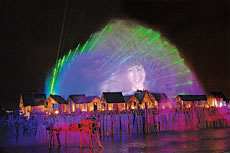
Indisputably the most spectacular entertainment on the island — it involves water again — is the twice nightly production “Songs of the Sea.” It is a simple story involving princesses and several species of multilingual fish and literally dozens of fountains, laser displays and fireworks. It is a 45-minute blast of raw energy and spectacle, which will raise a smile on the face of the most curmudgeonly of spectators.
Tourism has become a major industry in Singapore. Right up there with the world leaders, the good burghers of Singapore have erected what looks like a giant bicycle wheel — the Singapore Flyer. This is a 150 meters rotating observation wheel that provides from its 28 air-conditioned capsules some superb views of the Singapore waterfront and up to 45 kilometers beyond.
It officially opened to the public in March 2008. Official documentation on the event said that tickets for rides on the first three nights were sold out for 8,888 Singapore dollars (US$6,271), an auspicious number in Chinese culture.
The cultural makeup of Singapore is central to its life. While geography played an important role in Singapore’s success, the diversity and work ethics of its population of almost four million — made up of 77 percent Chinese, 14 percent Malays, 8 percent Indians and one percent Eurasians and people of other descent — is the city state’s real strength. Singapore’s development has been truly impressive — most especially as the island has no natural resources other than its people. Early in its history, it attracted migrants and merchants from the southern provinces of China, Indonesia, India, Pakistan, Ceylon and the Middle East.
Each ethnic group within Singapore has retained its own cultural identity but developed as part of the Singapore community. That applies to national monuments as well, notably the iconic Raffles Hotel.
The hotel was founded by four Armenians, the Sarkies brothers. They opened the 10-room colonial bungalow, named after the founder of Singapore, on Dec. 1 1887. The original location was by the seaside, but long-term reclamation has isolated the site some 500 meters away from the current seashore.
The hotel embodies its own measure of eccentric history. At the start of the Japanese occupation of Singapore on Feb. 15, 1942, for example, it is said that the invading soldiers encountered the guests at the Raffles Hotel dancing one final waltz.
The hotel survived World War II despite the hardships Singapore faced and the use of the hotel at the end of the war as a transit camp for prisoners of war. In 1987 the government declared the hotel a National Monument. The guest list is a historical document in itself sporting the names Rudyard Kipling, Joseph Conrad, W. Somerset Maughm (who called it “the legendary symbol for all the fables of the Exotic East”), Noel Coward, Charlie Chaplin and Queen Elizabeth II.
Apart from all its other diversions — and there are many — Singapore is world famous for its shopping facilities. Orchard Road — the main street — abounds with luxury department stores. Vast malls — Ngee Ann City, Tanglin Shopping, Raffles City Shopping Center to name a few are stuffed full of branded goods, curios and digital paraphernalia — enough to stun the fittest credit card. The prices for many of the goods on offer are ludicrously low by western standards. Moreover, given the strict and comprehensive government regulation and oversight on all business activity — even simple retail sales — the passing shopper never feels like a targeted poltroon, but a valued client. That gives the shopper a very comfortable feeling.
And if you want to get a touch of the Singapore feeling before you arrive, then there is nothing finer than the state airline, Singapore Airlines. Flying is one of the few areas where I could tolerate for ever things working properly, efficiently, reliably and as smooth as silk. And they do. It’s Singapore; how could things not?