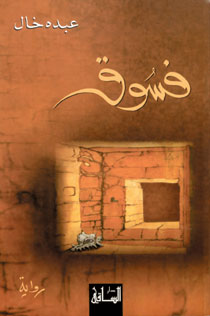
SHE escaped from her grave!
And thus a new novel, “Fosooq”(“Immorality”), by Saudi writer Abdo Khal, begins. The novel builds from there, stretching like a spider’s web through the narrow alleyways and old coral-brick buildings around the historic Al-Asad cemetery in downtown Jeddah.
The novel revolves around the scandal of the so-called escape of a girl from her grave days after she was buried in Al-Asad.
The search for the girl, or her body, evolves into a rich social metaphor of modern-day Saudi Arabia, touching upon untold scandals, human suffering, runaway girls, abnormal sexual relations, class distinction, terrorism and the morality police.
The search for the missing dead girl extends through the community who are as haunted by her story as they are about her body’s disappearance from the graveyard. The social-moral bog described in the novel is vigorously hidden and absurdly denied by the characters in the book.
The setting itself, modern-day Jeddah, becomes a character of the novel, says the 44-year-old Jeddawi novelist and columnist for the daily Okaz. He says he wrote the novel to expose the “hidden truths” of modern-day Saudi society.
“Immortality” was published in late 2005 and is in its third edition. It is not sold in the Saudi bookstores, but was featured at the Riyadh International Book Fair in February. Khal said that officials are planning to allow the book to be sold inside the Kingdom.
The gravedigger Shafeeq, who makes friends with the dead, is a relatively minor character in the novel until the end. Khal manages brilliantly to build up the entire story to serve the orphaned outcast Shafeeq, whom Khal admits was the inspiration for the novel.
“Shafeeq’s character was on my mind for more than ten years,” he said, adding that he began the book by writing the final three chapters where the relatively minor character in the book comes out as the key to the story’s macabre climax, shadowing the sympathies built up by the reader for Jalilah, the missing dead girl.
Khal, who in his youth worked as a journalist, said he covered a story in 1983 about the day-to-day life of gravedigger. Living for four days with the worker gave Khal the experience to describe in intimate detail the life of those that work with death. The smell of the graves and the modest quarters Shafeeq and his uncle live is vividly depicted.
Rumor plays a major role in the novel; it is the rumor swirling through the community of the girl who goes missing from the graveyard that starts the novel. Jalilah’s story is revealed though the novel, and it becomes apparent to the reader that it was rumors that forced her into a solitary life and ultimately her death; even in death, she is subject to rumors.
“Who can lead me to her neck?” is a refrain repeated by Jalialah’s father throughout to book. The father suspects that his daughter has faked her death in order to elope with her estranged lover. The father wants to kill her to clear her reputation caused by an innocent love story.
The interconnectedness of pride, violence and love is underscored by the back-story of Jalilah’s namesake, her father’s ex-lover, being brutally murdered by her brothers after a tryst with Jalilah’s father beneath the branches of a huge Nabk tree.
The story is told mostly through the eyes of Khaled, a police sergeant asked by his boss to find his daughter.
Khal said he wanted the story to pour through the police station because of the tradition of deference to authority in Arab culture.
“In our Arab heritage — in our subconscious — the police know everything. They represent absolute power,” he said.
As Sgt. Khaled’s investigation and interrogations commence, rotten spots of a society that pretends to be wholly virtuous are revealed. As the police sergeant moved through the streets of Jeddah, citizens are stripped of their angel’s wings.
The investigation into the missing girl becomes the mechanism by which the reader learns of the girl’s miserable end. Jalilah fell in love with Mahmoud, a young man in her middle-class neighborhood; they dream of marriage. When Mahmoud proposes to Jalilah in the traditional way — by asking her father, he is mocked for not being pure Saudi.
The young couple continues to meet in secret, but a run in with members of the Committee for the Promotion of Virtue and Prevention of Vice on Jeddah’s scenic seaside Corniche ruins their lives and puts an end to their pure, moral human feelings.
“How many times did you sleep with her?” asks one of the moral police officers when they stop the young couple in Mahmoud’s old car.
“Never,” replied the young man. “I love her and I want to marry her.”
“Now you want to marry her, you all say that when you get caught,” is the response before they’re both detained. Jalilah’s father picks up his daughter at the police station while Mahmoud spends a couple of months in jail.
Khal said that he uses this incident to turn the lives of the two young lovers upside down. Mahmoud becomes bitter and leaves Saudi Arabia to devote his life to the global jihadist movement in Afghanistan, Chechnya, Bosnia, until US forces in Iraq finally kill him.
Jalilah, on the other hand, must now face the stigma of rumors and a reputation ruined by innocent human love. The community sees her as spoiled goods, and she decides that she must choose between a life of prostitution or as a kind of Muslim nun. She chooses to “redeem” herself through silence and religious practice.
All the characters without exception survive in their own imaginary boxes.
“We are prisoners, we dream to escape. So, we live in these dreams, not outside in the harsh reality,” said Khal. “I too dreamt to hold my beloved by her hand and run carefree on the beach, or dance with her.”
Khal managed through one of the characters, Fawaz, a close friend of Sgt. Khaled to tip metaphorically and quietly at a major problem that face intellects in Saudi society. Fawaz stands in the novel as the intellectual force of the Kingdom. He often discusses the society that constantly attempts to erase individuality.
Fawaz holds a university degree in philosophy from abroad, as it is not taught in local universities due to a religious ban. He is a marginal character in the book, just as secular intellectuals are marginal characters in Saudi society.
“Fawaz represents Saudi intellectuals who suffer neglect and constant attack whenever they try to talk,” said Khal. “The authorities often marginalize such people, making them outcasts by calling them atheists and secularists.”
The relationship between what is real and what is a scrim on reality is a major theme in the novel.
“You cannot be the real you in our society. Because anything that is real and genuine will only receive accusations and avoidance,” said Khal.
Jalilah herself represents the issue of women as marginal characters in Saudi society. The story of the missing dead girl is told through witness testimony and opinions. Her back-story is told through narrative flashbacks, through Khal himself. Nearly everyone in the novel has something to say about the girl, except Jalilah herself.
“Why doesn’t she have a voice in the novel? Because we don’t talk about the truth, or maybe because the truth itself is absent,” said Khal.
As the novel approaches the climax, Shafeeq, the outcast orphan who makes friends with the dead, emerges in the novel and out from his imaginary world only to hit head-on with a harsh, violent reality.
Without revealing the climax, suffice to say that Shafeeq becomes a victim of mob mentality, with the authorities helpless to stop the momentum.
“The executive authority represented by Khaled is helpless in front of mass anarchy. That proves that the whole society is guide by rumors and chaotic agenda that reaches a level that cannot be controlled by authorities,” said Khal.
Through the absurd scene and enormous mess, Khal ends his novel with the indirect message of the importance of having a diverse set of voices in Saudi society instead of one voice that pretends and ignores.
“The intellects of the educated have been deliberately oppressed from many areas and carry no weight among street citizens,” said Khal.
The citizens of a society living in its own dreamscape of perfection wake up every morning and go about their own business. When they come to face with the ugly aspects of humanity, they respond with simple denial — a denial that occurs with a mandatory smiling mask.