

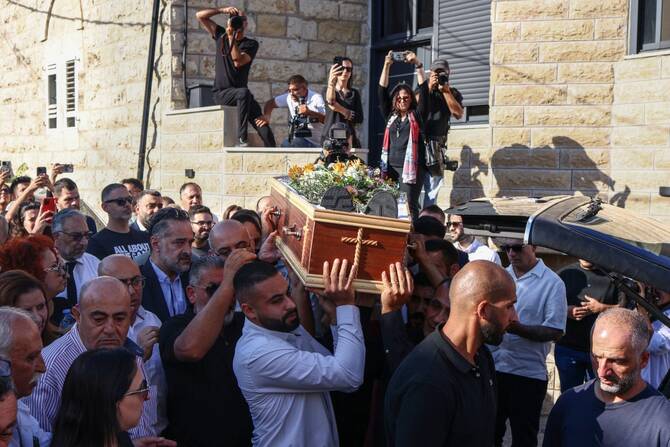

LONDON: Palestinian painter and sculptor Sliman Mansour, whose vivid depictions of Palestinian life, land and national identity made him one of the most prominent figures in contemporary Palestinian art, was buried on Wednesday in his hometown of Birzeit in the occupied West Bank.
A packed church near Ramallah hosted the funeral for Mansour, who died Monday at the age of 79 at his home in east Jerusalem, local and international media reported.
“The final chapter has been written,” the family said in a statement announcing his death. “For the world, he leaves behind a life filled with beauty and memories, and a legacy that will continue through everyone whose lives he touched.”
Born in Birzeit in 1947, during the final years of the British Mandate in Palestine, Mansour studied art and design in Jerusalem and graduated in 1970.
He went on to develop a distinctive visual language rooted in Palestinian landscapes, heritage and the struggle for self-determination.
His paintings often featured olive groves, citrus trees, traditional village scenes and Palestinian women wearing embroidered thobes. His work also used imagery associated with Palestinian identity, including Jerusalem, doves and the olive branch.

Sliman Mansour's Jamal Al-Mahamel, or Camel of Hardship. (Social media)
“He was actually the main Palestinian artist, the best known locally and internationally,” said Vera Tamari, a longtime friend, fellow artist and co-founder with Mansour of the New Vision collective.
“He portrayed Palestine in all its beauty and hope,” Tamari told the BBC. “He portrayed the Palestinian woman in her thobe ... and he portrayed people very much attached to the land. He wanted people to know that we are rooted here.”
Among Mansour’s best-known works is his 1973 painting “Camel of Hardships,” which the Palestinian Culture Ministry described as “an artistic and national icon.”
Another celebrated work, “Symbol of Hope,” painted in 1985, portrays a dove flying across a night sky with an olive branch in its beak as a mother cradles her children below. Created before the first Palestinian intifada, the painting became associated with hope amid Israeli military occupation.
Mansour’s work reflected not only Palestinian cultural traditions but also the restrictions imposed on artists in the occupied West Bank, the BBC reported. He recalled in a podcast that Israeli soldiers in the 1970s and 1980s confiscated posters and postcards and sometimes removed works from exhibitions.
“We developed a kind of art that is symbolic so that people will understand what we mean, and the soldiers will not understand,” Mansour had said.

Sliman Mansour's Symbol of Hope. (Social media)
During the first intifada, which began in 1987, Mansour helped to establish the New Vision collective with Tamari and other artists. The group boycotted Israeli-made art supplies and increasingly used natural materials such as clay, mud, straw and henna.
Mansour also helped to build Palestinian artistic institutions. He co-founded the League of Palestinian Artists and the International Academy of Art, contributed to the establishment of local galleries and worked as an art teacher.
Beyond painting, he produced cartoons and children’s illustrations and wrote books.
His works are held in private collections and institutions including the Guggenheim Abu Dhabi; Mathaf: Arab Museum of Modern Art in Doha; the Institut du Monde Arabe in Paris; and the British Museum in London.
He received numerous honors, including the UNESCO-Sharjah Prize for Arab Culture in 2019.
Despite the high value of his canvases, Mansour favored reproducing his work as affordable prints and posters, helping bring it into homes, schools and refugee camps across the region.
“He was the mastermind of creating a Palestine that unifies us all as Palestinians,” Amer Shomali, director general of the Palestinian Museum, told the BBC.
Shomali said he grew up in a refugee camp in Syria with two Mansour posters on his wall. “He was everywhere,” Shomali said. “He was focusing and capitalizing on reaching the masses.”
Friends remembered Mansour as soft-spoken, humble and generous with his time and ideas, according to the BBC.
When he completed a large mural for the Palestinian Museum, they said, he asked not for a substantial fee but for a fig tree to be planted in the museum’s garden.


