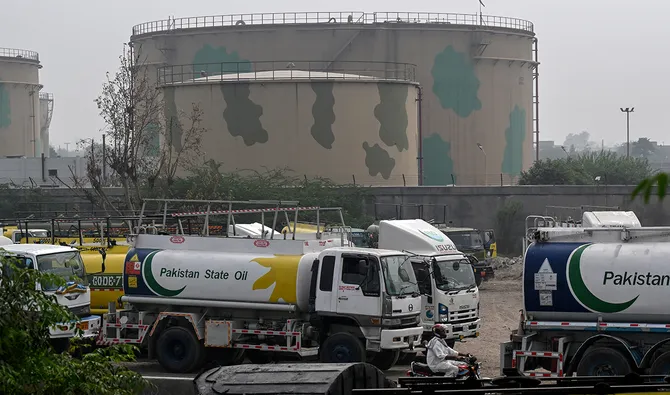
- Saudi Arabia, Kuwait and Qatar were consulted as Pakistan developed bonded-storage scheme
- Foreign suppliers will be able to store petroleum products for local sale or re-export
ISLAMABAD: Pakistan has approved a plan this week allowing foreign suppliers to import and store petroleum products in customs-bonded facilities, advancing an energy-security initiative developed after consultations with Gulf states including Saudi Arabia, Kuwait and Qatar.
The initiative is aimed at keeping greater fuel stocks physically available in Pakistan without requiring local companies to purchase them upfront, while allowing foreign suppliers to sell the products domestically or re-export them.
Pakistan has been trying to establish such a system since 2023, but no foreign supplier established a facility under the original framework. The government revived and revised the initiative this year after the Middle East conflict and disruptions around the Strait of Hormuz exposed vulnerabilities in Pakistan’s energy supply chain.
The Economic Coordination Committee (ECC), the cabinet’s main economic decision-making body, approved a Petroleum Division proposal on Monday “to allow import of petroleum products on foreign suppliers account through Customs bonded storage facilities,” the Finance Division said.
“The proposal focused on the development and strengthening of the key pillars of the country’s energy security architecture in the oil and gas sector, which includes indigenization, development of strategic petroleum reserves and promotion of Customs bonded storage facilities to ensure a resilient and sustainable petroleum supply chain,” the statement said.
Under the framework, foreign suppliers can retain ownership of petroleum products held in Pakistan’s bonded facilities, rather than requiring a Pakistani company to buy the fuel when it enters the country.
The scheme covers crude oil, petrol, high-speed diesel, jet fuel, furnace oil, liquefied petroleum gas and liquefied natural gas. Suppliers can use approved public or private bonded facilities, including at Port Qasim, Karachi’s Keamari port area, Hub and Gwadar, and can develop dedicated storage infrastructure subject to regulatory approvals.
The fuel can subsequently be sold to licensed Pakistani oil marketing companies and refineries or re-exported. Foreign suppliers will also be able to use Pakistan’s petroleum pipeline network to move bonded stocks from ports to approved inland facilities without triggering taxes and duties while the fuel remains under the bonded regime.
The arrangement differs from conventional fuel imports because the foreign supplier can continue to own the product while it sits inside Pakistan. Duties and taxes become applicable when a Pakistani buyer purchases the fuel and clears it for domestic consumption.
Pakistan first approved guidelines for imports on foreign suppliers’ accounts through customs-bonded storage in June 2023, seeking to diversify supply sources, reduce costs and encourage international suppliers to keep petroleum stocks in the country.
The initiative failed to attract a foreign supplier under the original framework, prompting authorities to revisit the policy this year. A government review involved the Petroleum Division and other ministries, regulators and agencies before revised guidelines were prepared.
The effort gained new urgency after the conflict involving Iran disrupted traffic through the Strait of Hormuz, a critical route for Pakistan’s imported energy supplies, prompting Islamabad to examine ways to make its fuel supply more resilient.
Petroleum Minister Ali Pervaiz Malik said earlier this month the revised bonded-storage scheme had been prepared following consultations with Saudi Arabia, Kuwait and Qatar.
“I am grateful to the governments of Saudi Arabia, Kuwait and Qatar that we will have a bonded scheme with them, under which these countries will store their oil on the secure territories of Pakistan at their own cost, and supply to the entire world from here,” Malik said at the time.
International commodity traders were also consulted, meaning the framework is not restricted to Gulf suppliers and can be used by other eligible foreign companies.
The government will retain limited access to bonded stocks during formally declared emergencies, including war, major natural disasters or a documented collapse of domestic supply. Any fuel requisitioned would have to be purchased at prevailing international market prices.
The commercial bonded-storage initiative is part of a broader energy-security strategy that also includes plans for strategic petroleum reserves. Unlike government-controlled strategic reserves, however, stocks held under the bonded scheme would remain commercially owned by foreign suppliers unless purchased.
Separately, the ECC approved a sale and purchase agreement between state-owned Pakistan State Oil and Oman’s OQ Trading under an intergovernmental agreement previously signed by Pakistan and the Sultanate of Oman.
The Finance Division said the agreement aimed “to promote and develop cooperation between OQ Trading and PSO in the field of energy.”