

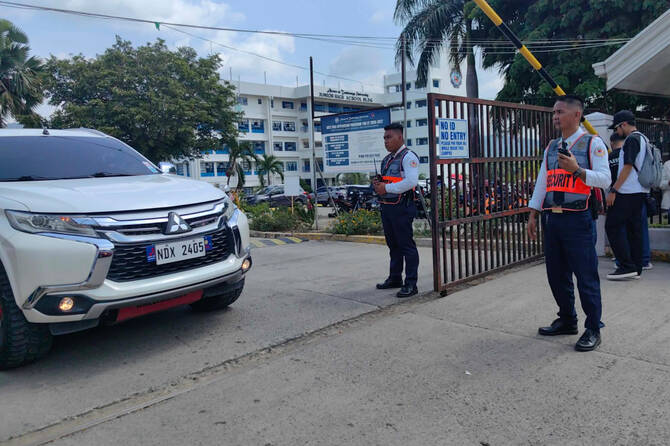

MANILA: A deadly shooting at a private college on Tuesday sent shockwaves across the Philippines, marking the seventh violent school attack since June.
A student at the high school unit of the Ateneo de Zamboanga University in Zamboanga City in the southern Philippines opened fire in a classroom filled with fellow students, killing at least one of them and injuring several others, before turning the firearm on himself and committing suicide. He livestreamed the attack using a body-worn camera.
According to an initial investigation by the Philippine National Police, the suspect, identified as a boy in grade nine, smuggled two firearms into campus, one standard pistol and another fitted with a tactical accessory to make it appear as a rifle.
The school shooting has sparked widespread concerns, especially among students and teachers, over safety in educational institutions.
“The continuing occurrence of violent incidents inside schools, involving young people, is deeply alarming … It is equally alarming that children can gain access to firearms. We call for a thorough investigation and accountability for those responsible for this grave failure to safeguard young people,” the Alliance of Concerned Teachers said in a statement.
“This is a manifestation of the culture of violence that has permeated our schools, a culture that has been normalized and instilled in the minds of many young people through the rampant cases of extrajudicial killings under the previous administration, and the continuing violence and repression against the people who demand accountability and respect for human rights.”
The Zamboanga shooting is part of a series of violent attacks that have unfolded at Philippine schools since June.
On June 16, a 14-year-old girl attacked several pupils with a kitchen knife at a private school in General Trias City, Cavite province, leaving seven elementary students injured.
On June 20, another stabbing incident took place at Cavite National High School in Cavite City, where a Grade 11 student stabbed a schoolmate.
On June 22, two students, aged 15 and 14, shot dead three students and left 20 wounded at the San Jose National High School in Tacloban, Leyte province.
On June 23, a 17-year-old student of Julio Ledesma National High School in San Carlos City, Negros Occidental, was stabbed by a Grade 10 student outside the campus.
A week later, in the same province, a 12-year-old student stabbed a 14-year-old schoolmate outside a public high school in Bacolod City.
On July 31, a student died after being stabbed by a fellow ninth grader inside school premises in Las Pinas City in Metro Manila.
“Recent tragic events in our schools are a stark reminder that we must act now to safeguard our students inside and outside the classroom,” said the national advisory body, the Second Congressional Commission on Education, as it called for immediate psychological support for the affected communities and policy reform to improve student safety.
The commission urged the enforcement of anti-bullying policies, hiring school counselors nationwide, and enacting the School Safety Bill, which would establish a nationwide program focused on preventing school violence, active-assailant incidents and other security threats.
Since last month, the bill has been pending in the House Committee on Basic Education and Culture.
El Consejo Atenista, a student government body at Ateneo de Zamboanga University, said it will be working with the university to advocate for student safety and accessible support systems.
“At a time when students should be able to learn, grow, and build their futures in a safe and nurturing environment, no student should have to experience violence, fear, or the trauma brought by such an incident,” it said on Facebook.
“May this incident not become another moment that we simply witness and move past, but an opportunity for us to reflect on how we can collectively create a community where every student feels safe, heard, and valued.”


