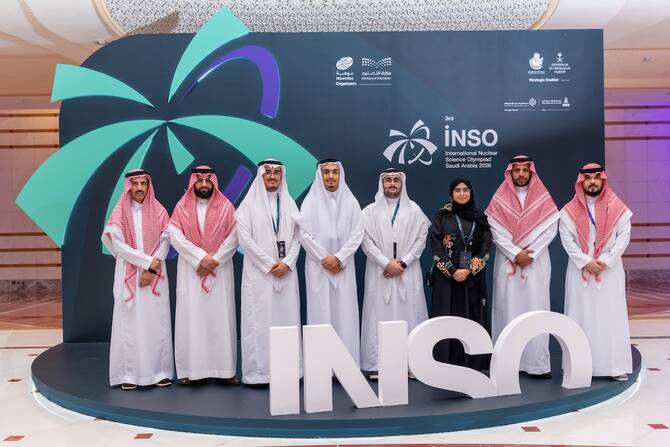

JEDDAH: As the third International Nuclear Science Olympiad draws to a close in Jeddah, Saudi team members say the competition marks the beginning of a longer journey toward contributing to Saudi Arabia’s ambitions in nuclear science, energy and medicine.
For the young Saudis who earned the right to represent the Kingdom, the Olympiad has become more than an academic contest. It has strengthened their determination to pursue careers in science and engineering and use their knowledge to support the Kingdom’s future.
Amjed Al-Darweesh of the Eastern Province Education Department said that his selection for the national team followed months of intensive training camps and selection exams organized by King Abdulaziz and His Companions Foundation for Giftedness and Creativity.
He told Arab News: “Realizing I had made the national team was a truly rewarding moment.”
Competing in an Olympiad hosted in Saudi Arabia for the first time made the experience even more meaningful for Al-Darweesh.
“It is a historic event for Saudi Arabia,” he said. “Representing my country at home gave me an extra sense of pride and motivated me to do my best.”
Al-Darweesh said that the experience confirmed his passion for nuclear science, an interest that developed through his love of physics before expanding into more specialized fields.
Among the many branches of nuclear science, medical physics has captured his imagination most.
“The use of nuclear in radiotherapy is incredibly inspiring,” he said. “Being able to use nuclear science to treat diseases and save lives shows how powerful this field can be.”
He also believes that nuclear technology will become increasingly important to Saudi Arabia’s future as the Kingdom invests in advanced technologies and prepares for its first nuclear power program.
Al-Darweesh plans to study electrical engineering at the University of California, Los Angeles.
“I see nuclear isotopes science playing a major role in both energy and healthcare,” he said. “It has enormous potential to support the Kingdom’s future development.
“I’m excited to combine what I learn in electrical engineering with my interests in energy and medical physics,” he added.
His ambitions remain firmly rooted in Saudi Arabia. “My goal is to complete my studies and then come back home,” he said. “I want to use my education to help develop my country and contribute to Saudi Arabia’s national goals.”
Abdulaziz Al-Shourayet, from the Al-Ahsa Education Department, said that he feels proud to represent his country in such an international contest.
“Being chosen to represent Saudi Arabia in the first edition of the Olympiad hosted by our country brings an even greater responsibility. We want to show the world the capabilities of Saudi minds,” he said.
Speaking about what drew him to nuclear science, he explained: “My passion for chemistry and energy was what first introduced me to nuclear science. The more I learned about it, the more fascinated I became by its potential and its impact on the future.”
Al-Shourayet plans to study chemical engineering while pursuing a minor in energy systems. “This will give me a strong understanding of energy technologies, including reactor design and power engineering, and help me contribute to the future of sustainable energy in Saudi Arabia,” he said.
The Olympiad Saudi team leader and supervisor of the nuclear sciences program, Talal Al-Dawood, told Arab News that the Olympiad aims to develop scientific and critical thinking, complex problem-solving, data analysis, and accuracy in experimentation and measurement.
“It encourages Saudi students to pursue future studies and careers in scientific and technical fields related to energy and nuclear science,” he said.
As the International Nuclear Science Olympiad concludes, the competition has inspired Saudi Arabia’s young participants to become future scientists determined to help shape the Kingdom’s scientific and technological future.
The event, hosted in Saudi Arabia from Aug. 2-9 under the theme “Bright Minds, Promising Future,” marks the first time the prestigious global competition has been held in the Middle East. It brought together 120 students and experts from 19 countries.
The Olympiad reflects the Kingdom’s growing commitment to advancing science education and nurturing the next generation of science, technology, engineering and mathematics talent.
It was jointly organized by the Ministry of Education, Mawhiba, King Abdullah City for Atomic and Renewable Energy, and King Abdulaziz University.