
Building an economy often takes decades of patient labour. Yet the collapse of political institutions, or the eruption of conflict in the aftermath of revolutions and coups, can cancel out years of growth with startling speed, condemning nations to a long and punishing struggle to recover what they have lost. Yemen offers a stark illustration of this reality.
A Houthi takeover of Sana'a in September 2014 led to the outbreak of war in 2015, when a regional coalition intervened to support the internationally recognised government of Yemen. Years of gruelling fighting and crippling siege transformed the foundations of Yemen’s economy and left it among those most grievously damaged by armed conflict anywhere in the world.
World Bank reports indicate that real gross domestic product per capita fell by approximately 54% between 2015 and 2023, returning income levels to those of the early 2000s. By 2024, the decline had deepened to 58%, as the economy fractured into two zones governed by rival financial and administrative institutions, while most Yemenis descended into poverty.
Yemen is now suffering one of the world’s gravest humanitarian and developmental crises. The war has claimed more than 21,000 lives, while nearly 80% of the population requires humanitarian assistance. According to the United Nations Development Programme, the conflict has voided more than two decades of development gains and returned the country to levels of human development that it would otherwise have surpassed long ago. Of course, the Houthi takeover is not the sole reason why Yemen's economy crumbled. Institutional fragmentation, regional intervention, declining oil exports, sanctions and siege all contributed to the downward spiral.
Before 2015, Yemen's economy certainly was not one that would be considered to be flourishing, yet it had unified state institutions, an oil sector that generated the bulk of state revenue, along with a formidable service and industry sector. Poverty and unemployment, however, still ran rampant. In 2011, a wave of popular protests swept the country as part of the "Arab Spring," culminating in the resignation of President Ali Abdullah Saleh after 33 years in power. In the aftermath of the protests, gross domestic product contracted by around 12.7% in 2011.
In 2012, growth resumed at 2.4% and later grew to 4.8% in 2013 as oil production recovered and non-oil sectors regained momentum. By 2014, however, growth had slowed once again to less than 2%, owing to repeated attacks on oil pipelines and a mounting fuel crisis, even before the country descended into full-scale war.
Effects of Houthi takeover
The Houthis, also known as Ansar Allah, are a Yemeni political and military movement rooted in the Zaydi religious tradition. They emerged in the northern governorate of Saada during the 1990s as an extension of a religious and cultural revivalist current, taking their name from the movement’s founder, Hussein Badr al-Din al-Houthi. Following his death in 2004, leadership passed to his brother, Abdulmalik al-Houthi.
The movement first arose in opposition to what it regarded as corruption and the neglect of Yemen’s northern regions. From 2004 onwards, however, it entered into armed confrontation with the government of President Ali Abdullah Saleh, fighting six rounds of war against the state between 2004 and 2010.
After the Houthi takeover of Sanaa, Yemen effectively became divided into two spheres of influence: the Houthi-controlled territory centred on Sana’a and Hodeidah, and government-controlled areas around Aden. The administrative division naturally produced an economic division, with competing policies and a fractured system that severely crippled the national economy.
Houthi-controlled areas contain roughly 70% of Yemen’s population, while territories under government control were where most of the country's oil and gas resources were located. In 2016, the government shifted the Central Bank headquarters to Aden, but struggled to secure sufficient foreign-currency liquidity amid a sharp decline in oil and gas exports. Limited external financing, the difficulties confronting domestic banks and the absence of conditions necessary for an effective monetary policy compounded these pressures.
Sana’a, meanwhile, remained Yemen’s principal centre of banking and commercial activity. Its larger population attracted a greater share of remittances and payments from relief agencies channelled through the formal banking system. Reports indicate that local-currency liquidity has contracted across Houthi-controlled areas, even as Yemen’s foreign-exchange reserves continue to dwindle.
A weakened rial
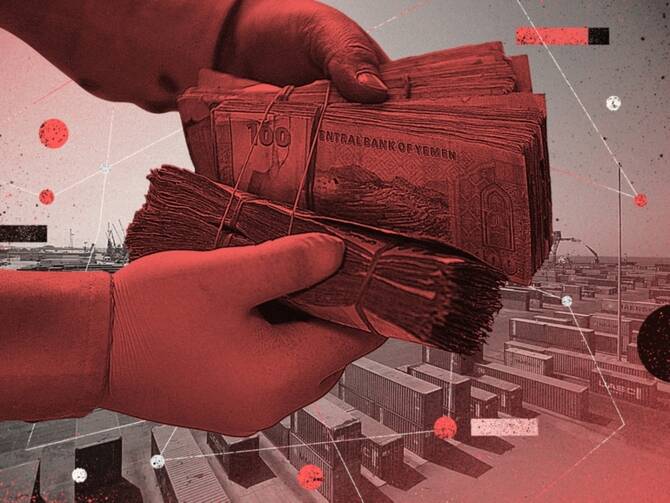
As a result, the Yemeni rial has lost much of its value. During 2024 and 2025, its exchange rate fell from 1,540 rials to the dollar to 2,065. Houthi-controlled areas maintained a less volatile rate through stringent monetary restrictions, leaving Yemen with two separate monetary systems and two sharply divergent exchange rates. According to the latest available figures from July 2026, the dollar stands at approximately 533 rials in Houthi-controlled Sana’a, compared with around 1,565 rials in government-controlled Aden.
In July, the Houthis began circulating a new 200-rial banknote, following their earlier issuance of a 50-rial coin, claiming that both were intended to replace damaged currency. The Central Bank in Aden declared the measures unlawful. Experts interpreted the move as evidence of an intensifying liquidity crisis in Houthi-controlled areas and warned that an expansion of the money supply without adequate backing could fuel inflation and further weaken the rial. Ambassadors of the European Union, France, Germany and the Netherlands likewise affirmed that the Central Bank in Aden is the sole authority empowered to issue legal currency.
According to the World Bank, recovery in the oil sector depends on the restoration of peace, the resumption of production and the attraction of fresh investment. Non-oil sectors, including trade and agriculture, continue to suffer from the effects of conflict, disrupted services, shortages of production inputs, corruption and institutional division. Remittances and humanitarian assistance, despite their importance in easing living conditions, remain vulnerable to the persistence of conflict. Nonetheless, remittances remain the principal non-aid source of foreign currency. According to the latest World Bank figures, since 2016, this has brought in $3.8bn to the country.
Iran also gives financial assistance to the Houthis, with various reports estimating that figure could be anywhere between $100mn and $300mn a year. The United Nations maintains that the group also draws upon substantial domestic sources of finance, while the United States says that part of its funding moves through oil-smuggling and money-laundering networks linked to Iran’s Islamic Revolutionary Guard Corps. International monitoring bodies have associated these networks with grave harm, loss of life and serious human rights violations.

Parallel economy
A report entitled The Parallel Economy: How Is the Houthi Group Reshaping the Private Sector and Turning It into a Pillar of the War Economy?, published in July by the Mokha Centre for Strategic Studies, describes how the economy in Houthi-controlled areas has evolved into a system of patronage dominated by networks tied to the group. Trade, imports, fuel, currency exchange and shipping have all become instruments for controlling financial resources. The private sector has been subjected to an elaborate regime of taxes, fees and levies, while the ability to remain in business has increasingly depended upon compliance.
Based on an analysis of nearly 68,000 commercial registrations and licences issued between 2014 and 2025, the report concludes that the private sector in Houthi-controlled territory has shifted from an economy governed by competition to one ruled by privilege and political loyalty. Companies close to the group have prospered, while the influence of Yemen’s established merchant families has diminished.
The report also details how the Houthis have asserted control over commercial registrations and licences, taxes, fees, levies, zakat and government contracts. This has inflated the group’s revenues and tied the survival of commercial activity to adherence to its policies, creating an ever-growing source of finance for the war economy.
A surge in company registrations has been concentrated in the most profitable sectors, including general trade, imports, food, shipping, currency exchange, energy and pharmaceuticals, according to the report. Its authors assert this development reflects a wider policy intended to tighten control over the market by granting licences and privileges to loyal companies and traders.
The group has attached particular importance to the oil and energy sector. It consolidated control over the import and distribution of petroleum products, together with transport and storage networks, turning the fuel trade into one of its principal sources of liquidity and levy revenue for military and security expenditure.
The report also notes that the Houthis expanded their influence over currency exchange and money transfers as the role of the banks receded. Exchange companies consequently became a principal channel for moving funds, financing trade and imports, and providing liquidity to businesses affiliated with the group.
The levies imposed by the Houthis extended far beyond the collection of revenue, penetrating every stage of commercial activity. They increased the cost of transporting goods between governorates by 20-30% and contributed to rises of approximately 10-20% in the prices of essential commodities. Customs and tax revenues reached around 700bn rials, equivalent to approximately $1.17bn at an exchange rate of 600 rials to the dollar. Annual revenues collected by the Zakat Authority exceeded 400bn rials, or roughly $667mn, while total revenue raised in Houthi-controlled areas amounted to nearly 2.2bn rials, approximately $3.7bn, in 2023. By comparison, the Yemeni government’s 2025 budget projects revenues of 3.96tn Yemeni rials, worth about $2.53bn at the exchange rate prevailing in government-held areas. Small and medium-sized businesses have been severely impacted, forcing some to scale back their operations or withdraw from the market altogether.
According to the same Mokha Centre study, commercial activity is heavily concentrated in Houthi-controlled governorates. The Capital Municipality accounted for 27% of new commercial registrations, followed by Sana’a with 16%, Hodeidah with 12% and Ibb with 11%. Saada also recorded notable growth between 2023 and 2025, reflecting the movement of part of the country’s economic activity towards the group’s principal stronghold.
The Houthis have also established a cross-border commercial and financial network extending into Iran, China, Malaysia and Hong Kong to procure and ship dual-use materials and technologies. Shipping and currency-exchange networks have helped facilitate payments and evade restrictions and sanctions, sustaining the flow of supplies and the financing of the war economy.
Financial crisis
Despite these achievements, the Houthis are reportedly experiencing their most severe financial crisis in years. A report by Asharq Al-Awsat citing "sources" alleges that payments owed to fighters had been delayed for nearly four months, while the disbursement of half a month’s salary to a section of civilian employees had been suspended amid a continuing deterioration in public services, particularly healthcare.
Sources attribute this "crisis" to declining revenues at Hodeidah’s ports following Israeli strikes, falling imports and customs receipts, the contraction of humanitarian organisations’ activities, reduced fuel flows and tighter US sanctions. Together, these pressures constricted the group’s financing networks and commercial transfer channels.
The report goes on to explain how this financial strain has taken a heavy toll on public services, pointing out how the Republican Hospital in Sana’a has almost entirely ceased admitting patients because of inadequate funding, while payments owed to healthcare workers have fallen into arrears. Austerity measures have spread across institutions administered by the group.
Signs of discontent are mounting across Houthi-controlled territory among fighters, employees and supporters. Military expenditure and weapons production continue to take precedence over social obligations and public services, while the group has intensified mobilisation and recruitment campaigns to compensate for shortages in its fighting ranks.
Deepening humanitarian crisis
Humanitarian funding for Yemen has fallen sharply in recent years, deepening hardship across the country. The threat of food insecurity has grown more acute, particularly since the World Food Programme suspended food assistance in Houthi-controlled areas in late 2023 and programmes funded by the United States Agency for International Development came to an end in early 2025.
The United Nations Development Programme estimates that damage to Yemen’s principal ports and the decline in their operational capacity have driven up freight, insurance and demurrage charges on food imports. These costs now account for nearly half the price of imported food, further aggravating the country’s crisis of nutrition and food security.
Yemen’s economy has continued to deteriorate since the UN-brokered truce expired in late 2022. That year had initially brought signs of improvement, buoyed by the truce that entered into force in April and temporarily halted hostilities, reduced casualties and revived economic activity. The respite, however, proved short-lived.
The truce expired in October 2022 without producing a lasting political settlement. Although an undeclared ceasefire has largely endured, economic conditions soon worsened once again. The crisis deepened after the Houthis imposed a blockade on oil exports belonging to the internationally recognised government in October 2022 and, from May 2023, prohibited the sale within their territory of liquefied petroleum gas produced in Marib.
According to the World Bank, living conditions are deteriorating for most Yemenis. An estimated 63% of the population suffers from inadequate food consumption, owing to weakened purchasing power across the country, the continuing depreciation of the Yemeni rial in areas governed by the internationally recognised authorities and the decline in humanitarian food assistance.
Yemenis also face a mounting succession of hardships, including higher rates of acute and chronic illness and an increasingly widespread burden of psychological distress. World Bank surveys indicate that many households have exhausted their capacity to cope and have been forced to adopt severe survival strategies. Some 19% have resorted to child labour or hazardous work, with lasting consequences for safety, health and the social fabric. Such measures perpetuate a vicious cycle of poverty and eroding human capital, driving the humanitarian crisis deeper still.
The World Bank’s Country Climate and Development Report for Yemen finds that climate change has become an additional force compounding the effects of war and humanitarian crisis, amid the convergence of conflict, underdevelopment and environmental strain. Around half of Yemen’s population is exposed to serious climate hazards, including heatwaves, droughts and floods, while a quarter simultaneously faces food insecurity and climate-related risks.
According to Climate-Resilient Agriculture: Translating Data into Actionable Policies, a report issued by the United Nations Economic and Social Commission for Western Asia, water scarcity, drought, flooding and desertification have reduced agricultural output, depleted water resources and heightened the danger of food insecurity in a country where millions depend on agriculture as their principal source of income and sustenance. Climate change also magnifies the effects of conflict by weakening communities’ capacity to adapt and placing greater pressure on natural resources and essential services, thereby making economic recovery more difficult still.
The World Bank warns that climate change could further intensify Yemen’s economic crisis. Under pessimistic scenarios, gross domestic product could decline by approximately 3.9% annually by 2040. Growth of up to 1.5% a year could be achieved if rainfall improves and effective adaptation policies are adopted. The report states that investment in water management and climate-smart agriculture could raise agricultural output by 13.5%. It also warns of declining fish stocks and rising healthcare costs, and calls for greater investment in renewable energy, stronger disaster-risk management and expanded climate finance to build a more resilient economy.