RIYADH: When Saudi actor Meshal “Mish” Alsunaid was a kid — around nine years old — he used to record short skits about knights and ghosts with his cousins on a Nokia phone.
“Some of it was shot in Riyadh and some in the Eastern Province; we did some at my grandparents’ house, we did some at my aunt’s house. Sometimes at our house in the basement,” he tells Arab News with a smile.
Being one of the youngest in his family, he tried to do the opposite of what was expected by the elders.

Meshal Alsunaid is a Saudi actor. (Supplied)
“If I’m doing a comedy play, then I want to play the dramatic role. And if I’m doing a dramatic play, I want to do a comedy role — I’ve been told that I’m ‘the silliest guy in the room.’ I’m always just trying to find ways to inject something completely different into it — I guess it’s kind of my own style.”
Does any of the old footage survive?
“I really wish I could watch it now. It was probably lost. I think it was one of my cousin’s phones, and when they upgraded, that was the end of that.”
Fast-forward to more than a decade later, and Alsunaid found himself acting again. This time, professionally. After graduating with a degree in theatre studies from Kent State University in Ohio, he enrolled in a full-time conservatory program at the Atlantic Acting School NYC.

Alsunaid (center, left) and members of The Arabic Theater Company. (Supplied)
Things shifted dramatically during his second year there. “I was nearing the end of my time in New York and I was looking for some guidance to where I was going to next in life and I stumbled upon this YouTube video from a creator called Islam Balbaa,” he says.
Balbaa, who, like Alsunaid at the time, is also an Arab in America, is the founder of The Arabic Theater Company, which puts on bilingual Arabic and English shows primarily in North America.
“I really appreciated how he explained it all (in the video). It really did feel like he was talking to me directly,” Alsunaid recalls. “I found his Instagram in the description and sent him a follow. A few hours later, he followed me back. And then a couple of days later, he shot me a message. He was like: ‘I’m doing an Arab improv show. Would you be interested in joining?’ I was very scared of improv — I still am to a degree. But, you know, I’d never found an Arab artistic community in my time in the US and I really felt like this was a rare moment for me. I just said yes. And it might have been one of the best times in my life.”

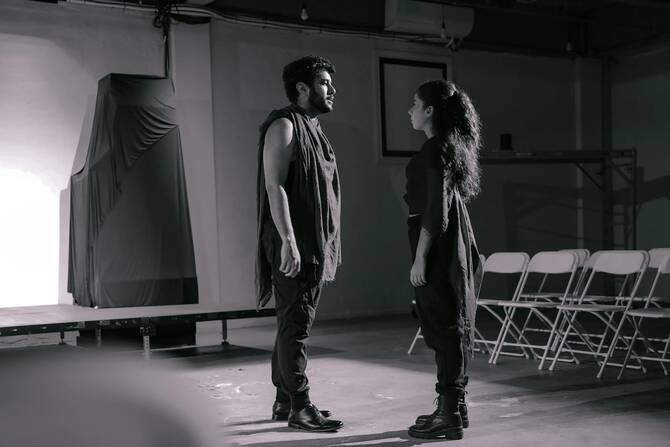
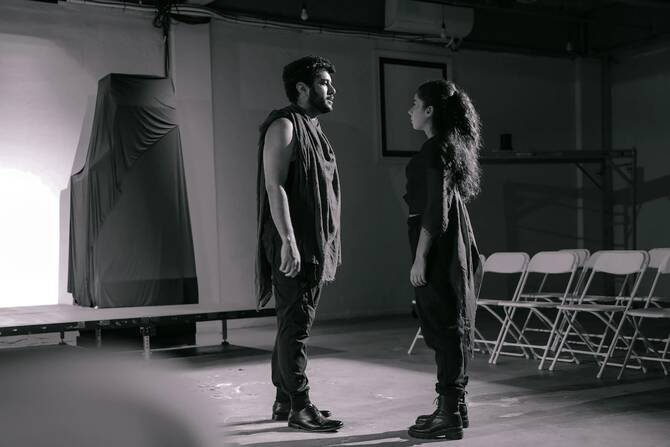
Meshal Alsunaid in 'The Hunchback of Seville.' (Supplied)
The format was already in place in NYC but became “its own full thing” in 2024 and the company celebrated its second anniversary last month.
Recently, Alsunaid moved back to his hometown but still works closely with the company. While most of its members are based in the US, Alsunaid has maintained his passion and dedication across the continents.
“There is no theater company like us that has the Shammis from the Levant, the Khaleejis — me, and the North Africans; all of us under the same roof. I think that’s one of our strongest suits, and I always emphasize to the rest of the cast just how unique our ensemble really is.
“Our signature show is a bunch of improv games, half in Arabic, half in English. That’s what’s really gotten us on the map. We’ve taken that to New York, to Montreal, to Ottawa, and we have plans to expand to Toronto also,” Alsunaid says.
“Now we want to take it to the next level. Islam decided to divvy up different roles, so I got given the public relations, and we have other friends and cast mates who are marketing, artistic directors, or stage managers.”
While his hometown has gone through a tremendous transformation over the past few years, so has Alsunaid. His expressive eyes instantly light up whenever he talks about any kind of live performance. And being back home has also inspired him to write.
“I’ve been watching a lot of clips of ‘The Fresh Prince of Bel-Air,’ that classic Nineties show — it’s definitely one of my favorite shows of all time — and it’s really got me thinking about what something like that, if you injected a bit of Arab to it, would be like. ‘The Fresh Prince of Saudi Arabia?’ What if it’s ‘The Fresh Prince of Buraidah?’ I would absolutely watch it.”
Having been back in Riyadh for a while, Alsunaid is optimistic that he — and perhaps the Arabic Theater Company — could have a role to play in furthering the Kingdom’s creative growth.
“We have a booming artistic community that’s starting here,” he says. “We have a lot of different people moving here from all different parts of the world, and I think something like the company — which combines Arabic, English, and our culture — would fit perfectly.”