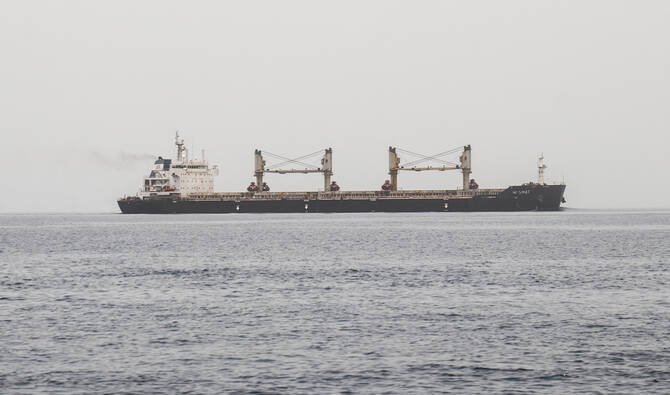
ISLAMABAD: Pakistan’s foreign office spokesperson Tahir Andrabi on Thursday condemned attacks on commercial vessels in the Bab Al-Mandab Strait, describing them as a violation of international law and reaffirming Islamabad’s commitment to its defense cooperation with Saudi Arabia.
Pakistan is among 14 countries that last Thursday backed the establishment of a Saudi-led multinational maritime defense alliance aimed at protecting shipping routes through the Bab Al-Mandab Strait, the Red Sea and the Gulf of Aden.
The Bab Al-Mandab is a 20-mile-wide, 70-mile-long strait between the Horn of Africa and the southern tip of the Arabian Peninsula. It links the Red Sea to the Gulf of Aden and is one of the world’s busiest maritime chokepoints, carrying about 12 percent of global trade.
The alliance was announced last week amid escalating threats to commercial shipping in the Red Sea, after the Iran-backed Houthi rebels declared what they described as a maritime blockade on Saudi Arabia last month. The Houthis claimed attacks on Saudi-linked vessels.
“We have condemned attacks on vessels belonging either to Saudi Arabia or to any other countries because, essentially, these are commercial vessels,” Andrabi said during a weekly press briefing.
He was talking about attacks on commercial vessels in the Bab Al-Mandab Strait.
“Attacks on them are a blatant violation of international law and go against the safety and security of commercial maritime traffic,” he added.
Pakistan and Saudi Arabia also signed a landmark defense agreement in September last year. The pact states that aggression against either of the two nations would be seen as an attack against both, formalizing decades of security cooperation between the countries.
Andrabi said defense cooperation between Pakistan and Saudi Arabia will continue. However, he declined to comment on whether Pakistan has deployed its naval forces to protect commercial vessels or not.
“I am not particularly aware of any escorting vessels,” he said. “This is an operational detail of which I am not aware.”
Andrabi warned that the standoff in the Strait of Hormuz is complicating efforts to achieve a sustainable settlement for the broader crisis engulfing the Middle East and the Gulf region, particularly tensions between Iran and the US.
Iran has virtually closed the strait since the US and Israel launched attacks against it in February. Twenty percent of the world’s oil and gas supplies passed through the strait before the conflict erupted.
“The resolution of the standoff in the Strait of Hormuz will obviously create a conducive environment for the parties to return to the Islamabad MoU and the framework of talks as envisaged in the Pakistan-Qatar joint statement,” he said.
When asked about Pakistan’s role as a mediator in the US-Iran tensions, Andrabi maintained that Islamabad is still playing its part to resolve the conflict.
“We remain engaged with the parties,” he said. “On certain issues, specific countries take the lead, while on others, comprehensive efforts are undertaken by Pakistan, Qatar, and other brotherly countries.”
Andrabi also announced that Deputy Prime Minister Ishaq Dar has invited Iranian Parliament Speaker Mohammad Bagher Ghalibaf and Foreign Minister Seyed Abbas Araghchi to visit Pakistan, adding that specific dates will be finalized through diplomatic channels.