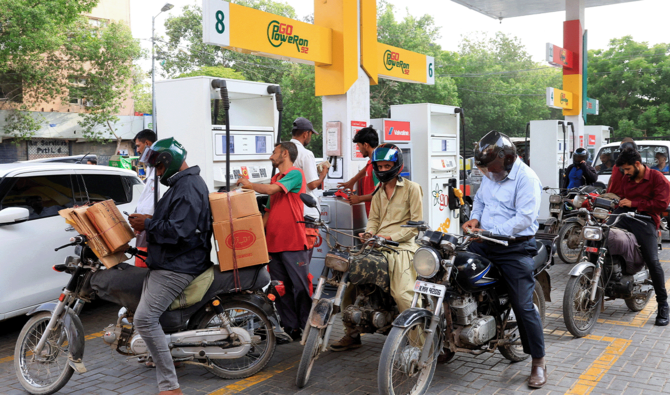
ISLAMABAD: Sales by Pakistani oil marketing companies (OMCs) surged by 23 percent year-on-year (YoY) in July, the highest annual jump in 15 months, a leading brokerage firm said this week in its report, with analysts and officials attributing the increase to tighter border controls that helped curb the smuggling of illicit Iranian fuel into the country.
Pakistani petroleum dealers have frequently complained of Iranian fuel smuggled into the country through its restive southwestern Balochistan province. While fuel smuggled into the country through Iran is cheaper for the consumer, it causes losses to the national economy and OMCs. As per an investigation report cited by Nikkei Asia, around $1.02 billion worth of petrol and diesel from Iran was smuggled across the 900-kilometer-long border into Pakistan in 2023.
OMC sales surged 23 percent year-on-year to 1.5 million metric tons in July, data by brokerage firm Topline Research showed in a report. Excluding furnace oil, legal sales reached 1.43 million tons up by 18 percent, with petrol up by 19 percent to 729,000 tons and high-speed diesel rising by 23 percent to 624,000 tons.
“The YoY increase was mainly attributable to reduced fuel smuggling amidst improved border controls and improving economic activity,” Myesha Sohail of Topline Securities told Arab News on Wednesday.
Among listed companies, the Pakistan State Oil reported the strongest gains, the report said. Its sales rose 38 percent year-on-year to 702,000 tons, increasing its market share to 46.52 percent. Attock Petroleum’s sales climbed 28 percent to 127,000 tons, while Wafi Energy posted a 24 percent increase.
Topline Research expects OMC sales to grow by 8 percent to 10 percent in fiscal year 2027, supported by lower fuel smuggling and improving economic activity.
Pakistan and Iran have frequently remained at odds over their shared, porous border. Militants based on the border areas of the two countries have often attacked law enforcers on both sides, while large quantities of petrol, diesel and other fuel are smuggled into Pakistan from Iran.
Pakistani authorities have tightened border management by expanding the border fencing, introducing a passport-and-visa requirement for cross-border movement under the “One Document Regime,” and limiting cross-border fuel trade to residents of border districts through designated buffer zones on the Pakistani side of the frontier.
The measures preserve limited local trade for border communities and prevent fuel from moving beyond those districts, Balochistan government spokesperson Shahid Rind told Arab News.
“Fuel trade is restricted exclusively to residents of the border districts and is conducted only through designated buffer zones established on Pakistan’s side of the border,” Rind said.
The official said the One Document Regime initiative was implemented from March 31, 2026. It allows for the movement of people through passport and valid visas only. Rind spoke about additional measures, saying that authorities had also established joint check posts with the paramilitary Frontier Corps personnel in Balochistan and continued anti-smuggling operations.
“There has been a substantial decline in the movement of smuggled Iranian fuel since coordinated enforcement measures intensified,” Rind said.
He said the volume of smuggled Iranian fuel had dropped by “approximately 23 million liters per day” in October 2023 to “an average of around approximately 1.2 million liters per day” in recent months.
Usama Qureshi, vice chairman of Cnergyico Pakistan Limited, a prominent Pakistani oil refining company, said reduction in illegal fuel imports translated directly into higher sales for licensed OMCs.
“The most important factor was the government’s continued action against smuggling, which, because of the enforcement at borders, there were less molecules coming in from across the border,” Qureshi said.
He added that smuggled fuel was causing a “dent” to the Pakistani oil industry and government in the form of revenue losses.
The Cnergyico official said expectations of higher oil prices during periods of regional uncertainty this year also encouraged consumers and businesses to buy more fuel, leading to additional sales.