

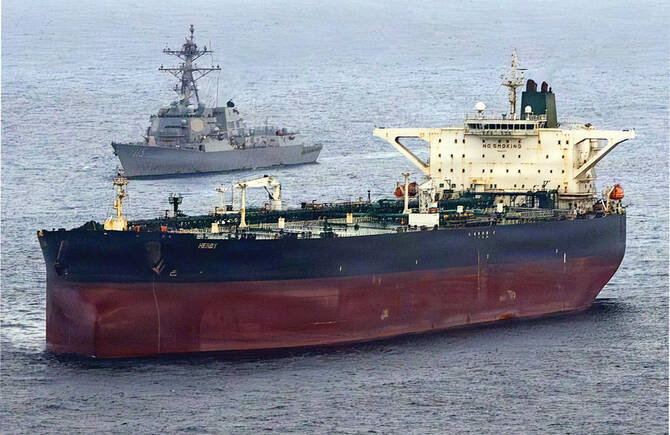
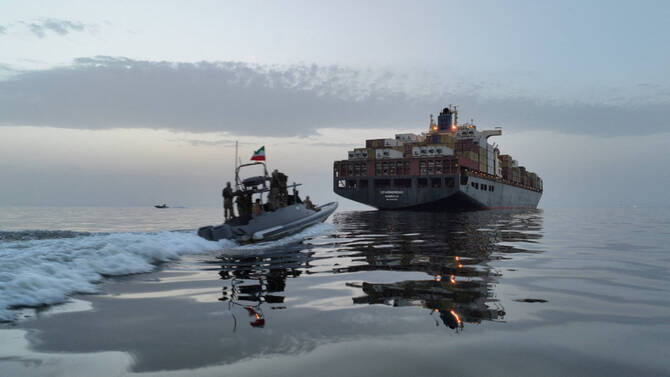

LONDON: Negotiations are now underway between the US, Iran, and Oman to reopen the Strait of Hormuz, and while the agreement’s precise shape remains unknown, it seems at least one side will land responsibility for managing what has, until now, been an international waterway.
From a legal and practical perspective, any such deal raises huge questions, not least what it means for the continuity of international law, what it means for other trading chokepoints, and what it means for the inflationary pressures heaping themselves on world economies.
Richard Barnes, professor of international law at the UK’s University of Lincoln, who specializes in freedom of navigation and the international law of the sea, was unequivocal when asked about the legal merits of any deal that should emerge.

“There is no clear or plausible basis in international law for one or both of Iran or the US to adopt a management regime for the strait that imposes charges or permits boarding and inspections of transiting ships,” he told Arab News.
“All ships enjoy the right of transit passage through the strait. Under the law of the sea ships enjoy freedom of navigation. Coastal states can introduce rules related to safety, including traffic schemes, but such laws shall not discriminate between foreign ships nor have the practical effect of denying, hampering or impairing the right of transit passage.”
The law to which Barnes is referring is the UN Convention on the Law of the Sea, UNCLOS, adopted in 1982 and enforced since 1994, Article 38 of which provides a right of unimpeded “transit passage” through more than 100 straits worldwide, Hormuz included.
However, there does appear to be a caveat. Neither the US nor Iran are parties to UNCLOS, raising questions around just how bound they are by the treaty. Regardless, Barnes said both parties are bound under customary international law — a general and consistent practice accepted as legally binding.
Donald Rothwell, professor of international law at Australian National University, told Arab News that despite 170 countries being parties to the convention, the fact that neither Iran nor the US are signatories meant there was scope for something.

Infographic created by Gemini (Google AI).
“Iran and the US could argue that they are effectively opting out of the accepted law of the sea as it has applied to the Strait of Hormuz and creating their own distinct regime for the waters of the strait,” Rothwell said.
“Oman is a party to UNCLOS so legally its position does not provide it as much flexibility as Iran and the US. Ultimately, the issue is whether the majority of countries in the international community who are UNCLOS parties will accept any alternate regime to manage the strait.”
Barnes said any unilateral or bilateral agreements between the US and Iran to “manage” the strait would not be binding on third states, particularly considering the context surrounding the issue.
“Management here means not subjecting vessels to harm or control by the US or Iran and is effectively a form of extortion; it may be dressed up in language that suggests that shipping should pay for the costs of local regulation, but this is disingenuous.”
Should the pending Iran-US deal include provisions concerning the management of the strait by either one, or both of the parties, Barnes and Rothwell agreed that there would likely be “considerable resistance because of the precedent it may set.”
FASTFACTS
• The Strait of Hormuz is the only maritime gateway connecting the Gulf to the open ocean.
• Around 20m barrels of oil — about a quarter of global seaborne oil trade — pass through it each day.
• Bordered by Iran and Oman, the strait is just 33km wide at its narrowest point.
Nonetheless, logistics firms are being inundated with requests for contingency measures in the case of further geopolitical flashpoints.
“Between Ukraine, Gaza, and now this situation in the Gulf, the level of anxiety in global supply chains has skyrocketed, and it does not help that there is not all that much trust in either side when it comes to Hormuz,” one freight forwarder told Arab News.
But the forwarder stressed that while supply chains crave continuity, they can adapt — “just look at how quickly we normalized transits around Africa, or how we got goods moving during the pandemic lockdowns” — and there are alternatives, to an extent, to Hormuz.
One operator to have shown this is DHL, which early in the Iran conflict activated a range of contingency routes across air, ocean and road, with the clear objective of maintaining connectivity into and out of the region without relying on a single alternative.

This handout photo taken on March 11, 2026 and released by the Royal Thai Navy shows smoke rising from the Thai bulk carrier 'Mayuree Naree' near the Strait of Hormuz after an attack. (Royal Thai Navy/AFP)
A spokesperson for the company told Arab News: “In air freight, more cargo for the Gulf Cooperation Council area has been routed towards Muscat and Riyadh, providing additional capacity away from affected airspace. From there, cargo is trucked to its final destination within the GCC.
“In ocean freight, cargo has been discharged at alternative ports and gateways, including Sohar, Salalah and Khorfakkan, as well as Red Sea gateways in Saudi Arabia such as Jeddah. From these ports, onward distribution is supported through the regional road networks.”
Much of this was made possible by the willingness of the GCC countries to cooperate and cut through some of the bureaucracy that otherwise may have inhibited cross-border flows, with a haulage operator telling Arab News that government support had been critical.
The DHL spokesperson said that the road network across the GCC remains operational, and that cross‑border trucking was continuing to play a “critical role,” although other forwarders have suggested that these alternatives are “stopgaps at best” and the ships need to return.

This handout picture released by the Omani News Agency shows Oman's Sultan Haitham bin Tarik (R) receiving Iranian negotiators in Muscat on June 23, 2026. (Omani News Agency / AFP)
Should a deal materialize, reportedly set to be an interim 60-day agreement, it does not look likely that maritime traffic will swiftly return to the waterway, with exporters and their freight forwarding partners less than confident about the longevity of any truce between the sides.
One freight forwarder active in the region told Arab News that “when it comes to shipping of containers, it is a simple decision, avoid Hormuz,” noting that they would continue to use the alternative routes that they had developed.
And lawyers remain concerned about the looming deal, with Barnes describing the potential of a bilaterally imposed toll system as “a threat to the existing rules,” adding that the world would have to sit back and “see how this plays out.”
A spokesperson for the UN’s International Maritime Organization told Arab News: “This is an evolving situation, and we are unable to comment on the latest statements.”
Iran’s ability to threaten the Strait of Hormuz exposed a deeper vulnerability at the heart of the global economy.

Vessels exiting through the strait have come under Iranian attack. (AFP file)
Edward Fishman, a former US State Department official and author of “Chokepoints,” told CNN’s Becky Anderson on Wednesday that the assumptions underpinning three decades of globalization were beginning to unravel.
He said the international economic system would need to adapt to reduce the risk of other strategic supply chain chokepoints being exploited by rival states.
“Fundamentally, what we have is that we embraced a globalized economy back in the 1990s when we thought there would not be any meaningful geopolitical competition. But as we’ve seen in the past decade … we’re seeing that the geopolitical foundations of globalization have totally crumbled,” he said.
“And so I think the return of geopolitical competition against this backdrop of continued economic integration has led to proliferating economic warfare and more and more weaponization of chokepoints all around the world. I think this will only continue until we have a fundamentally reshaped global economic system.”


