

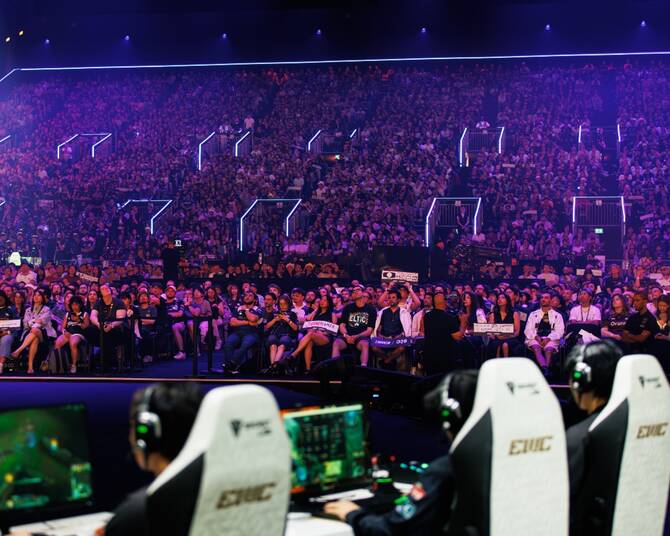

DUBAI: As the Esports World Cup 2026 unfolds in Paris, the Middle East and North Africa’s influence on the tournament is increasingly more visible.
Beyond the success of individual clubs, the tournament has revealed a regional talent pool that now stretches across international organizations, multiple game titles and every corner of the competitive ecosystem.
The EWC’s move to Paris, after two editions in Riyadh, marks a new chapter in its international expansion, but the tournament remains rooted in Saudi Arabia, where its long-term vision continues to be shaped by the Esports Foundation.
This summer, nearly 150 players from across 16 MENA countries are competing at EWC 2026, representing more than 40 teams and organizations.
Some compete under the banners of regional powerhouses such as Team Falcons, Twisted Minds, Geekay Esports and Nigma Galaxy. Others wear the colors of globally recognized organizations including Team Heretics, Karmine Corp, Aurora Gaming, Virtus.pro and Spacestation Gaming.
Together, they tell the story of a region whose influence is no longer measured solely by the clubs it builds, but by the players it produces.
Region represented globally
Saudi Arabia is one of the region’s two largest contributors at EWC 2026, with over 40 players competing across a wide range of titles. The Kingdom’s presence reflects years of growth in gaming and esports, supported by the National Gaming and Esports Strategy and a large, highly engaged gaming population.
Turkiye also sends close to 50 competitors, placing both countries at the forefront of MENA representation at this year’s tournament. Egypt follows with 15 players, while Iraq contributes close to 10.
Algeria, Jordan, Morocco, Kuwait and Lebanon all have multiple competitors in Paris, while Bahrain, Iran, Libya, Qatar, Syria, Tunisia and Yemen each have representatives on the world stage.
Whether a country sends one player or dozens, every competitor has earned a place alongside the world’s best. Together, they demonstrate that elite esports players are emerging from across the region.
Hans Jagnow, director, national team, club and player relations at the Esports Foundation, said: “The scale of MENA representation at EWC 2026 has nearly doubled since 2024, growing from 84 participants to 145 this year, and that reflects how much the region has evolved in recent years.
“We’re seeing players from more countries competing across more game titles and organizations than ever before, which speaks to the strength of the ecosystem and the opportunities now available to players throughout the region and beyond.
“It’s encouraging to see that growth translating into meaningful representation on one of esports’ biggest stages.”
Talent beyond borders
The diversity of organizations represented by MENA players is equally striking, with Saudi Arabia continuing to play a central role both through its clubs and players.
Team Falcons are chasing an unprecedented third consecutive Club Championship. Twisted Minds remain one of the competition’s leading multi-title organizations, while PWR’s continued rise highlights the growing depth of Saudi esports.
Together, they demonstrate that the Kingdom’s competitive ecosystem is no longer defined by the success of a single club, but by a broader network of organizations capable of competing on the world stage.
That strength is also reflected in the players.
Saudi Rocket League stars Rw9, Kiileerrz, trk511 and Nwpo compete across leading organizations, while Mosaad “Msdossary” Aldossary remains one of the region’s defining names in EA SPORTS FC. Across multiple titles, Saudi players are the backbone of some of the tournament’s strongest lineups.
The wider MENA region is equally well represented. Turkish Counter-Strike stars XANTARES, woxic and Wicadia line up for Aurora Gaming, while Wo0t and RieNs continue to establish themselves among Europe’s elite with Team Heretics.
Egyptian VALORANT player avez competes for Karmine Corp, Moroccan Rocket League player dralii represents Team Falcons, Jordan’s Ammar “ATF” Alassaf remains one of Dota 2’s standout competitors, and Lebanese veteran GH continues to anchor Nigma Galaxy’s Dota 2 roster.
More than one path to the top
MENA players are competing across an equally diverse range of titles.
From Counter-Strike 2, VALORANT and Dota 2 to Rocket League, EA SPORTS FC 26, PUBG MOBILE, Mobile Legends: Bang Bang, Free Fire, Fortnite, Rainbow Six Siege, Street Fighter 6, TEKKEN 8 and Chess, the region is represented across almost every major competitive title and game genre at EWC 2026.
That diversity reflects the evolution of the region itself. Success is no longer built around a single game or handful of star players. Competitive pathways now extend across PC, console and mobile esports, producing specialists capable of performing on the biggest stages regardless of discipline.
Growing stage for women
MENA’s presence at EWC 2026 also reflects the growing role of women across the region’s esports ecosystem.
Saudi Arabia, Egypt and Turkiye are represented in the Mobile Legends: Bang Bang Women’s Invitational through players competing for Virtus.pro, Geekay Esports, FUT Esports and Team Falcons Vega MENA.
Their participation reflects the increasing opportunities for women in competitive gaming. As more reach international competitions, they are broadening MENA’s esports story and inspiring the next generation of players.


