

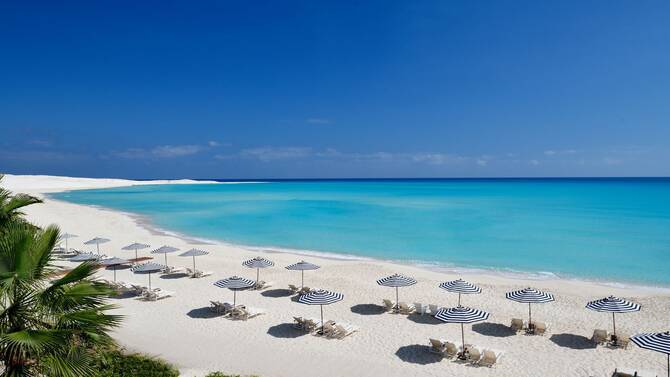

CAIRO: A dispute over access regulations at a luxury residential and resort development on Egypt’s North Coast has ignited a wider debate on the balance between private investment and public rights.
The controversy, at Emaar Misr’s Marassi project, began when homeowners there objected to the introduction of fees for access to certain beaches and services and an electronic system for regulating guest and visitor entry. Critics argue that the measures restrict the rights of property owners within the development.
The dispute intensified after videos and complaints circulated on social media, prompting several homeowners to pursue legal action seeking to overturn some of the decisions and claim compensation.
Speaking at an event on the North Coast last week, Emaar Misr Chairman Mohamed Alabbar sought to reassure residents by emphasizing the company’s long-standing commitment to Egypt.
“Marassi is 100 percent Egyptian and Egyptians deserve the credit for implementing every detail,” the Dubai-born businessman said. “They are the owners of this place and we learn from them.”
Alabbar said that his role within the project was largely symbolic and that its management and execution relied on Egyptian expertise.
Egyptian billionaire Naguib Sawiris defended Alabbar. He said in a post on X that the criticism was a “manufactured campaign” targeting one of the UAE’s largest and longest-established real estate developers and a major investor in Egypt.
All tourist resorts and residential developments operated under rules designed to ensure fairness among homeowners, hotel guests and visitors while protecting the rights of all parties, he said.
Marassi covers about 6.5 million sq. meters and includes five beaches, 23 residential communities and about 3,300 hotel rooms.
During a meeting with Alabbar in 2022, Egyptian Prime Minister Mostafa Madbouly reaffirmed the strong ties between Egypt and the UAE and reiterated Cairo’s support for Emirati investment.
Mesbah Kotb, deputy editor-in-chief of Al-Masry Al-Youm, told Arab News that successive governments had permitted the construction of hundreds of adjacent tourist resorts, many of which had come to regard nearby beaches as their private property.
“Beaches are a public right for all Egyptians and everyone residing in Egypt,” he said. “Private rights may exist in certain cases, but they must be properly regulated and clearly defined.”
Kotb said that he did not support granting exclusive beach access to every hotel along the coast, although limited exceptions could be justified for some remote resorts.
“For all other beaches, there should be unified regulations governing their use, whether they are adjacent to tourist resorts, hotels or residential communities,” he said.
Kotb compared such regulations to beach safety measures like warning flags and lifeguards, arguing that public beaches should be managed through clear rules rather than broad restrictions on access.
“The same principle applies to public conduct generally,” he said. “Just as there are rules governing streets and public parks, beaches should be regulated in a way that protects everyone’s rights.”
Former Tourism Minister Mounir Fakhry Abdel Nour said that Egypt’s coastline should remain open to the public but acknowledged that carefully regulated exceptions could apply to genuinely private beaches.
“The general principle is that the sea should be accessible to everyone, whether residents or visitors,” he told Arab News.
As a possible solution, he proposed setting aside public beaches at regular intervals along the Mediterranean coast.
“For example, I would create a 2 km public beach every 20 km along the coastline,” he said.
On the online backlash to North Coast developments, Abdel Nour said that debate on social media often became exaggerated.
“This is not a question of foreign versus local investment,” he said. “It is fundamentally a question of social justice.”


