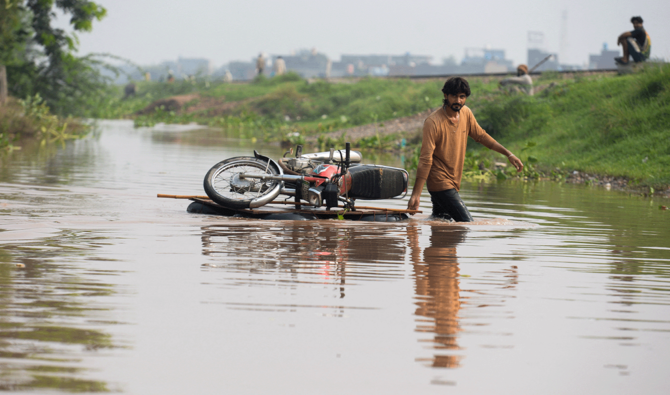

ISLAMABAD: Pakistani authorities stressed stronger coordination among various government departments, the National Disaster Management Authority (NDMA) said on Friday, as the country braces for more rains with its monsoon death toll since June 26 rising to 122.
The federal Emergency Response Committee (ERC) urged government departments to remain on high alert earlier this week, forecasting a fresh spell of heavy rains in various parts of the country from July 29-August 5.
Torrential rains across Pakistan, especially the northwestern Khyber Pakhtunkhwa (KP) and eastern Punjab provinces, have killed 122 people since June 26. KP has reported the highest number of rain-related deaths, 55, followed by Punjab with 46, Azad Jammu and Kashmir with 10, Balochistan 8, Sindh 2 and the northern Gilgit-Baltistan with one casualty.
The ERC held its daily meeting to review Pakistan’s monsoon preparedness under the chair of Planning Minister Ahsan Iqbal and attended by key government ministers and officials, including the NDMA chairman. The NDMA informed members of the committee that rainfall is expected over Pakistan’s northern and central parts, with isolated to scattered showers also likely over southeastern Sindh till August 5.
“The participants reiterated the importance of maintaining close coordination among all stakeholders to ensure a timely and effective response to any emerging situation,” the NDMA said.
The NDMA team also briefed the committee on the humanitarian response being coordinated with national and international humanitarian partners, including the ongoing relief operations in affected areas.
Participants of the meeting reiterated the importance of maintaining close coordination among stakeholders to ensure a “timely and effective” response to any emergency situation.
According to the NDMA’s latest situation report, most deaths from rain-related incidents since June 26 have been caused by house collapses, electrocutions, flash floods, and drownings.
Pakistan is among countries considered most vulnerable to climate change and has experienced increasingly erratic weather in recent years, with more frequent heatwaves, droughts and extreme monsoon rainfall.
In 2025, above-average monsoon rains and flooding killed more than 1,000 people and caused widespread damage to homes, roads, agricultural land and public infrastructure, with Punjab among the hardest-hit provinces.
In 2022, record monsoon rains and glacial melt triggered catastrophic floods that killed more than 1,700 people, affected over 33 million people and caused an estimated $30 billion in economic losses, making it one of Pakistan’s worst natural disasters.