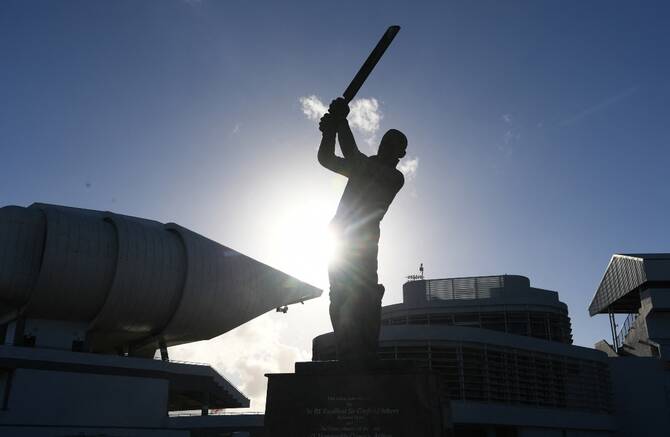

It occurred to me after last week’s tribute to the cricketing genius of Sir Garfield Sobers to wonder how he would have viewed the state of the game today.
In his era, between 1953 and 1974, the strongest national teams were Australia, England, New Zealand, South Africa and the West Indies. Although India’s national cricket team had played its first test match in June 1932, it was not until 1952 that a first test victory was claimed. In its first 50 years of international cricket, up to 1982, India won only 35 of the 196 test matches it played. Pakistan was inducted into the governing body, the Imperial Cricket Conference, in 1952, becoming the seventh test-playing nation. It, too, took its time to become established, winning 11 of its first 72 matches, seven of those at home.
In 1964, the name of the Imperial Cricket Conference was changed to the International Cricket Conference in recognition of shifting geopolitics. The first non-test playing nations were admitted as associate members. Ceylon, later becoming Sri Lanka, Fiji and the US were the first ones, joined in 1968 by Bermuda, Denmark, East Africa and the Netherlands. This eclectic bunch of countries must have had some logic at the time, but only Sri Lanka has achieved success at the top of the international game since the 1960s.
These first stirrings of formal recognition of international cricket outside the seven full members may not appear to have much relevance to Sobers. However, between 1960 and 1974 he came to embody the image of an international cricketer. In his tellingly titled autobiography, Cricket Crusader, published in 1965, Sobers uses the term “world cricketer,” as in someone who has reached a world-class standard. He aspired to be one, saying: “My kind of cricket is world cricket …. the jet plane makes all-year-round cricket possible for the individual world player.”
Although, like other West Indians, he played league cricket in northern England, this image was manifest in his spell playing for South Australia between 1961 and 1964, later reinforced by his seven-year stint for Nottinghamshire.
Sobers admitted that he “lived well in my 20 years in the game”, making every effort to realize his value. There were some pinch points. In early 1963, whilst in South Australia, he received his invitation from the West Indies board to tour England in the summer. The tour fee was £800, less than he could earn playing league cricket. Sobers was not happy and considered rejecting the invitation. He was persuaded by a stern letter from his captain and mentor, Sir Frank Worrell, who was the first permanent black captain of the West Indies. Worrell’s acceptance of the captaincy offer in 1960 was seen as the moment of release when the door closed on six decades of prejudice in West Indian cricket.
Worrell welded a group of players from different islands, cultures and backgrounds into a successful team, deploying skilled person management attributes and instilling a strong sense of patriotism. When Sobers took over as captain in 1965 his approach was different, based more on leading by example rather than tactical nous, though he did not lack in that respect. There was another key difference. Worrell was steeped in cultural and political awareness; Sobers much less so. He believed “there should be no barriers in sport”. This extended to a controversial visit to Rhodesia for a double-wicket competition in September 1970, when he said he “knew nothing of politics at the time”. A biography of Worrell published in 1987 contained a foreword by Clive Lloyd, who took over the West Indies captaincy in 1974. I was struck by Lloyd’s view that “I considered my team to be an extension of what Sir Frank started,” with no mention of Sobers’ contribution.
The power, aggression and hostility displayed by Lloyd’s team spoke of an evening up of scores against colonial oppression and racial discrimination. Sobers seemed to be more concerned with achieving better remuneration for players. He championed Kerry Packer’s World Series Cricket in 1977 and eagerly led the Rest of the World XI against England in 1980. This five-match series was arranged following the cancellation of South Africa’s tour to England for political reasons. Nevertheless, five South Africans were included in the 14-man squad.
Several years later, Sobers did not appear to join in the widespread and vituperative criticism of two West Indian rebel tours to South Africa between 1982 and 1984. It is reasonable to assume he would have felt the remuneration the players received of between $100,000-$125,000, placed them on a financial footing which they could never have achieved in domestic cricket. The “rebels” were a combination of exceptionally talented players who could not break into the national team or those past their prime as test players. All were banned from representing the West Indies for life and struggled to re-establish themselves elsewhere in the game. Clive Lloyd considered the tours as “an affront to the black man throughout the world”. Sobers tried to separate sport from politics.
In the last 40 years, the two have become malignly entangled. There is no record of how Sobers felt about this. He lived through a global expansion of cricket, the introduction of T20, the rapid growth of women’s cricket and the injection of huge capital into the game. He admitted, with perhaps a touch of envy, that his “mind boggled at the earnings of today’s players,” although he would have approved of players receiving just rewards. It is reasonable to assume that Sobers would have been a colossus in T20 cricket, able to name his price, although the shortness of the format would never have done justice to his all-round talents. Surely, he would have approved of women’s cricket on the scale to which it has now developed. Equally, it is probable that he would have approved of and indulged in the vastly expanded opportunities for betting.
Above all, given that his kind of cricket was world cricket, Sobers would have wholeheartedly embraced the opportunities for year-round, cross-format, cross-border international cricket now on offer to the leading players. He would have been spoilt for choice and delighted that so many others, both men and women, had similar opportunities. He may have been surprised to learn that cricket was being played in such diverse places as Nepal, Thailand and Brazil. Certainly, he would be disappointed in the decline of the West Indies national team at Test level, although many West Indian players have prospered financially and professionally in T20 cricket in a way that he might approve.
Overall, there have been developments in the game since the Sobers era of which it is likely he would have approved. One is how the possibility of becoming a “world cricketer” has come to fruition. This has been most notably articulated by the Jamaican, Chris Gayle, with his self-titled “Universe Boss.”
It is tempting fate to consider the developments that Sobers would dislike. I suspect that he would abhor the notion that politically imposed impediments exist to prevent players from one country featuring in the same team and sharing the same dressing room with players from certain other countries. He believed that cricketers are entertainers and should be unshackled by politics, facilitating them to be world cricketers.