

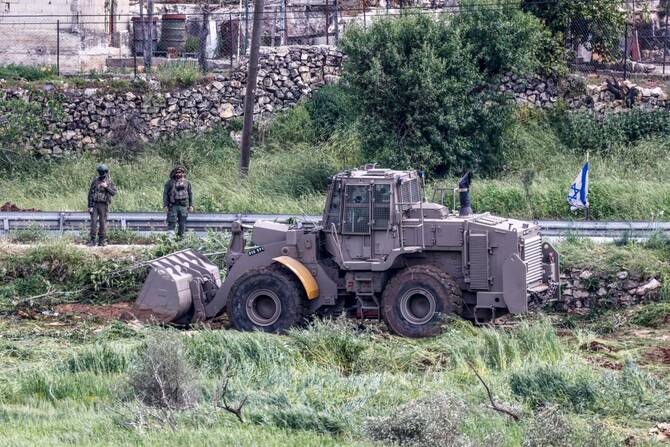

LONDON: Israeli settlers cut down more than 20 lemon and orange trees in Wadi Qana near Deir Istiya, northwest of Salfit in the central West Bank, local sources said.
The Palestinian news agency WAFA reported that dozens of settlers entered the area and uprooted trees belonging to resident Salah Yousef Mansour.
The incident forms part of a broader pattern in Wadi Qana, where residents say Israeli forces and settlers have repeatedly carried out land clearing, tree destruction and assaults on farmers.
Such actions, they add, are aimed at restricting Palestinian movement and facilitating the expansion of nearby settlements.
More broadly, attacks on Palestinian agriculture are a recurring feature of the olive harvest season across the occupied West Bank. These range from assaults on farmers to crop theft, tree burning and damage to farming equipment.
Such incidents are often compounded by access restrictions that prevent Palestinians from reaching their land, deepening the economic impact on families who rely on the harvest for income.
International monitors have documented a rise in these trends. The UN human rights office, OHCHR, said in October 2025 that violence and restrictions surge during harvest periods, describing settler violence as having “skyrocketed” and citing hundreds of attacks in the first half of the year.
Similarly, the UN Office for the Coordination of Humanitarian Affairs reported that October 2025 saw more than 260 settler attacks resulting in casualties, property damage, or both.
It added that violence during the olive harvest reached the highest level in recent years, with about 150 attacks recorded, injuring more than 140 Palestinians and damaging more than 4,200 trees and saplings across 77 villages.
Against this backdrop, large-scale tree destruction has also been reported elsewhere in the West Bank.
In August last year, the Israeli military reportedly destroyed about 3,000 olive trees in Al-Mughayyir, a village northeast of Ramallah, according to the head of the local council.


