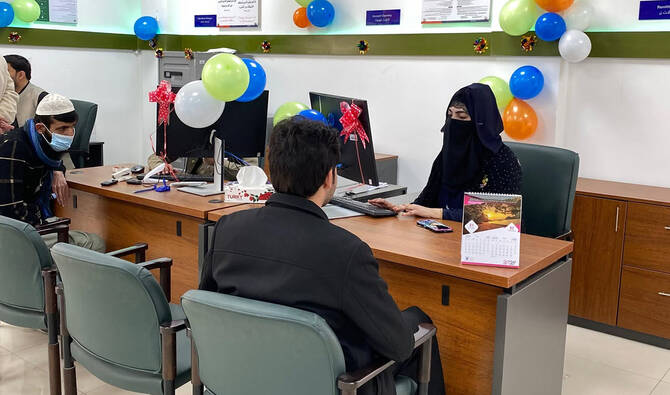

ISLAMABAD: A Pakistani Senate committee on Wednesday directed the country’s central bank to stop commercial financial institutions from forcing female staff members to wear abayas and headscarves, ordering the immediate implementation of a previous policy declaring national attire as the official dress code.
The directive came during a meeting of the Senate Standing Committee on Finance and Revenue after lawmakers raised concerns that women employed by several financial institutions, including Islamic banks, continued to face pressure to comply with strict religious dress codes despite earlier instructions from the Senate committee.
“All banks should issue a circular and share it with us,” committee chairman Senator Saleem Mandviwalla told SBP Governor Jameel Ahmad, directing the central bank to ensure banks stop forcing female staff members to wear abayas and headscarves.
The issue was raised by Senator Dr. Zarqa Suharwardy Taimur of jailed former Prime Minister Imran Khan’s Pakistan Tehreek-e-Insaf (PTI) party, who said female employees at Islamic banks and the Bank of Punjab continued to face pressure despite the committee’s previous directives.
“You mean to say they are forced to wear that dress?” Mandviwalla asked.
“Yes,” Taimur replied, adding the banks had failed to inform employees about revised policies and urged them to formally notify staff and conduct awareness sessions.
“The women working in these banks, they need to be told,” she continued, adding that female employees “feel like they face biased treatment.”
Taimur said many employees were reluctant to speak publicly because they feared losing their jobs.
Senator Sherry Rehman supported the concerns, saying the issue involved fundamental workplace rights rather than personal preference.
“This institutionalization of dress codes against women in banks is absolutely wrong,” she said. “It’s not a question of hot or cold weather. There is a fundamental, basic principle to this.”
She said women had privately reported discriminatory treatment, particularly in Sharia-compliant banking.
“Active discrimination happens, you are told you cannot be dressed like this,” Rehman said. “People are encouraged to wear tight abayas, especially for Sharia-compliant banking... This is institutional and absolutely should be in compliance with Pakistan’s national dress that is totally modest, and you have no right to go beyond that in the private sector either.”
SBP Governor Ahmad told lawmakers the central bank had already communicated the committee’s earlier decision to all commercial banks after discussions held in late 2025.
“The banks amended their HR policies where dress codes were previously defined,” he said. “Every bank made its policy consistent and gave us confirmation of it. Now, if there is an implementation issue anywhere, please tell us specifically.”
Reading from the policy, Ahmad added: “There shall be no compulsion on female employees to wear the abaya or any specific religious dress.”
Responding to the allegations, Meezan Bank representative Khalid Zaman Khan told the committee the bank had fully implemented the SBP’s instructions.
“State Bank communicated that to us. We have fully implemented it in our HR policy,” he said.
Mandviwalla questioned the bank’s interpretation of the policy and directed the bank official to submit a copy of its human resources rules.
“Show us what you have implemented. Give us a copy of it,” he said. “We only wrote 'modest dressing' and nothing else.”
The committee concluded by directing the SBP governor to ensure all banks issue fresh circulars reaffirming that female employees cannot be compelled to wear abayas, headscarves or any other specific religious attire.