


RIYADH: Saudi Arabia’s robotics industry is entering a new phase — one defined less by futuristic concepts than by practical deployment.
While robots are often associated with science-fiction humanoids, the Kingdom’s focus is firmly on technologies that deliver measurable value. Drones, autonomous ground vehicles and industrial robots are already being deployed to inspect infrastructure, monitor assets, map terrain, transport materials and patrol sites, typically operating in coordinated fleets under human supervision.
The challenge is no longer proving what robots can do. It is ensuring they can operate reliably, safely and cost-effectively in real-world environments, day after day.
As automation gathers momentum under Vision 2030, the emphasis is shifting from innovation to implementation. Success increasingly depends on transforming promising prototypes into dependable systems that can be validated, maintained and seamlessly integrated into existing operations.
That transition is taking shape at KAUST’s Robotics Bay, a 1,000-sq.-meter facility equipped with advanced infrastructure for designing, testing and deploying robotic technologies for practical applications across multiple industries.
Eric Feron, a KAUST professor specializing in autonomy and safety for aerial and ground systems, said the scale of the facility plays a vital role in fostering collaboration and enabling more ambitious testing.
“Having a wide working space means that many teams can now work side-by-side and learn from each other,” he told Arab News.

KAUST is exploring ways to involve product development engineers earlier in the research process. (KAUST)
“The sheer size of the Robotics Bay enables the creation of experiments that would be impossible otherwise.”
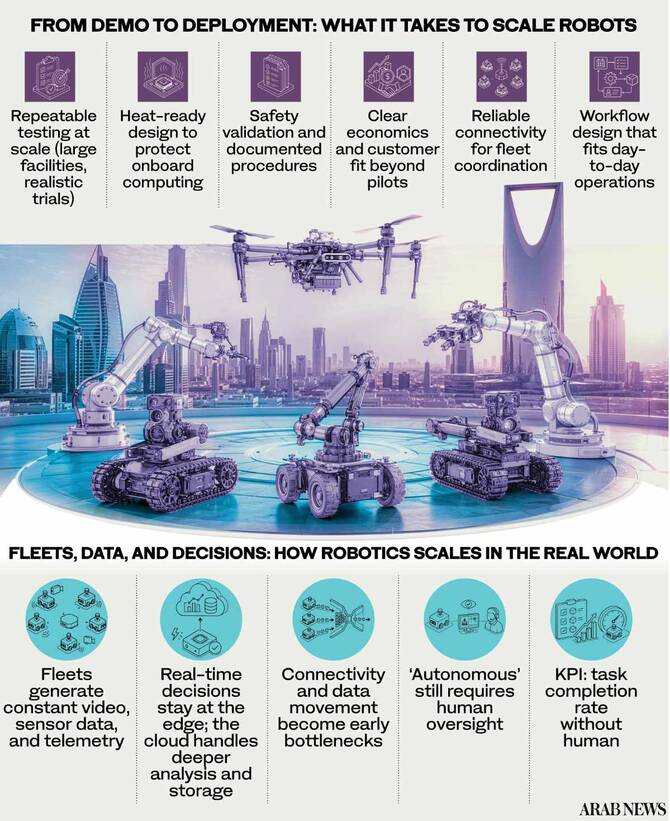
The 50-meter-long testing area allows researchers to evaluate drones and other aerial robots over meaningful distances, generating the repeatable results needed before systems can be deployed beyond the laboratory.
Consistent performance is critical. While demonstrations can showcase technical capability, commercial deployment requires evidence that robots can operate safely and reliably under everyday conditions.
Feron said several KAUST projects are being developed for external users, “for whom reliability, safety, and security are paramount,” adding that the university is exploring ways to involve product development engineers earlier in the research process.
Saudi Arabia’s climate also presents engineering challenges.
“Heat certainly impacts the way we design field machinery at KAUST,” Feron said. “Computing units are especially sensitive to heat and must be packaged within special containers.”
Even when technical hurdles are overcome, bringing robots to market can remain difficult.

KAUST’s Robotics Bay is a 1,000-sq.-meter facility equipped with advanced infrastructure for designing, testing and deploying robotic technologies. (KAUST)
“The biggest limiting factor is often economics,” Feron said, noting that identifying a viable product and the right customer can be harder than solving the engineering problems themselves.
He added that safety is often underestimated, despite being fundamental to large-scale deployment, where processes must be validated, documented and consistently replicated.
As robotic operations expand from individual machines to coordinated fleets, a new set of operational challenges emerges.
Shinkyu Park, a KAUST assistant professor whose research focuses on multi-robot systems, said the greatest advantage of robot fleets lies not in futuristic autonomy but in operational resilience.
“Today the clearest value is coverage and redundancy — a fleet can cover a large site faster than a single robot, and if one unit fails or needs to recharge, others continue the task without interrupting the overall mission.”
That capability, however, comes with added complexity.
“Communication is usually the first bottleneck, since effective coordination depends on reliable connectivity,” Park said.
DID YOU KNOW?
• Saudi’s Robotics Federation partnered with VEX Robotics and RECF to boost STEM robotics in schools and competitions nationwide.
• The global robotics market was valued at $90.2 billion in 2024 and is projected to reach $205.5 billion by 2030.
• AI helps robots spot defects and anomalies, avoid obstacles, and coordinate tasks, especially when operating in fleets.
“A fleet needs a shared, up-to-date picture of the environment and of what every other robot is doing. When connectivity is intermittent or bandwidth-limited, coordination degrades quickly.”
Asked how operators should assess success, Park pointed to a straightforward benchmark: “Task completion rate without human intervention.”
He argued that dependable performance often depends less on sophisticated algorithms than on careful preparation of the operating environment.
“A well-instrumented site with good positioning references, accurate maps, and a consistent layout makes even a relatively simple algorithm work reliably,” he said.
“While a poorly set up site can defeat a sophisticated one.”
The lesson, he said, is that software and physical infrastructure must be designed together.
Park also challenged a common misconception that autonomous robots can simply be deployed and left to operate independently.

Aramco has been exploring ground robots to improve operational safety and efficiency. (Aramco)
“In practice, autonomous usually means AI-driven decision-making operating under human oversight, not full independence.”
He said robotics projects are also more likely to fail because of operational shortcomings than technological limitations.
“Workflow design is the most common stumbling block,” he said.
“If it doesn’t fit naturally into how people already do their jobs — handoffs, scheduling, exceptions — the system ends up being worked around rather than relied upon.”
As robotic fleets generate continuous streams of video, sensor readings and telemetry, managing the resulting data presents another critical challenge.
Saeed Al-Zahrani, general manager of NetApp Saudi Arabia, said organizations are often caught off guard by one issue in particular.
“In many cases, it is data movement, and it catches organizations off guard,” he said.

Saeed Al-Zahrani, general manager of NetApp Saudi Arabia, says organizations are caught off guard by data movement. (Supplied)
While storage capacity can be planned, he explained, ensuring data moves quickly enough to remain useful is often the greater challenge.
Al-Zahrani also emphasized the distinct roles of edge and cloud computing.
“Real-time decision-making has to stay at the edge,” he said. “It cannot depend on a round trip to the cloud.”
He described the future as “a hybrid model: the edge handles immediacy, while the cloud handles depth.”
Park believes one practical step could significantly accelerate robotics adoption across industries: creating a standardized interface for maps, positioning references and obstacle layouts that any fleet management platform can use.
Such a framework would simplify integration, shorten deployment timelines and enable more consistent rollouts across multiple locations.
Ultimately, Saudi Arabia’s robotics ambitions will be judged not by the sophistication of laboratory demonstrations, but by how reliably robots perform long after deployment — and how effectively organizations can scale from operating a single machine to managing entire fleets.


