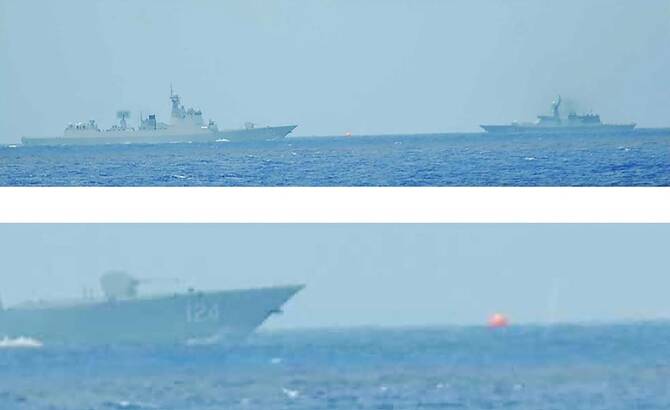
TOKYO: Chinese and Russian naval forces conducted a joint live-firing exercise using machine guns within Japan’s exclusive economic zone, a sign of their deepening military cooperation, Tokyo said Tuesday.
The incident on Sunday was the first time that Japan’s defense ministry has spotted a live-fire drill by China within its EEZ and disclosed it, according to Japanese media.
Tokyo sees the drill as “part of a move by the two militaries toward strengthening their cooperation,” Japan’s top government spokesman Minoru Kihara said at a Tuesday briefing.
Relations between Japan and China have worsened since Japanese Prime Minister Sanae Takaichi angered Beijing in November with comments about Taiwan.
On Sunday, the Chinese navy’s Luyang III-class missile destroyer was seen conducting the exercise 180 kilometers (110 miles) southwest of the Okinotori island, Japan’s southernmost territory, alongside a Russian naval vessel, officials said.
A fleet comprising three Chinese ships and a Russian navy frigate was first sighted at around 2:00 am (1700 GMT Saturday) 330 kilometers southwest of the island, heading northeast.
Japan told Beijing via diplomatic channels that the drill “could have endangered the navigation of nearby ships,” according to Kihara.
Chinese and Russian air forces jointly flew bombers over waters around Japan last month, while their navies also conducted a joint exercise this month.
The latest live-firing drill prompted Tokyo to mobilize by air and sea to surveil and monitor the situation, Kihara said.
“We will continue to monitor with concern the behaviors by Chinese and Russian vessels in the waters around our country,” he added.
Ships from Japan’s and China’s coast guards faced off near disputed islands this month, with each claiming they drove out the other’s vessels that had intruded into their territorial waters.
The incident took place near uninhabited islands claimed as the Senkaku in Japan and the Diaoyu in China, which sit between Taiwan and Okinawa and have caused diplomatic tensions for decades.
Takaichi said in November that Tokyo could intervene militarily in any attack on self-ruled Taiwan, drawing Beijing’s ire.
Under Takaichi, Japan has also accelerated its pivot toward a more proactive defense policy, further shaking off — with US encouragement — a pacifist outlook in place since the end of World War II.


![]()

China, Russia conducted firing drill in Japan’s economic waters: Tokyo
Short Url
https://arab.news/yshjv
China, Russia conducted firing drill in Japan’s economic waters: Tokyo
- Chinese and Russian naval forces conducted a joint live-firing exercise using machine guns within Japan’s exclusive economic zone, a sign of their deepening military cooperation, Tokyo said Tuesday


Latest updates


© 2026 SAUDI RESEARCH & PUBLISHING COMPANY, All Rights Reserved And subject to Terms of Use Agreement.