

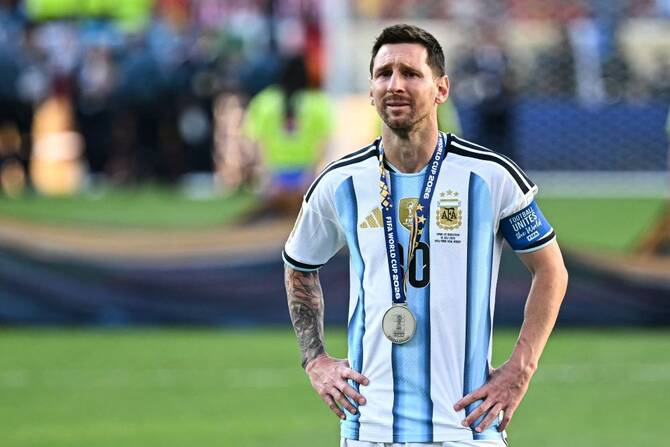

DUBAI: The undisputed greatest of all time stood battered, bruised and badly beaten. The defeat added poignancy as it came at the hands of someone who had grown up idolizing him, and now, had all but ended his illustrious career.
The date was Oct. 2, 1980, and the fight between Muhammad Ali and Larry Holmes, billed as “The Last Hurrah,” had ended in a brutal defeat for the 38-year-old boxer, for whom the moniker GOAT was invented, after his corner saved him from a more savage beating by stopping the bout in the 10th round.
An emotional Holmes, 30 at the time, and a former sparring partner and protege to Ali, cried in the ring as he was declared victor.
Thankfully, only sporting parallels exist between the closing chapter of Ali’s career and that of 39-year-old Lionel Messi after defeat in the World Cup final against Spain on Sunday.
Whether Lamine Yamal felt a tinge of sadness for his childhood hero is not clear, but there was a clear element of the torch being passed as the two shared a warm embrace at the final whistle. The tears, eventually, came from Messi as he received the adoration of the Argentinian fans in the stands at MetLife Stadium in New Jersey.
Messi is far from the only sporting legend since Ali to seemingly close out his career in a downbeat manner.
Tennis fans will remember Roger Federer agonizingly giving up two championship points in the 2019 Wimbledon final against Novak Djokovic to eventually lose in five sets. He never won another Grand Slam.
Perhaps the closest comparison to Messi’s last dance came in 2006, when Zinedine Zidane, having won the World Cup eight years earlier with France, led his country to the final in Germany before losing to Italy. Infamously, the French captain was sent off late in extra time for headbutting Italy’s Marco Materazzi after the two had exchanged words away from the action.
Zidane then, and Messi this summer, had almost single-handedly dragged France and Argentina to an unexpected final years after their finest hours.
What’s more, both rolled back the years to deliver signature performances that many thought were beyond them at the start of their respective tournaments.
The 34-year-old Zidane’s virtuoso performance in the 1-0 quarterfinal win over a Brazil team boasting Ronaldo, Ronaldinho, Kaka, Roberto Carlos and Cafu has since gone down in World Cup folklore as one of the finest of all time. His efforts in a 3-1 win against Spain and in the final were not behind.
Messi’s performances at the 2026 World Cup arguably eclipse Zidane’s 20 years ago. Clearly still the best player in a relentless but otherwise modestly gifted Argentine team, the man nicknamed La Pulga put on one masterclass after another to take reigning champions to a final many fans thought they barely deserved.
For sheer resilience and willpower when all seemed lost, few can compare with his grab-a-match-by-the-scruff-of-the-neck performance in the 2-1 comeback win over England in the semifinal.
In truth, Messi’s heroics barely masked the glaring shortcomings of Argentina’s class of 2026, culminating in the final when he was as helpless as those around him in stopping Spain’s total, embarrassing dominance. If nothing else, Messi and company can have few, if any, complaints about a thoroughly humiliating loss.
But unlike four years ago in Qatar, when Argentina and Messi rode a wave of goodwill and love on their way to a glorious triumph against France, this tournament will be remembered as the one in which the world turned on them.
Thanks to a series of seemingly questionable refereeing decisions in wins over Algeria, Egypt, Switzerland, not to mention that shameful final performance, the backlash, particularly on social media, was savage. As ever, long-standing country, club and player rivalries added fuel to the fire, as did, not always fairly, geopolitical realities and assumptions.
While it is a shame that Messi’s international curtain call should echo the disappointments of Ali, Federer and Zidane, it should in no way detract from the fact that, to the last, he remained the greatest player on the planet, pulling off football miracles match after match. Not even his biggest critics, or haters, could claim that he had in any way outstayed his welcome. If anything, his latest flirtation with glory should, once the dust has settled and emotions calmed, be seen as one last proof of his unrivaled genius.
From his explosion on the La Liga scene as a Barcelona teenager, through the majestic years under Pep Guardiola and Luis Enrique, to his late-career glory with Argentina, he was rarely anything less than simply breathtaking, producing football arguably beyond the capacity of even Pele, Diego Maradona, Zidane and the two Ronaldos.
The stats show a career that produced a world record 46 major team trophies, including 10 La Liga titles, four UEFA Champions Leagues and, of course, the 2022 World Cup. To an astonishing total goals tally of 919, there were countless individual honors and man-of-the-match awards.
But neither those numbers, nor any words, can come close to painting a picture of his true greatness.
It may have all ended in tears on Sunday, but like Muhammad Ali all those years ago, his status as the GOAT will never be in doubt. We will never see his like again.


