

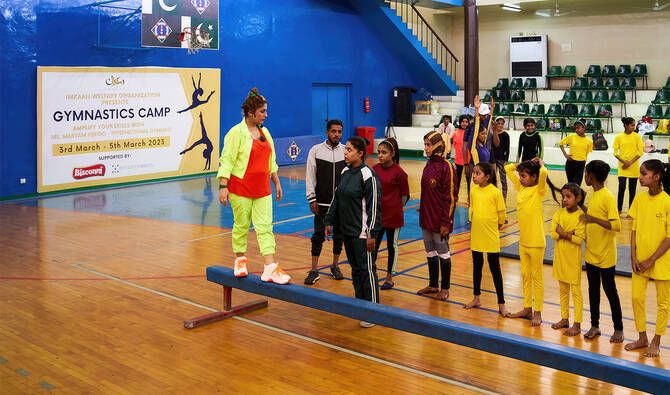

KARACHI: In Karachi’s Machar Colony, a neighborhood better known for poverty than sporting success, teenage girls are defying social expectations through gymnastics, dreaming of one day representing Pakistan despite criticism over their clothing and questions about whether girls belong in the sport.
Better known to outsiders as Fisherman Colony, Machar Colony is home to thousands of low-income families, including many from undocumented Bengali and Rohingya communities.
Over the past decade, girls training through Imkaan Welfare Organization’s Khel learning and recreation center have gone on to win medals at provincial and national gymnastics competitions, challenging perceptions both inside and outside their community.
“I came here because it was my dream to do gymnastics, become a national player and make my parents proud,” 15-year-old gymnast Samreen Mir Ahmed told Arab News.
“When I come here for training, a lot of people make comments and criticize my clothes. So I tell them, it’s my choice what clothes I wear. I’m doing gymnastics to build my career.”
For 20-year-old Kiran Mohammad Fayaz, the journey began a decade ago. After winning medals at competitions, including gold at the National Games and Sindh Games, she got married two years ago and is now the mother of a one-year-old daughter. Recently, she has returned to the same gym where she once trained, this time coaching the next generation of girls.
Her own family, however, had initially struggled to accept her decision to pursue the sport.
“In the beginning, when I started doing gymnastics, my mother had to listen to a lot of people saying, ‘She’s a girl, she’s wearing tights, boys are training her,’” Fayaz said.
“After that, my mother made me stay at home. I stayed home for at least a month.”
Fayaz said she eventually persuaded her father to accompany her to one of her competitions, where he saw the training environment and the commitment she had put into the sport.
“My father saw what the boys there were like, how we trained and how hard I had worked in the heat,” she said. “Then my father convinced my mother, saying, ‘Let my daughter continue. When she has come this far, let her keep playing.’“
Imkaan Welfare Organization, which established the Khel sports center, has worked in Machar Colony since 2012, providing education, health care and recreational opportunities for marginalized children.
Founder Tahera Hasan said the organization initially formed a boys’ gymnastics team before girls began asking why they could not participate too.
“Most of the children that come to us from the community are without identity so they are stateless,” she said.
“When the girls’ team was developed, the challenge we faced every step of the way was documentation. We had to fight along the way so that they could play inter-school, so that they could play nationals.”
Despite those obstacles, Hasan said several girls earned places on the Sindh team.
“They trained really hard. They were able to get into the Sindh team to participate in the nationals and the only reason for that was that they were better than everybody else.”
Gymnastics coach Mohammad Furqan, who has trained the girls for the past nine years, said misconceptions about male coaches working with female athletes remain common in conservative communities.
“In Pakistan’s smaller communities, where people have a narrow mindset, such issues come up that male coaches are touching girls,” he said.
“We receive full training on how to work with them physically, how to touch them and how to help them. We are fully trained.”
Furqan said success had gradually changed attitudes.
“When these girls achieve something and represent Pakistan, like our girls who became national champions and won national gold medals, people see them in the media and realize they really worked hard for it,” he said.
“They appreciate them a lot.”


