

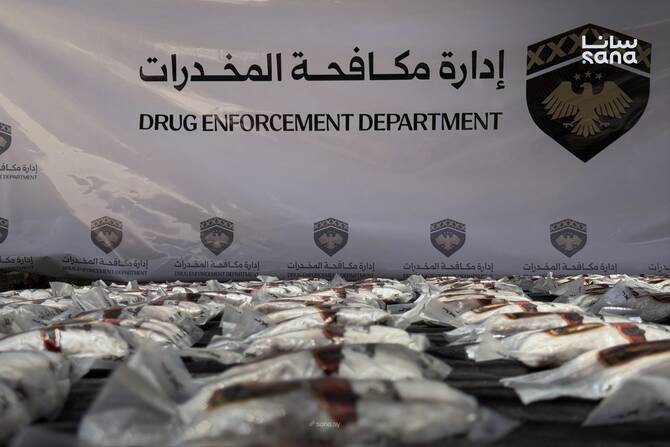

LONDON: Authorities in Syria seized a further 200,000 captagon pills on Thursday.
They were confiscated by the country’s Drug Enforcement Administration during a raid on a criminal network in the southern province of Daraa, along the border with Jordan. Six balloons used to smuggle drugs across the Middle East were also recovered, the Syrian Arab News Agency reported.
The illegal trade in captagon, a synthetic, amphetamine-like drug, has a significant affect on public health and security in the Middle East, according to the UN Office on Drugs and Crime. Authorities across the Arab region have intercepted at least 177 million captagon tablets since late 2024, according to figures published at the end of last year by the office.
Syria became a hub for the production and distribution of captagon under former president Bashar Assad, who fled to Russia in December 2024 when his regime was toppled by opposition forces following nearly 14 years of civil war. His government had largely ignored the concerns of neighboring countries about the negative effects this was having on the region.
Officials from Jordan, Syria, Iraq, Egypt, Saudi Arabia and Lebanon met in Amman this week to discuss strategies for combating the production, trafficking and distribution of synthetic drugs, and coordinate their efforts.
According to UNODC’s World Drug Report 2026, published last month, captagon remains a dominant synthetic drug in the Middle East, despite seizures of large quantities of the narcotic by Syrian and Lebanese authorities since the fall of the Assad regime.


