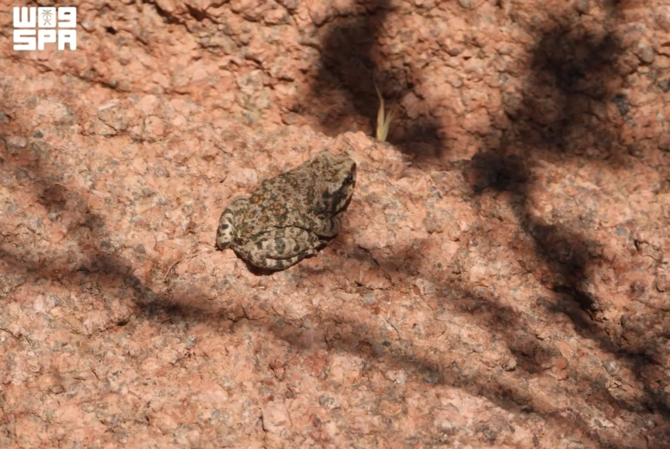
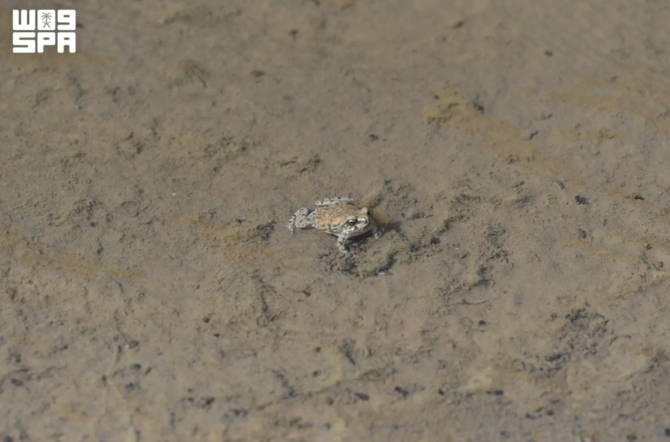

RIYADH: The King Salman Royal Reserve has announced a new scientific breakthrough after researchers documented the behavior of a rare Arabian toad, marking what is believed to be the first observation of its kind in the wild.
The discovery was made by a team of environmental specialists during a field survey within the reserve, where they observed young tadpoles in the early stages of development attacking a larger, more developed individual nearing metamorphosis.
The behavior, known as reverse cannibalism, overturns the biological pattern typically seen in amphibians, in which larger individuals prey on smaller ones.
According to a study published in the scientific journal Herpetology Notes, this is the first documented case of the phenomenon in a natural environment, both in Saudi Arabia and globally.
Researchers said the finding offers new insight into feeding behavior within the same species and could reshape scientific understanding of how environmental conditions influence amphibian development and survival.
The Arabian toad is native to the Arabian Peninsula and is well adapted to mountainous and semi-arid habitats where water sources are available. While the species has been studied in laboratory settings, observations of its behavior in the wild remain limited, making the discovery particularly significant.
The finding forms part of the reserve’s ongoing wildlife monitoring and environmental research program across its more than 130,000 sq. km. Research teams have placed particular emphasis on amphibians because of their important role in maintaining healthy ecosystems and their sensitivity to environmental change.
Officials said the achievement highlights the reserve’s growing role as a center for biodiversity research and scientific discovery, while reinforcing Saudi Arabia’s contribution to global environmental research.