

King Salman Royal Reserve hosts over 2,850 rare birds this winter

1 / 4
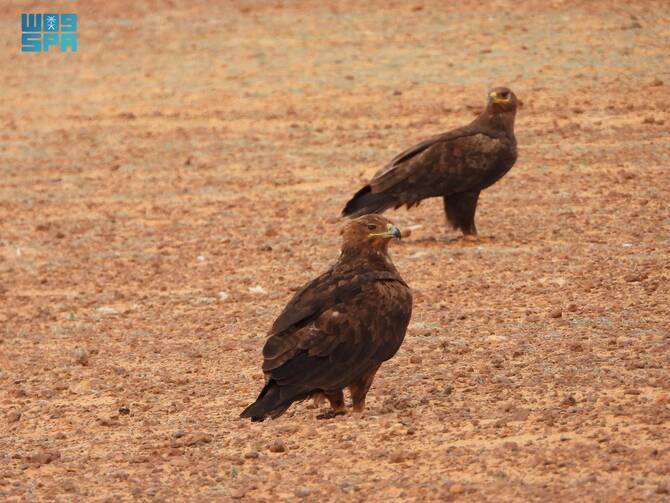
The nationwide survey, conducted from Jan. 16 to 26, aimed to ensure accuracy and prevent double counting. (SPA)
2 / 4
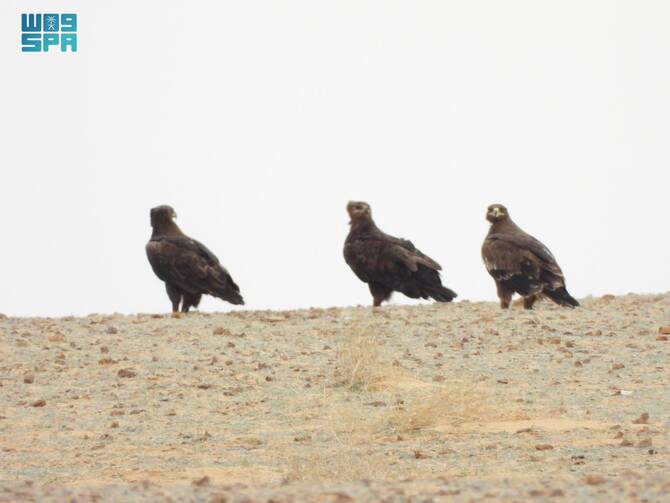
The nationwide survey, conducted from Jan. 16 to 26, aimed to ensure accuracy and prevent double counting. (SPA)
3 / 4
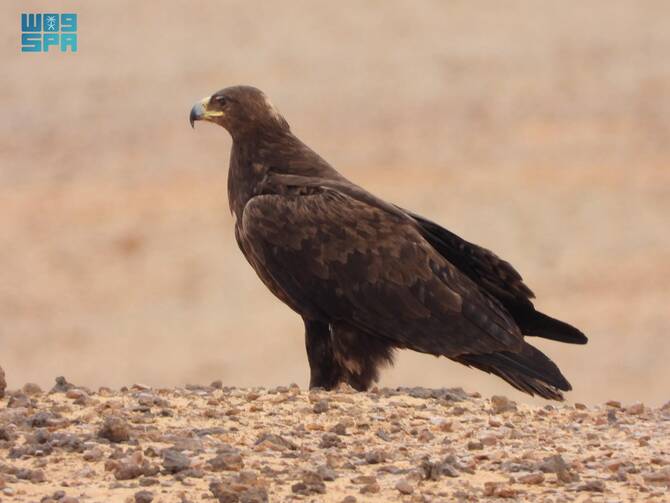
The nationwide survey, conducted from Jan. 16 to 26, aimed to ensure accuracy and prevent double counting. (SPA)
4 / 4
The nationwide survey, conducted from Jan. 16 to 26, aimed to ensure accuracy and prevent double counting. (SPA)
Short Url
Updated 17 February 2026
Follow

King Salman Royal Reserve hosts over 2,850 rare birds this winter

RIYADH: The King Salman bin Abdulaziz Royal Reserve Development Authority recorded more than 2,850 rare birds of prey wintering in the reserve, highlighting its role as a critical habitat for endangered species.

The authority participated in the national program monitoring the endangered steppe eagle’s numbers and wintering sites, according to the Saudi Press Agency.

The initiative brought together the reserve, the Saudi Ornithological Society, the National Center for Wildlife, Telad, and BirdLife International.

The nationwide survey, conducted from Jan. 16 to 26, aimed to ensure accuracy and prevent double-counting.

Monitoring occurred in the early morning and late afternoon, when raptors are most active, the SPA reported.

Field teams identified more than 1,600 steppe eagles, over 1,200 black kites, 35 cinereous vultures, and 25 eastern imperial eagles, underscoring the reserve’s ecological importance as a raptor gathering area.

To reduce electrocution risks, the authority worked with the National Center for Wildlife in 2024 to insulate medium-voltage power towers and lines within the reserve.

A follow-up assessment found no bird fatalities beneath treated lines, confirming the measures’ effectiveness in protecting endangered raptors and their habitats.

The reserve includes five sites designated as Important Bird Areas and one globally recognized Key Biodiversity Area under bird-specific criteria.

Migratory birds account for about 88 percent of recorded species, with residents making up the remaining 12 percent.


From buyer to builder: What World Defense Show reveals about Saudi Arabia’s industrial moment

Updated 9 sec ago
Follow

From buyer to builder: What World Defense Show reveals about Saudi Arabia’s industrial moment

RIYADH: On Saudi Arabia’s Founding Day, we reflect on state formation. At World Defense Show 2026, we witnessed an industrial formation.

The two are not separate stories.

For decades, the global defense market has operated on familiar lines: nations procure, suppliers deliver, exhibitions showcase, contracts follow. The choreography is well rehearsed. But occasionally, a country moves from participant to architect. From buyer to builder.

WDS 2026 signaled that Saudi Arabia is entering that phase.

The headline numbers tell part of the story: 1,486 exhibitors, 513 official delegations from 121 countries, 137,000 visitors and $8.8 billion in purchase contracts signed. Sixty-one of the world’s top 100 defense companies were present, underscoring the depth of global industry engagement. These figures represent growth from the previous edition. They also confirm World Defense Show’s place among the world’s leading defense exhibitions. But scale alone is not the point.

What matters is structural change.

Defense exhibitions have traditionally functioned as marketplaces. At WDS 2026, substantial contracts were signed — but the marketplace was not the story. In Saudi Arabia’s case, the exhibition operated as an instrument of economic policy. The agreements were not merely transactions. They were industrial anchors — mechanisms through which technology transfer, domestic production, supply chain integration and workforce development take root.

Localization, once an ambition, is now a discipline.

That discipline is not limited to contracts and supply chains. More than 6,000 students from over 100 educational institutions took part in this year’s Future Talents Program, reflecting a deliberate investment in the human capital required to sustain long-term industrial growth.

Saudi Founding Day commemorates the establishment of a political entity in 1727. Yet state-building has always been more than the formation of borders. It is the steady accumulation of institutional competence, industrial capability and strategic autonomy. If the early years of the Saudi state were defined by unity and stability, the current era is defined by building industrial depth and strategic self-sufficiency.

Defense industrialization is one of the clearest expressions of that maturity.

At WDS 2026, global primes did not merely exhibit. They engaged with a domestic ecosystem increasingly capable of partnership rather than dependence. The Saudi Supply Chain Zone demonstrated an expanding network of SMEs prepared to integrate into global production chains. Meet the KSA Government sessions formalized structured procurement pathways rather than symbolic handshakes. The Future Defense Lab spotlighted technologies emerging from within the Kingdom itself.

This is not rhetorical diversification. It is infrastructural diversification.

The $8.8 billion in contracts signed during the show are often reported as an indicator of scale. But the more significant question is what those contracts generate downstream: jobs in engineering and advanced manufacturing, training pipelines for young Saudis, industrial clusters, export pathways and long-term contributions to gross domestic product.

Defense is often framed narrowly as security expenditure. In reality, it is also an industrial policy.

The transition from buyer to builder does not occur overnight. It requires sustained reform, investment discipline, international credibility and the confidence of global partners. It requires long-term commitment sustained over years rather than months. Above all, it requires the willingness to move beyond comfort — beyond import dependency — into the demanding terrain of domestic capability.

WDS 2026 demonstrated that Saudi Arabia is prepared to inhabit that terrain.

Saudi Founding Day reminds us that states are not static achievements. They are ongoing projects. In 1727, the project was political cohesion. In 2026, it is industrial sovereignty.

Exhibitions do not build factories. They do not train engineers. They do not create policy. But they can crystallize momentum. They can signal seriousness. They can demonstrate readiness.

What WDS 2026 ultimately revealed is not that Saudi Arabia can host a large defense exhibition. It revealed that Saudi Arabia can convene the world while simultaneously building the conditions for long-term industrial autonomy.

In the defense sector, as in statecraft, maturity is not declared. It is demonstrated.

And this year, it was.

— Mansour Al-Babtain is the vice president of commercial partnerships and liaison at World Defense Show.