

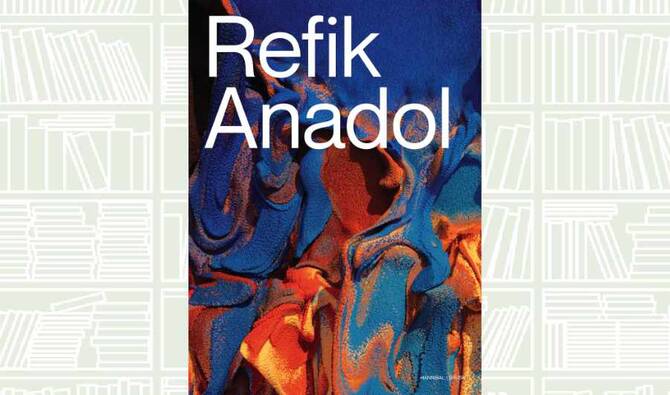

DHAHRAN: Whether we like it or not, the future of artists using artificial intelligence is now. An upcoming book, out this September by a pioneer in this field, named after the artist himself, “Refik Anadol,” dives deep into this digital murky water.
Working at the intersection of art, science, and technology, Anadol is best known for his public artworks that use machine learning, AI, and data to visualize complex systems.
“Data is the pigment of our time,” Anadol writes. And, indeed, it is. He is not just a random person chasing the AI trend — he has trained for this his whole career.
“Literally, in human history, we have never had intelligence as a technology,” he later writes. Also true.
Growing up in a family of teachers, the now 40-year-old Turkish-American digital artist taught himself basic programming in Turkiye when he was 8.
In 2008, he projected large-scale images outdoors onto a concrete area to create the illusion of movement. Coining the term “data painting,” the piece inspired Anadol to use light as material and data as pigment.
Fast-forward to now, he teaches at UCLA’s department of design media arts, his alma mater, and serves as director and co-founder of Refik Anadol Studio in Los Angeles.
More recently, he co-founded Dataland, the first-ever museum of AI art which opened this June, also in Los Angeles.
This book coincides with his global work displayed at the inaugural program at BRUSK, the new museum for contemporary art that launched on May 8 in Bruges, Belgium.
BRUSK, whose name is a versatile acronym for BRUgge Schone Kunsten — using the Dutch word for “fine” or “beautiful” — was created to serve as an open, dynamic hub for both historical and contemporary exhibitions.
There, Anadol presents a major site-specific installation that immerses visitors in data-driven landscapes.
This monograph from Hannibal Publishers showcases a tangible exploration of that installation.
Using thousands of museum images, archival photographs and live city data, he makes digital cities unfold across monumental data paintings and data sculptures.
Through it, we journey through Bruges — where the exhibit is hosted — and also to Berlin, Germany; New York City and Portland in the US; Stockholm, Sweden; and Seoul, South Korea.
This book, which is dual English and Dutch, is published to accompany that “Refik Anadol” exhibition, which will be on view until Nov. 8.
Anadol is not the first or last artist who will use AI as a medium, but he might be one of the few to ethically integrate data and technology in a fun and artistic way at scale.


