

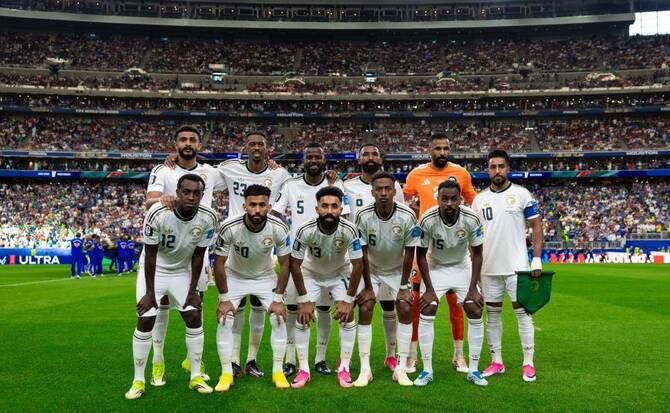
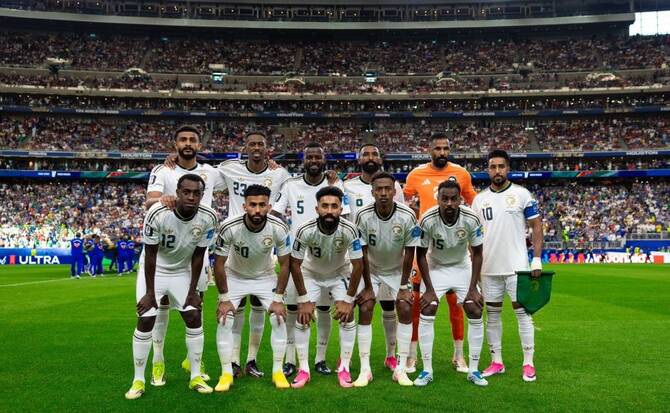
The Saudi national team’s elimination at the group stage of the 2026 World Cup — and their failure to defeat Cape Verde — was not surprising at all.
Argentina struggled against them, and Spain and Uruguay were unable to defeat them. Perhaps the problem lies with the team or elsewhere, but I rule out the possibility that the solution lies only in someone’s resignation or holding another accountable, because that does not explain the Saudi national team’s 30-year absence from winning at championships.
What has been said requires an honest and impartial answer, and I believe such an answer is available. It can be discussed as follows.
We cannot hold outgoing Saudi Arabian Federation President Yasser Al-Misehal and his team responsible for the failures that preceded his tenure, because the decline began with the introduction of professional contracts in 1993, and the local football community became a platform for concealing shortcomings of Saudi players.
The quality of foreign stars at the SPL clubs helped mask the technical and physical shortcomings of Saudi players.
Their absence from the national team stripped away the fig leaf covering local players — a fact confirmed by their mostly lackluster performances abroad.
Even their former coach, Roberto Mancini, said that they “do not know how to play football”, as alleged in national team player Ali Al-Bulaihi’s statement in an interview broadcast on April 8, 2025, and published by the Saudi sports newspaper. The current situation has proved that Mancini’s assessment was spot-on, and anyone who has watched the national team’s recent matches will certainly notice their lack of even the most basic skills in receiving and passing under pressure.
Scientific evidence for this was presented in a British study published in 2020 in the Journal of Sports Science, which documented a clear technical lag and slower immediate muscle recovery among players trained in static schools — such as national team players — compared to their counterparts in high-intensity dynamic schools. This is evident in the muscular fatigue and erratic decision-making of local players when faced with the high speeds and physical intensity of stars from European and Latin American national teams.
A French study published in 2022 in the International Journal of Sports Management confirmed that excessive engagement on social media platforms, particularly by players in domestic leagues — who are paid huge sums — gives them a false sense of success and reduces their motivation to exert greater effort on the field by 30 percent. In contrast, players from player-exporting nations such as Morocco and Senegal — who train and live in challenging environments and are forced to hone their skills daily to secure a chance to play professionally abroad — raise their level of play and their market value.
Saudi football had a golden age in the 1980s and 1990s. Saudi Arabia won two AFC Asian Cups, in 1984 and 1988, the first under a Saudi coach named Khalil Al-Zayani, and the FIFA World Youth Championship in 1989. They also ended their Gulf Cup drought in 1994 under the leadership of another Saudi, Mohammed Al-Kharashi, with an estimated budget for all national teams not exceeding $1.8 million — or about SR6.7 million. That budget was allocated on an annual basis, and has been verified and documented in reports from the General Presidency for Youth Welfare since 1984, until its name was changed to the Sports Authority and subsequently elevated to a ministry.
Today, this budget amounts to only two-tenths of 1 percent when compared to the Football Federation’s budget for 2026, which is estimated at $693 million, according to a report published by Asharq Al-Awsat newspaper on May 4 of this year. It is noteworthy that the amount has not been reflected in the performance of the national team.
Excessive spending does not stop at club budgets; rather, it goes so far as to spoil Saudi players with million-dollar salaries and endorsement deals before they have even achieved anything substantial with their national team — to the point that it has become a kind of local anaesthetic, dampening their desire to compete and excel.
Meanwhile, we see that a smart investment like the Mohammed VI Academy in Morocco — founded in 2010 with a budget of no more than $16.8 million — has produced stars who are now being marketed for huge sums, including Achraf Hakimi whose market value has reached $85.6 million, whereas the combined value of all players on the Saudi Arabian national football team is estimated at about $38 million — meaning that his market value alone exceeds that of the entire national team by 223 percent, due to his technical and physical prowess and his early professional career in European leagues.
What matters right now is to turn things around before the 2027 AFC Asian Cup and the 2034 World Cup by returning to the option of a Saudi national coach and appointing Saad Al-Shehri to lead the senior national team, given his achievements and experience with the junior and youth national teams over the past nine years.
No foreign manager has ever led a country to winning the World Cup. Every single winning team have been coached by someone from that country.
Moreover, the entire current national team roster must be replaced without hesitation, as a temporary measure, with the exception of Musab Al-Juwair, as he is the best option in his midfield position, is 23, and has a 78 percent success rate on key passes internationally — the highest among local players, according to the Saudi national team’s history and statistics website.
Saudi Arabia must also field a national team with an average age of 21 as a stopgap measure, and then move on to permanent solutions by launching a mandatory overseas scholarship program for promising players, aged between 16 and 20, to turn professional and actually play for mid-tier European clubs, fully funded by the government, to enable them to learn the fundamentals of playing at a fast and intense pace.
We must also work to set a cap on contracts and salaries for players under 23 in the domestic league, with a maximum limit of SR1 million, to force them out of their comfort zone and encourage them to pursue professional careers abroad to help develop their physical and technical skills.
Additionally, youth sectors should be established and separated financially and administratively from the club’s first team, with their operations entrusted to international companies and academies, such as at Ajax and Benfica, to ensure the development of a generation that restores the national team’s former prestige — at the very least.
- Dr. Bader bin Saud is a columnist for Al-Riyadh newspaper, a researcher in media and knowledge management, a university professor and expert in crowd management and strategic planning, and the former deputy commander of the Special Forces for Hajj and Umrah in Saudi Arabia. X: @BaderbinSaud.


