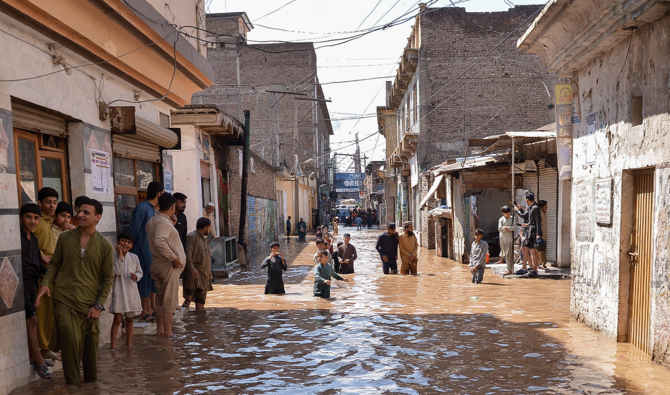

ISLAMABAD: Pakistan’s weather agency on Saturday warned of a heightened risk of glacial lake outburst floods (GLOFs) in northern regions over the coming week, urging people to exercise caution in vulnerable areas.
The South Asian country has seen erratic changes in its weather patterns that have led to frequent heatwaves, untimely rains, storms, cyclones, floods and droughts in recent years.
The annual monsoon, which runs from June till September, triggers flash floods, landslides, and house collapses. The National Disaster Management Authority (NDMA) projected that rainfall this year would be up to 26 percent higher than in 2025.
A fresh westerly weather system is expected to reach northern Pakistan next week that will bring heavy rains and thunderstorms to Gilgit-Baltistan and Khyber Pakhtunkhwa, according to the Pakistan Meteorological Department (PMD).
“The rapid expansion of glacial lakes can destabilize their natural ice or moraine dams, potentially triggering GLOF incidents,” it said in a statement.
“The thawing of permafrost, combined with excess surface water, can trigger heavy mud and debris flows down mountain slopes,” the PMD said. “There are chances of flash flooding in vulnerable locations.”
It urged the public to take precautions, avoid camping and trekking, and stay away from unstable terrain due to the risk of landslides.
Substantial warming, combined with increased precipitation, could accelerate snow and ice melt, raise water levels, and potentially trigger the formation of new glacial lakes, according to the PMD.
Since June 26, at least 23 people have been killed and 90 others injured in rain-related incidents, including roof and wall collapses and lightning strikes, according to the NDMA.
Pakistan is among the countries most vulnerable to climate change despite contributing less than one percent of global greenhouse gas emissions. In 2022, floods killed more than 1,700 people, affected 33 million, and caused over Rs8.3 trillion ($30 billion) in damage and economic losses, according to the government and the World Bank.
Last year, riverine floods triggered by India’s release of excess water into three rivers devastated farmlands in Punjab, Pakistan’s breadbasket, damaging large areas of the wheat crop.