

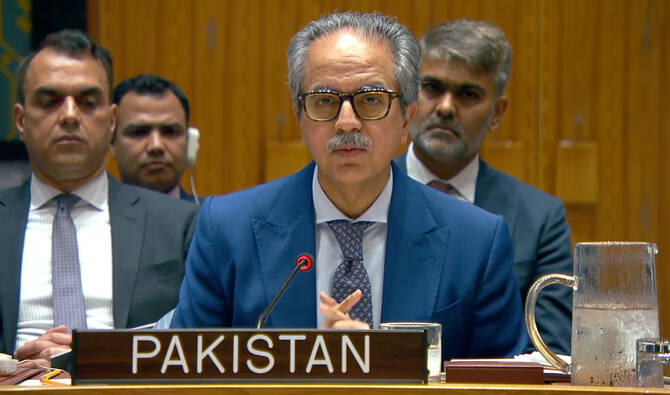

ISLAMABAD: Pakistan on Friday urged the United States and Iran to uphold their commitments under an interim peace framework during a United Nations Security Council briefing, calling on them to avoid steps that could undermine ongoing negotiations, as Prime Minister Shehbaz Sharif held a telephone conversation with Iranian President Masoud Pezeshkian to discuss the regional situation.
Pakistan’s appeal came amid renewed tensions in the Gulf region after the US launched fresh airstrikes on Iran on Thursday and Tehran responded by targeting US interests across the Middle East.
The latest escalation put the Pakistan-brokered Islamabad Memorandum of Understanding (MoU), signed last month to guide the United States and Iran toward a final agreement within 60 days, under strain.
“The Islamabad Memorandum of Understanding, signed last month, offers a viable roadmap to address all outstanding issues through diplomatic means,” Pakistan’s Permanent Representative to the UN, Ambassador Asim Iftikhar Ahmad, told the Security Council.
“Pakistan urges all sides to uphold their respective commitments under the Islamabad MOU, which remains an enduring foundation for understanding, mutual respect, and shared prosperity for the region and beyond.”
The envoy said Pakistan was encouraged by the expert-level talks held so far and the positive progress made on issues related to the implementation of the interim peace understanding, adding that Islamabad looked forward to continued constructive engagement between the parties.
“As these sensitive negotiations continue, we should avoid any actions or messaging that may contribute to misunderstanding,” Ahmad said. “All our efforts and energies should be devoted to advancing the implementation of the Islamabad MOU.”
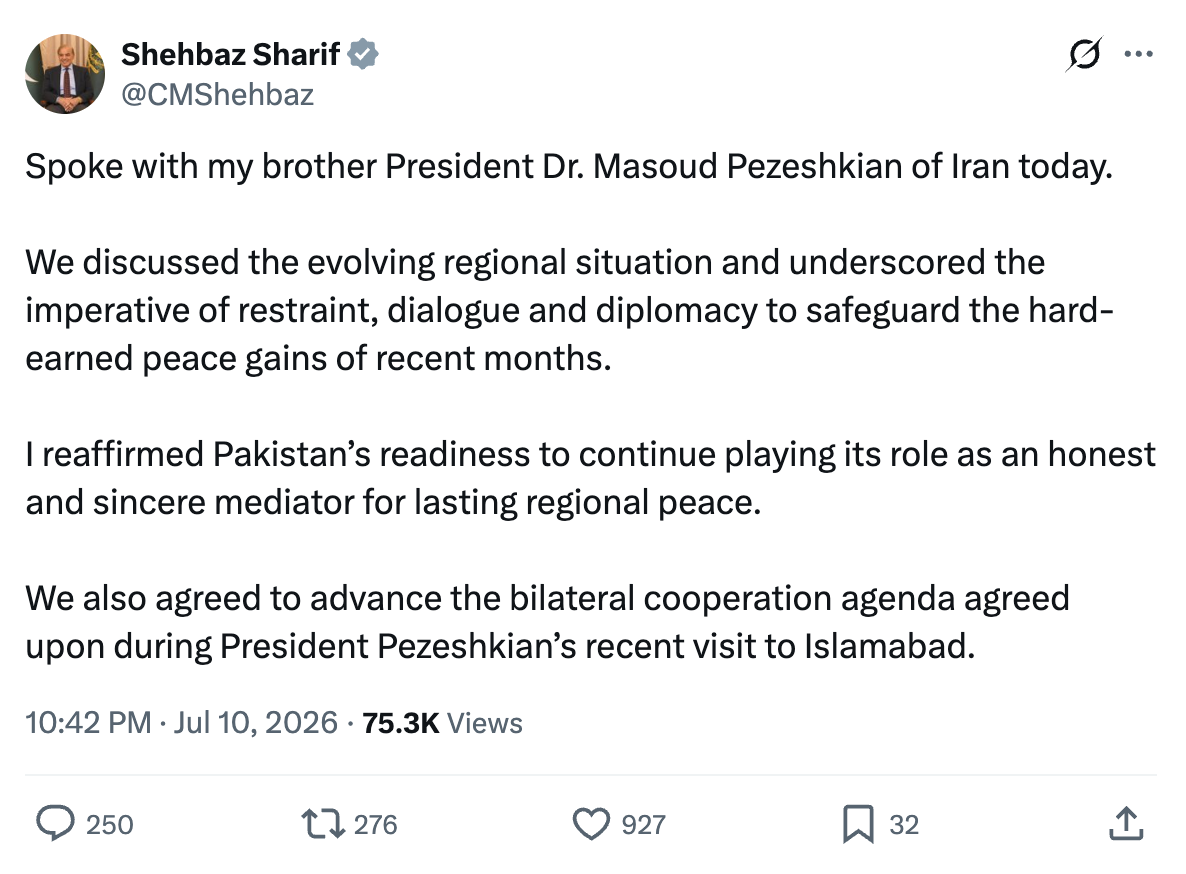
Pakistan’s Prime Minister Sharif also spoke by telephone with Iranian President Pezeshkian to discuss the recent situation following the latest hostilities.
“We discussed the evolving regional situation and underscored the imperative of restraint, dialogue and diplomacy to safeguard the hard-earned peace gains of recent months,” Sharif said in a post on X.
“I reaffirmed Pakistan’s readiness to continue playing its role as an honest and sincere mediator for lasting regional peace,” he added.
Sharif said the two leaders also agreed to advance the bilateral cooperation agenda reached during Pezeshkian’s visit to Islamabad last month.
Iranian Foreign Minister Seyed Abbas Araghchi also held a telephone conversation with Pakistan’s army chief, Field Marshal Asim Munir, on Thursday, according to Iranian state media, during which he accused Washington of failing to adhere to the Islamabad MoU.
Pakistan’s military has not publicly commented on the call.


