

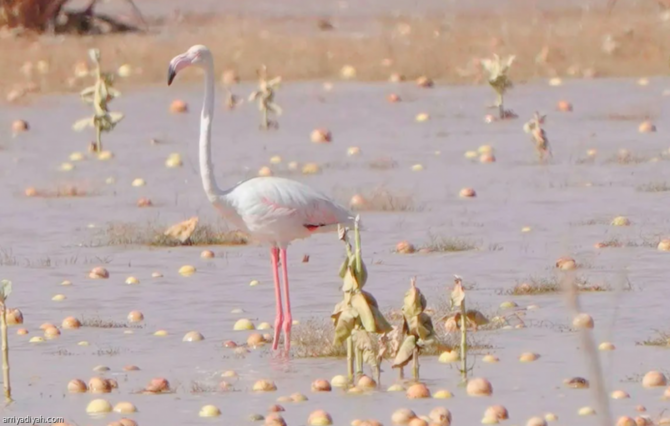

RIYADH: The King Abdulaziz Royal Reserve Development Authority has documented nine rare migratory bird species in the reserve for the first time.
In a major scientific milestone, the discoveries, which were announced this week by the authority, add significantly to ornithological records in Saudi Arabia and the Arabian Peninsula, while offering new insights into bird migration across the region.
A year-long field survey was carried out by a joint research team from the authority and King Saud University using the internationally recognized systematic point-count method, a scientific technique for monitoring bird populations.
Abdulaziz Al-Furaih, the authority’s official spokesperson, said: “The species were documented through a comprehensive field survey conducted over one year.”
The survey recorded birds from five taxonomic orders and eight families, including terrestrial birds, waterbirds and species that had strayed from their usual migration routes.
The nine species documented for the first time in the reserve were the saker falcon, long-eared owl, rosy starling, yellow-throated sparrow, black-headed bunting, slender-billed gull, Eurasian dotterel, spur-winged lapwing, and the greater flamingo.
The announcement of the species was made after the Arctic red phalarope was spotted in a rare inland sighting.
Researchers say the presence of the birds reflects the reserve’s diverse ecosystems, which provide vital stopover sites for migratory species traveling across the Arabian Peninsula.
Covering more than 28,000 sq. km, the reserve includes vegetation-rich valleys, water bodies and artificial lakes formed behind dams.
Combined with conservation measures such as restrictions on hunting and grazing, these habitats have helped restore ecosystems and improve conditions for both resident and migratory wildlife.
The findings have been published in the peer-reviewed international journal Check List, one of the leading scientific journals specializing in biodiversity and ornithological records.
It serves as an important reference for documenting rare and vagrant species while helping update global migration maps.
“It provides a scientific reference documenting bird diversity in Saudi Arabia and highlights the quality of the joint scientific efforts undertaken within the reserve,” Al-Furaih said.
The information builds on a series of environmental achievements for the reserve, including its inclusion on the International Union for Conservation of Nature’s Green List, which recognizes protected areas meeting high standards of conservation and management.
The authority said it will continue monitoring programs and scientific studies — in partnership with universities and research institutions — to document native wildlife, track migration patterns and strengthen scientific databases that support evidence-based environmental decision-making and the sustainable management of Saudi Arabia’s natural resources.


