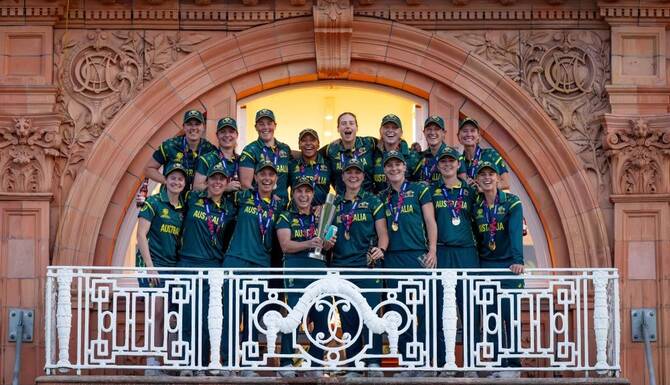

The only two unbeaten teams in the 2026 ICC Women’s T20 World Cup progressed to the final on July 5.
Australia were favorites by virtue of dominating performances in the tournament, only looking in jeopardy at 68 for three against India in their final group match, Elysse Perry coming to the rescue. England had home advantage and local support, although that was unlikely to faze the Australians. A nagging doubt about the England team was that it lacked depth by comparison.
Neither England nor Australia featured in the 2024 Women’s T20 World Cup final, the first time that had happened in nine editions. Similarly, neither were in the 2025 ODI World Cup in India, where the hosts triumphed. Australia had come into the tournament with some doubts about the fitness of its new captain, Sophie Molineux. Some observers even questioned her place, arguing that Alana King was a better leg-spin bowler.
Others were surprised that Molineux had been preferred over two established members of the team who had been interviewed for the post, suggesting that team harmony may be compromised. These potential chinks in the armor did not materialize publicly.
By the day of the final, Australia’s favorites tag was based on sound evidence. An Australian team has won six of the nine women’s T20 World Cups and has been beaten only once in a final — by the West Indies in 2016. In head-to-head matches against England since 2020, Australia lead six to three, whilst they hold a five-to-two advantage over England in the T20 World Cups, including three wins in the finals of 2012, 2014 and 2018.
Remarkably, prior to the final, they had won 26 of their 29 matches in the T20 World Cup since 2018, losing to South Africa in the 2024 semifinal and twice to India in the group stages of 2020 and 2018. Set against this record, England held an 11-to-six lead in home T20Is against Australia, including a 2-1 series win in 2023.
On the day, Australia drew first blood, winning the toss and asking England to bat on a fresh pitch. A clear indication that the Australian squad had done its homework came in the dismissal of Amy Jones. Since scoring a 50 in the opening match, she has scored only 42 in her subsequent six innings, each time caught in the offside ring. This time, on six, she edged to gully, where Georgia Voll claimed a smart, low catch.
Thereafter, England’s progress in the first six overs — the powerplay — was pedestrian, reaching 39 for two and scoring only five boundaries. The pitch was later described as slow, dry and low with even Nat Sciver-Brunt struggling to score freely on it. However, nothing should be taken away from the Australian bowlers and fielders who were in top gear, frequent field changes illustrating their attention to planning.
Sciver-Brunt anchored the innings and received late assistance from Freya Kemp, who scored 44 from 28 deliveries in an 80-run partnership which carried England to 150 for four. The general feeling was that the total was at least 20 runs light. Despite the early loss of Voll, the veracity of this soon became apparent, as Australia raced to 62 for one in the first six overs.
It was noticeable that Beth Mooney was going to meet the ball in order not to allow its slowness to get the better of her, whilst Phoebe Litchfield batted as if it was an exhibition match. A reverse sweep for six in the 11th over took her to 46 and the total to 107. She then became a little too flamboyant and, playing back, missed a straight ball that seemed to keep low, two runs short of a 50.
Mooney ploughed on reaching 50 before falling to a reviewed appeal in the 16th over. By then, the game was up and it was left to Ellyse Perry to apply the coup de grace. This was fitting, given that she has been part of all of Australia’s seven T20 women’s titles, missing only the 2020 final for which she was injured.
Perry also has two ODI World Cup winner’s medals, as well as being the first player to score 1,000 runs and take 100 wickets in women’s T20Is. It is hard to imagine that there will be a finer all-round woman cricketer than her or that there will be a career quite like hers, which is not over yet.
Amongst these achievements, it should also be remembered that she was a fine footballer who represented Australia. In 2011, she was part of Australia’s squad for the Women’s World Cup in Germany and can lay claim to be the first Australian to appear in both ICC and FIFA World Cups.
In Australia’s march to their 2026 victory at Lord’s, they did so without major contributions from established stars. Annabel Sutherland, who has a test century to her name, batted only three times, but did bowl 21 overs. Alana King played in the first four matches, bowling only eight overs, whilst Tahlia McGrath did not play at all. Nicola Carey played all seven matches but did not bat or bowl in four of them. This illustrates their all-round depth.
Strong leadership has also been a constant. The pre-tournament doubts around new captain Molineux have been firmly squashed. After the final, she was asked whether there was satisfaction at putting those doubts to bed. Her answer was an emphatic “Yes.”
She added: “I think when I took over, I was a bit messy at the start, to be fair. Captaining a couple of games and getting injured, shock. I suppose there were a few doubts internally and a few doubts externally. But I think what maybe I’ve learnt over my journey so far is that you just have to keep believing.”
In contrast, the England team and squad were, to use a football term, gutted. They had been clinically dissected by a superior opponent in front of almost 30,000 spectators at Lord’s on a glorious summer’s afternoon. They suffered openly and with raw emotion, disappointment etched on their faces.
They have to believe that they can continue to sustain the marked improvement displayed in recent months. I was fortunate to watch 22 of the 33 matches. If there is one aspect that appears to require all-round improvement, it is fielding and catching. Overall, the Australians did this best, especially in the final, revealing themselves as real athletes.
There were several record-breaking crowds. Over 245,000 fans attended the tournament, a record for an ICC Women’s T20 World Cup.
At Lord’s, members of the Afghan women’s team were present. During my interviews with two of them days before the final, captured by Arab News video, I was stopped in my tracks when I heard their broad Australian accents. This was unexpected but gained from their adopted homeland.
It is an extraordinarily impressive achievement for these women who could not speak English when they left Afghanistan in 2021 in challenging circumstances. No doubt, they were delighted by Australia’s victory.
I also asked them if they had advice for young Saudi Arabia women starting on a cricketing journey. Unequivocally, it was to be yourself and that women have the right to chase their dreams without fear. This was in abundant evidence at the T20 World Cup.