

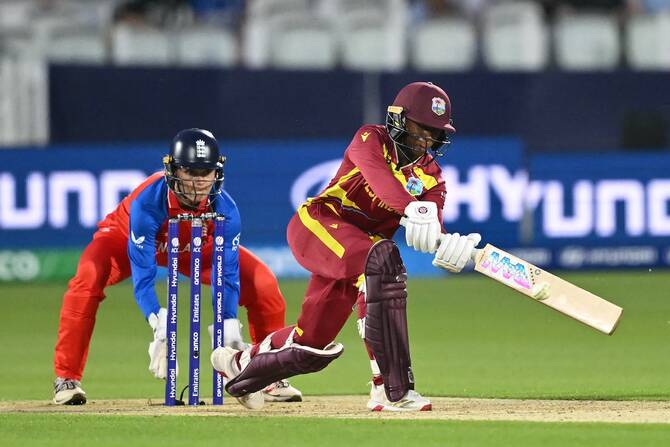

LONDON: The words of the West Indies coach, Shane Deitz, resounded during the matches that followed his team’s victory over New Zealand in the 11th match of the 2026 T20 Women’s World Cup.
Deitz felt that the gap is gradually closing between the top teams and the rest. This opinion was supported in subsequent press interviews with players and coaches, especially in terms of any team in this tournament being capable of beating any other team on its day.
In the West Indies’ very next match against Scotland, they were on the brink of being beaten by a team ranked five places below them. Struggling in the 15th over on 85 for 5, the team was rescued by Stafanie Taylor, now aged 35. She made her West Indies debut in 2008, going on to open the batting and be captain in a distinguished career of almost 300 international appearances. Recently, she has been slowed by injury but, rolling back the years, she smote 47 from 19 deliveries, including three sixes, to raise a total of 153 for six.
Scotland’s chase started strongly, reaching 51 in the first five overs. Hayley Matthews then struck twice in the sixth over of the chase and again in the eighth to stop the Scottish innings in its tracks at 58 for four. Darcey Carter led a fightback to push the score to 132 after 18 overs, leaving 22 runs to be scored from 12 deliveries. Scotland’s hopes were all but crushed in the next over. Aaliyah Alleyne claimed Carter’s wicket and then two more, which meant that 17 runs were required from the final over, with only two wickets remaining.
This proved to be too much, the innings closing on 148 all out. The greater experience of the West Indies proved decisive at critical moments.
New Zealand’s team arrived in Southampton having lost its first two matches and needing to beat Ireland to avoid elimination. Whether it was nerves, pressure or the adoption of an aggressive strategy, the beginning of the innings was calamitous, bordering on reckless. Three wickets were gifted for only 14 runs. A steady recovery was built by the captain, Amelia Kerr, Brooke Halliday and Izzy Sharp, who all made scores in the thirties, before Suzie Bates scored 19 from 12 deliveries. This included a last ball six, taking the total to 140.
Gaby Lewis and Orla Prendergast took the game to New Zealand in a marvellous second-wicket partnership of 110, reaching 116 midway through the 18th over, 23 runs required from 15 deliveries. Then, Prendergast tried to clear the boundary, only to be superbly caught. In the following over, Lewis was well caught by Suzie Bates, who was then called upon to bowl the final over, with Ireland needing 15 runs for victory. Bates used all her experience in restricting the batters to 10 runs, victory achieved by six runs, the same number as she scored off the final ball of the New Zealand innings. Ireland was on the verge of history, one six away from a first T20 World Cup victory that would have eliminated the reigning champions.
The result eliminated Ireland and allowed New Zealand to stay alive, which had seemed unlikely at times during the match. New Zealand’s next match was against Scotland in Bristol, where Scotland were invited to bat. Darcey Carter led the way, racing to 41 in an opening partnership of 51 in the first seven overs. After 14 overs, Carter was still there with 54 out of 96 but visibly slowing down in the scorching heat. In the last six overs, Scotland scored only 33 runs, totalling 131 for 7 wickets.
Their bowlers then gave renewed hope, claiming three wickets for 26 runs in the first five overs, putting the game in the balance. Brooke Halliday used her experience to rebuild the innings with 21-year-old Izzy Sharp, who was making only her fifth T20I appearance. The pair carried the score to 83 in 14 overs, before accelerating the scoring rate to achieve victory with eight deliveries to spare.
Scotland and Ireland played their way into promising situations but failed to close them out, most notably Ireland against the West Indies. It was clear from comments made by Orla Prendergast to the media that the young team is still rueing that failure. A lack of experience at critical moments frequently cited to explain the failure. Only by playing the top teams can that experience be gained. The opportunities to do so outside of World Cups is limited, as are the opportunities to be selected for franchise cricket.
Sri Lanka’s captain, Chamari Athapaththu, made the same point about her young team. She has played in 10 T20 World Cups, five as captain, and emotionally stated that she regards herself as a failure as a captain because Sri Lanka has never reached a T20 World Cup semi-final.
After victory against Ireland, a slim mathematical chance remains. Ireland batted first, losing two wickets for three runs. The captain, Gaby Lewis, marshalled the rest of the innings with 59. A target of 131 was no problem for Athapaththu, who powered her way to an unbeaten 106 from 61 deliveries. Afterwards, she said that she has had the opportunity to play all around the world in international and franchise cricket, learning from other top players and in-match challenges. She worries that the young Sri Lankans may not get the same opportunities and experiences.
Elsewhere in the 10 matches between Match 12 and Match 22, Australia won all four of its games in emphatic style, thrashing the Netherlands and Pakistan by 98 runs and 113 runs, respectively. The Netherlands were delighted at their performance with the bat, in which Babette de Leede and Sterre Kalis shared a third-wicket partnership of 96 which raised the noise levels among their enthusiastic supporters. Pakistan, on the other hand, endured a dismal tournament, losing four matches.
Against Bangladesh they needed 124 runs for victory, having let their opponents off the hook at 13 for three. Pakistan reached 58 for one in nine overs, but in the next nine overs, seven wickets fell in a panicked display of wild shots and poor decisions. A scarcely believable final score of 84 for eight was posted. The main architect of this downfall was Nahida Akter. Afterwards, Pakistan’s coach was bemused. He said that they talk about handling pressure as a group and individually, but had no explanation for the collapse.
Australia is almost certain to claim a semi-final spot from Group A. South Africa, Marizanne Kapp in particular, rediscovered form to beat India by six wickets. One of these two teams is likely to claim the other semi-final spot, unless Bangladesh causes a major upset. India’s final group match is against Australia. In Group B, England beat the West Indies by 38 runs to secure a semi-final place. If the West Indies beat Ireland, they will also make the semi-finals.
Although there have not been any major upsets, the tournament has shown how competitive the expanded event has become, with potential upsets only narrowly avoided. There is a common view that the gap between full members and associate nations is shrinking. Independently from Deitz, Amelia Kerr said that “there’s no reason why any team can’t beat anyone.” This does look to be the case but is yet to be seen on a regular basis.


