


LONDON: France has returned 23 Syrian archaeological artifacts that had been in Paris since before the outbreak of the civil war in Syria, handing them back during President Emmanuel Macron’s recent visit to Damascus.
The move has been welcomed as a sign of renewed ties and respect for Syria’s cultural heritage, but it has also reopened questions about why the objects were not returned years ago and whether they can be protected.
The artifacts were taken to Syria aboard the French presidential aircraft after being held as part of an exhibition of Syrian antiquities at the Arab World Institute in Paris, Syria’s Foreign Ministry said on Tuesday.
The objects were loaned in 2010, during the rule of now-deposed President Bashar Assad, from museums in Damascus, Aleppo, Latakia and Palmyra. They were due to be returned in 2014, but stayed in France after diplomatic relations between Paris and Damascus were severed after the start of the war in March 2011.
For some observers, the handover amounts to a diplomatic gesture signaling a reset in French-Syrian relations. For others, it is simply an overdue correction.
Loujein Haj Youssef, a Paris-based Syrian journalist, told Arab News that France “has decided to rebuild ties with countries on the basis of respect for history and shared memory.”
She described the repatriation as a “gesture of goodwill” that shows “relations with Syria should be kept apart from the old colonial past.”
Syria was under a French mandate from the early 1920s until 1946, a period widely regarded in the region as a form of colonial rule because France exercised direct political and military control while claiming to prepare the territory for self-government.

Archaeological artifacts were on loan from museums in Damascus, Aleppo, Latakia and Palmyra. (SANA)
Madison Leeson, an Amman-based researcher focused on cultural heritage crime, also welcomed the return, calling it “a victory for Syria to get these back where they belong.”
She said she hoped it would be “the first of many repatriations.”
“Macron is a strong supporter of restitution, so it’s no big surprise that France is the first to return Syrian antiquities,” Leeson told Arab News.
Haj Youssef said the restitution “is in line with the decision of the French state,” referring to a French law passed in May on the return of cultural artifacts looted during colonial rule.
The law followed a pledge Macron made to African countries in 2017, at the start of his first term, as part of what he described as a “new chapter” in relations between France and countries formerly under colonial rule, Le Monde reported in May.

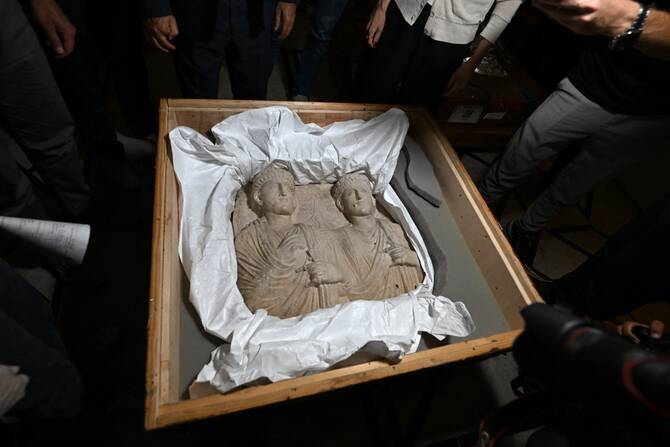
The returned Syrian objects include artifacts covering the Mesopotamian, Canaanite, Nabataean, Palmyrene, Roman, Byzantine and Umayyad civilizations, according to the Elysee Palace. (AFP photo)
Still, the Syrian case differs in one important respect. The 23 artifacts were not looted during colonial rule; they were loaned to the Arab World Institute in Paris and were supposed to be returned in 2014, according to Syria’s Directorate-General of Antiquities and Museums, or DGAM. But with Syrian-French relations suspended during the war and strict US-EU sanctions imposed on Syria, the objects stayed in France.
Maamoun Abdulkarim, Syria’s former director-general of antiquities and museums, said the artifacts belonged to the Syrian people regardless of who governed the country and could have been returned through mediation.
“What is particularly unfortunate is that recent events have overshadowed what actually took place over the past years: the refusal of the Arab World Institute to return archaeological artifacts that had been loaned under a formally signed agreement with the Directorate-General of Antiquities and Museums,” Abdulkarim told Arab News.
“These artifacts belong to the Syrian people, not to any political regime,” he said.
He said that after the loan period expired in 2014, the DGAM made “continuous and sustained efforts to recover these artifacts through official correspondence and every available channel.
“However, all requests were either rejected or left unanswered, on the grounds that sanctions imposed on the Syrian regime prevented communication with Syrian state institutions.”
Abdulkarim noted that even mediation through UNESCO was rejected. “The Arab World Institute even declined UNESCO’s willingness to mediate the return of the artifacts,” he said.
In his view, framing the return as a diplomatic gesture obscures a more basic point.
“Today, these artifacts are being returned as though they were a gift or a political gesture, when in reality they are Syrian cultural property that should have been returned years ago in accordance with the signed loan agreement, irrespective of political considerations,” he said.
“It is regrettable that cultural heritage — an asset that should remain part of humanity’s shared legacy — has instead been treated as a bargaining tool in political affairs.”

Officials look at a mosaic piece from the Umayyad Mosque dating back to the 8th century AD, during the process of the opening the crates of artifacts recovered from France at the National Museum in Damascus. (AFP photo)
Abdulkarim also noted that the artifacts remained in France for more than a year after Assad’s fall on Dec. 8, 2024, and after interim President Ahmad Al-Sharaa, who led the rebel offensive that toppled Assad, took office in January 2025.
“This also raises a legitimate question: if the previous justification for withholding the artifacts was the existence of the former regime, why were they not returned during the 20 months following its fall?” Abdulkarim asked.
“I can personally attest to the immense pressure that the DGAM faced during that period,” he added.
“We were subjected to investigations and intense pressure from the Presidential Palace under the former regime, where we were repeatedly asked why we had failed to recover the artifacts.”
He said the directorate’s record of repeated requests for the artifacts’ return may have shielded staff from various accusations.
“Had the directorate not retained the official correspondence documenting its repeated requests for their return — and the absence of any response from the French side — many of us could have faced serious consequences after being accused of negligence,” Abdulkarim said.

Officials inspect a Palmyrene funerary scene from the 2nd–3rd century A.D. as crates of artifacts returned from France are opened at the National Museum in Damascus. (AFP photo)
Yet the debate does not end with the artifacts’ return. For Haj Youssef, the more urgent question now is whether Syria can keep them safe.
She said the biggest challenge is to “ensure that the returned artifacts are not stolen.”
Referring to the theft last November of six Roman-era marble statues from Syria’s National Museum in Damascus, she said: “To date, no transparent public account has been given of the stolen pieces’ fate.
“In other words, good initiatives need a proper framework to support them in order to be effective.”
The theft took place overnight on Nov. 12, prompting Syrian authorities to take steps to strengthen protection and monitoring systems. UNESCO condemned the theft as an attack on Syria’s cultural heritage and history.
Haj Youssef’s concern reflects the broader devastation Syria’s cultural heritage has endured. All six of Syria’s UNESCO World Heritage sites suffered heavy losses during the 14-year war, and the country continues to face major challenges during its fragile transitional period.


