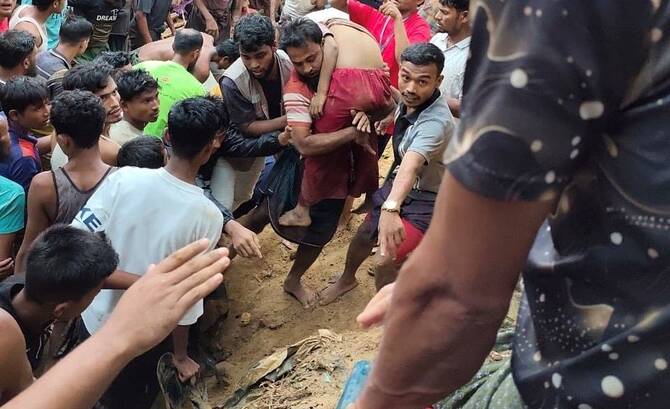

DHAKA: At least 18 Rohingya, most of them children, were killed by landslides triggered by record rainfall in Cox’s Bazar, local authorities said on Wednesday, as conditions in refugee camps are deteriorating amid decreasing humanitarian support.
About 1.3 million Rohingya shelter in 33 camps in the coastal district of southeastern Bangladesh, turning it into the world’s largest refugee settlement. It is also one of the most climate-vulnerable ones.
The Chattogram region, of which Cox’s Bazar is a part, recorded on Tuesday the highest rainfall in the last four decades — over 412 millimeters in 24 hours — according to Bangladesh’s met office data.
In the camp area, the ground is waterlogged and hillsides unstable, resulting in more than 200 landslides and flash floods, which since Monday have destroyed thousands of shelters and infrastructure, especially in the hilly camps of Ukhiya and Teknaf.
At least eight children were killed on Wednesday alone when a landslide struck a mosque and madrassa in Ukhiya.
“A retaining wall collapsed due to heavy rainfall. We heard that a teacher was also among the casualties. Rescue operations are underway,” Sanwar Hossain, senior assistant secretary at the Refugee, Relief and Repatriation Commission in Cox’s Bazar, told Arab News.
While heavy rains occur every year during the monsoon season, the situation has been worsening as climate change makes extreme weather events more frequent.
“It has been raining incessantly, and experts say the amount of rainfall is the highest recorded in the last 43 years,” Hossain said.
“In some parts of the camps, conducting rescue operations is also difficult as many roads are submerged by rainwater. Compared with last year, the situation is worse, as the number of fatalities is higher. It is a worrisome situation.”
Most of the homes and infrastructure in Rohingya camps are built from bamboo, tarpaulin and corrugated metal sheets, which are vulnerable to heavy rain, landslides and strong winds.
“There are many slopes inside the camps. So, due to heavy downpours, the area becomes prone to landslides. Previously, this hilly area was part of a forest. To accommodate the Rohingya, there was extensive deforestation, which eventually made the land more prone to landslides,” Hossain said.
While more than 20,000 Rohingya have as of Wednesday been relocated from landslide-prone areas, the UN refugee agency warns it is facing “operational constraints posed by severe camp congestion” and the urgent need for increased funding under the 2026 Joint Response Plan.
The UNHCR’s funding for shelter and risk management in Rohingya camps is only 40 percent covered.
“Immediate funding is essential to scale up emergency slope stabilization, drainage and watershed management, access improvements, and specialized technical capacity to protect lives, reduce disaster risks, and sustain humanitarian access,” it said.
A mostly Muslim ethnic minority, the Rohingya have lived for centuries in Myanmar’s western Rakhine state but were stripped of their citizenship in the 1980s and have faced systemic persecution ever since.
In 2017 alone, some 750,000 of them fled military atrocities and crossed to Bangladesh, in what the UN has been referring to as a textbook case of ethnic cleansing by Myanmar.