UNITED NATIONS: Saudi Arabia reaffirmed its position as one of the largest donors to the UN Relief and Works Agency for Palestine Refugees in the Near East, revealing that it has provided $835 million in development and humanitarian assistance through the agency over the years.
It came as member states gathered at the UN General Assembly on Tuesday at a pledging conference for voluntary contributions to UNRWA.
In his address to the gathering, which offered the international community an opportunity to align political commitments with predictable financing to help keep the agency operational, UN Secretary-General Antonio Guterres urged countries to provide immediate financial support, amid warnings that severe funding shortfalls were threatening humanitarian operations and regional stability.
The agency continues to play an essential role in efforts to improve humanitarian conditions and provide food, health and education services across the region, particularly in Gaza.
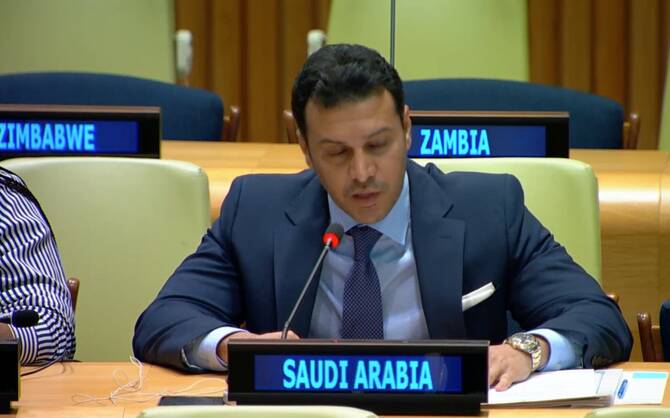
Waleed Mamdouh M. Mosly, first secretary and head of the Fourth Committee and Organizations at the Saudi mission to the UN, said the Kingdom’s support for UNRWA reflected its commitment to the Palestinian question and efforts to preserve the dignity of Palestinian refugees.
The Saudi Development Fund has separately contributed $13.9 million for the agency’s education, health care and relief programs, he added. Riyadh is also preparing new UNRWA-implemented projects, the plans for which were drawn up in February with an estimated cost of $20 million, covering key sectors in Gaza, Syria and Jordan to help the agency meet the growing needs of Palestinian refugees, Mosly said.
He noted that UNRWA had been the target of political attacks, despite serving as a lifeline for Palestinian refugees, and warned that such campaigns target not only the agency itself but also, in violation of international law, the very core of the Palestinian question and the right of refugees to return.
He stressed that the agency cannot be replaced and urged the international community to take urgent action to close a funding gap that threatens its ability to fulfill its mandate.
Mosly also called for an end to the Israeli occupation of Palestinian territories, and endorsed a statement delivered on behalf of the Gulf Cooperation Council by Bahrain’s ambassador, Nancy Abdulla Jamal.
Speaking on behalf of the UAE, Saudi Arabia, Oman, Qatar, Kuwait and Bahrain, Jamal cited the harsh conditions in Gaza, including overcrowding and poor health conditions, as well as settler violence in the West Bank and the volatile humanitarian situation in Lebanon, as she called for the immediate removal of obstacles to humanitarian and medical aid.
She welcomed a General Assembly resolution in December that renewed UNRWA’s mandate, as well as the International Court of Justice’s advisory opinion in October detailing Israel’s legal obligations as the occupying power in Palestinian territories. She underscored the link between
UNRWA’s mandate and the right of Palestinians to self-determination, including the inviolability of agency premises in the occupied territories.
The GCC also expressed its support for the Comprehensive Plan to End the Gaza Conflict, presented by President Trump and endorsed in November by the Security Council through Resolution 2803, and said progress in Gaza and reform of the Palestinian Authority could enable Palestinians to achieve self-determination and statehood.
Jamal reiterated the GCC’s support for a two-state solution that would establish an independent, sovereign Palestinian state, based on 1967 borders with East Jerusalem as its capital, in line with the Arab Peace Initiative and international resolutions.


![]()

Saudi Arabia reaffirms status as a top UNRWA donor, warns funding gap threatens agency’s mandate
Short Url
https://arab.news/re7kx
Saudi Arabia reaffirms status as a top UNRWA donor, warns funding gap threatens agency’s mandate
- Kingdom provides $835m in development and humanitarian assistance to UN Relief and Works Agency for Palestine Refugees over the years
- Saudi Development Fund backs $13.9m of agency programs, Riyadh providing $20m for projects in Gaza, Syria and Jordan to meet growing needs of Palestinians


Latest updates


© 2026 SAUDI RESEARCH & PUBLISHING COMPANY, All Rights Reserved And subject to Terms of Use Agreement.