
DUBAI: UNRWA is warning it may soon be forced to scale back essential services in Gaza and the West Bank as a deepening funding crisis threatens the future of the UN agency relied on by millions of Palestinian refugees.
The director of UNRWA Affairs in the West Bank, Roland Friedrich, told Arab News if the agency is unable to continue its operations, it will have a direct impact on the people they serve and the stability in the region.
Established in 1949, UNRWA provides education, healthcare and humanitarian relief to nearly six million registered Palestinian refugees in Gaza, the West Bank, Lebanon, Syria and Jordan. Amid growing Israeli restrictions on the agency’s operations, UNRWA officials say that its ability to continue delivering basic services is now under unprecedented threat.
Currently, in Gaza, UNRWA provides shelter to more than 90,000 displaced people and provides services to 940,000 registered Palestinian refugees in the occupied West Bank.
“UNRWA is the only UN agency that directly provides services to beneficiaries. Our mandate is to provide services to registered Palestine refugees … we work in five different areas, the West Bank including East Jerusalem, Gaza, Syria, Lebanon, and Jordan,” Friedrich said.
The agency focuses on five main services, Friedrich said, which are education, health, infrastructure, finance and in severe crises, humanitarian aid.
“If we face a severe humanitarian crisis like the war in the Gaza Strip from October 2023, or also, for, the situation in Syria and now in Lebanon, we also provide direct lifesaving humanitarian aid. We do developmental work and we do lifesaving humanitarian work at the same time,” he said.
“Violence by Israeli settlers in the #WestBank continues unabated.
The fact that large groups of settlers storm Palestinian communities, brutalise residents and torch buildings is an outrage in itself.
But what is worse is that these egregious acts are accompanied by total… pic.twitter.com/IlkVLkAbRe
— UNRWA (@UNRWA) March 25, 2026
UNRWA is facing a funding crisis after the Israeli government took measures to limit the agency’s function in the region.
“Since the 7th of October there has been a systematic campaign of delegitimization based on unproven accusations,” Friedrich said. “In early 2024, we received the allegations that 19 of our then 13,000 staff in Gaza would have participated in the Hamas strike of 7th October, without any evidence,” he said,
“A UN-level investigation was then launched and investigators came to the conclusion that if they had been given access to appropriate information and if the information had been authenticated, which (it) was not, then there is a strong likelihood that nine people would have participated in the attack,” Friedrich said.
The director said any alleged participant was fired before the results of the investigation came out, but the damage these claims caused resulted in losing a large number of donors who UNRWA relied on to continue its operations.
“A lot of our donors basically came back, except for the United States. It was clear that there is a commitment by the agency to deal with these accusations. All donors who said two years ago they would stop funding, came back. We’re committed to implementing that plan and of course it’s also true that we work in very difficult circumstances,” he added.
Friedrich said about 20 percent of UNRWA operations in the West Bank now are related to direct life-saving humanitarian aid for internally displaced people.
“A lot of what we do is under more difficult conditions because of Israeli policies, because of the financial situation, because of movement and access restriction,” he added.
Due to a deficit in funding, Friedrich said the agency has reduced to a 30-hour service week in all five of their operational fields.
“We are still trying to keep schools operating for five days because education is absolutely essential and because, particularly in the West Bank, the learning loss for children for the last five years has been so high, so we have to really give them priority,” he said.
However, this comes at a cost. Friedrich said for them to continue providing education for five days a week in the West Bank, UNRWA staff are not getting paid full salaries.
“90 per cent of our staff only get 80 per cent of their salary. It was a painful decision but we had to do it because otherwise we cannot keep operating. We call upon donors to honor their commitments … not just in the interest of the people we serve, but also in the interest of stability in the region,” he said.
But the obstacles do not end there.
In October 2024, the Israeli Knesset passed legislation to ban UNRWA from operating in occupied East Jerusalem and the Palestinian territories.
“The Israeli parliament issued two laws a bit more than a year and a half ago. Both laws are in violation of international law. One of them is a ban on UNRWA activity within the sovereign territory of the state of Israel, which from Israel’s perspective includes occupied East Jerusalem.
“UNRWA work was banned in Eastern Jerusalem and the work in the West Bank and Gaza strip was made more difficult by a no-contact policy under which Israeli authorities cannot speak to UNRWA,” Friedrich explained.
Friedrich said the agency took a decision, on principle, to continue operating for as long as possible because, he said, they have a duty to serve the people in the area and they kept the schools and health centers open in East Jerusalem for as long as they could.
When my colleagues and I were forced to evacuate our compound in #EastJerusalem in January this year due to the entry into force of Israel’s anti-UNRWA laws, it was with an unwavering commitment to our mandate and to continuing @UNRWA’s work in the #WestBank. Making good on this… pic.twitter.com/QFuEeWWyEK
— Roland Friedrich (@GRFriedrich) December 22, 2025
“Israeli authorities in a severe violation of international law, forcefully closed our six schools in East Jerusalem, forced the children and students to leave at gunpoint, cut water and electricity from the two health centers … Let’s be very clear here. This is a severe violation of international law.
“The schools, the headquarters, the clinics, they have diplomatic protection, they enjoy privileges and immunities. And it’s unprecedented in my knowledge that a member state of the United Nations in peace time systematically and on purpose destroys diplomatic protected UN sites,” he added.
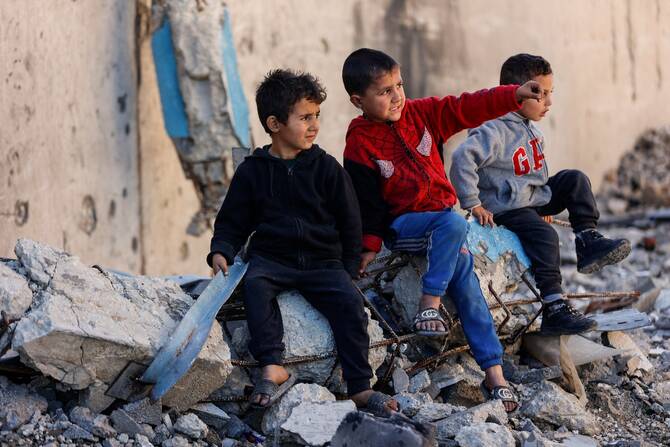
As for Gaza, the agency is no longer able to deliver aid packages to the war-torn communities living among the rubble of Gaza.
“We still have almost 3,000 truckloads of aid in Ashdod, Al-Arish, and in Jordan that we cannot bring in as UNRWA because Israel does not allow it. It’s unacceptable. We have to work with other organizations to try to get that aid to the people who need it badly in Gaza,” he said.
After October 2023, Friedrich said UNRWA operations in Gaza completely shifted to life-saving humanitarian aid following Israel's military campaign.
In the Gaza Strip before the war we had 300,000 children in schools and more than 200 school buildings, probably half of the school buildings in Gaza were destroyed, primarily by the Israeli military,” he said.
“The schools that we still have in Gaza are shelters. All our schools in Gaza that we operate, they’re all shelters where people live. That means when we now teach children, we basically ask the family staying in the shelter to leave during the day for a couple of hours. We bring in some tables, we bring in chairs, we bring in a blackboard, teach the children from that shelter for two or three hours and then they’ll leave and the families come back for the night. This is not normal education,” he added.
In the #Gaza Strip, access to learning remains critical.
UNRWA supports nearly 60,000 children across shelters and over 280,000 children through digital platforms, to continue their learning in the most challenging conditions.#UNRWAworks to support children and their futures. pic.twitter.com/5k5fa2fO3d
— UNRWA (@UNRWA) April 2, 2026
“In Gaza overall more than 600,000 children have not had access to proper education for more than two years, which is a catastrophe … We hope that the ceasefire in Gaza holds, that things further stabilize and what we will concentrate on going forward is particularly education and health and social services,” he said.
With financial challenges and restrictions from the Israeli government, UNRWA’s former head of the UN Palestinian refugee agency, Philippe Lazzarini, said operations may no longer be viable.
“I must inform you that UNRWA may soon no longer be viable, with potentially far-reaching consequences for Palestine refugees at a time when the region faces seismic political and security challenges,” Lazzarini said in a letter to the president of the UN General Assembly dated Mar. 17.
Lazzarini said in the letter that UNRWA’s work was vital for implementing the Gaza peace plan and that Israel would have to assume responsibility for Palestinians in the occupied territories if UN states did not urgently provide political and financial support.
However, if the agency is no longer operating in Gaza and the West Bank, Friedrich said UNHCR will claim the responsibilities of UNRWA.
“Under international law, if UNRWA cannot continue, then the responsibility goes to UNHCR. The difference is that the UN has a mandate to resettle refugees. UNHCR has a mandate to resettle or naturalize refugees,” he said.
Friedrich said that this would affect the region and hinder years of peace negotiations between states.
“That would have huge political implications. We do see now a strategy by the government of Israel to unilaterally impose, or try to unilaterally impose, a ‘solution for the refugee issue.’ The refugee issue is the most difficult, most emotional question of the Israeli-Palestinian conflict and affects the Israeli-Arab conflict,” Friedrich said.
“If UNHCR is asked to take over UNRWA’s role, it would mean that the pressure will grow on the host countries to nationalize and or resettle Palestinian refugees. That is politically not in line with what decades of peace negotiations have seen as the objective, meaning a viable and sovereign Palestinian state living in peace and security with the state of Israel, including a just and fair solution to the refugee issue,” he added.
Friedrich said after the US Israeli attack on Iran in February, the situation escalated severely in the West Bank.
“We have had seven Palestinians murdered by settlers since the 28th of February. This has never happened in the West Bank, that high number. In particular in such a short time span. This is a very dangerous development. This is not how you build peace,” he added.
Israeli military offenses intensified in southern Lebanon and Beirut with clear intention to displace people, Friedrich said.
“Almost a million people were displaced from southern Lebanon. We also see systematic destruction of villages similar to what we saw in the Gaza Strip and what we also see in the northern West Bank in our camps.
“That clearly suggests that the intent is not to let people return. So again, this is forced displacement. This is a great violation of the Geneva conventions,” he added.
The escalation of conflict has affected millions of people in #Lebanon.
On his first day of his tenure, @CFSaundersUN witnessed first-hand how #UNRWAworks in one of its emergency shelters.
UNRWA launched its emergency response a month ago, to help thousands of people who have… pic.twitter.com/4wQotAEz4W
— UNRWA (@UNRWA) April 3, 2026
“Current UNRWA operations in Lebanon have shifted toward emergency support services with a number of shelters opening in UNRWA schools in the north and the center of the country.
“Schools and health centers are open depending on the security situation, and we’re ready to do more, but it is a very difficult situation. There are grave concerns about the future of Lebanon as a country, particularly if the situation escalates further in the coming weeks,” he added.
The former head of the UN Palestinian refugee agency, Lazzarini, was appointed by UN chief Antonio Guterres, and will be temporarily replaced by Britain’s Christian Saunders, currently a UN special coordinator, from April 1 until further notice, a UNRWA spokesperson said.