

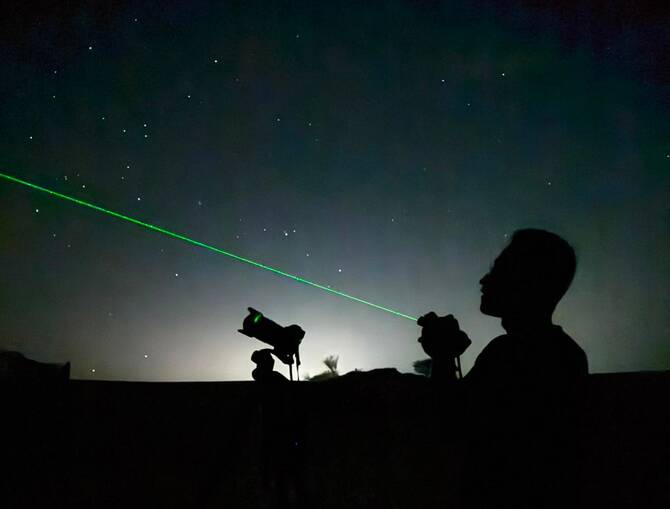

JEDDAH: As light pollution increasingly obscures the night sky across much of the world, Saudi Arabia’s Red Sea destination is taking an unusual approach to luxury tourism: preserving darkness.
Red Sea Global has introduced a destination-wide dark-sky strategy aimed at protecting pristine night skies, supporting biodiversity and creating a new benchmark for sustainable tourism. The initiative spans resorts, infrastructure and public spaces, with the developer seeking international dark-sky recognition not only for the destination as a whole but also for individual resorts — an approach sustainability experts say would be a world first.
Lola Okunrinboye, sustainability director at Six Senses Southern Dunes, said most dark-sky certifications are awarded at the destination level.

Lola Okunrinboye, Sustainability Director at Six Senses Southern Dunes. (SUPPLIED)
“The goal is for properties such as Six Senses Southern Dunes and Desert Rock to receive their own certifications. To our knowledge, no destination elsewhere in the world has pursued certification at the resort level in this way. That is what makes the initiative particularly innovative.”
The project reflects a broader vision for tourism development along Saudi Arabia’s Red Sea coast, where preserving natural darkness has been embedded in planning from the earliest stages of design and construction.
Situated on the Kingdom’s northwestern coast, the Red Sea offers favorable astronomical viewing conditions for much of the year, including clear weather, low cloud cover and stable temperatures. But for Red Sea Global, dark skies are about far more than stargazing.
Ahmed Althaher, senior manager of Astrotourism at Red Sea Global, said the strategy is designed to protect the nocturnal environment while ensuring that architecture, infrastructure and guest experiences remain in harmony with the surrounding landscape.
“Dark-sky principles are applied at a destination level through planning guidelines, design reviews, and operational controls, so the same philosophy extends beyond guestrooms to pathways, arrival areas, amenities, and infrastructure.”
Rather than adding lighting and reducing it later, Althaher said the resorts begin with darkness and introduce illumination only where it is essential.
FASTFACT
Did you know?
- The Red Sea aims to become the first destination to obtain dark-sky certification for individual resorts.
- Dark-sky measures were integrated into the resorts’ design, including downward-facing, low-intensity lighting.
- Dark-sky protection supports astronomy, cultural heritage, responsible tourism and lower energy consumption.
“The reduction is managed through careful zoning, lower-impact lighting locations, and operational controls such as dimming, scheduling, and scene setting, rather than simply counting fewer fixtures.”
The approach incorporates shielded, downward-directed lighting, concealed fixtures, lower mounting heights, warmer color temperatures and intelligent controls.
“The ambition is to make the light feel integrated into the architecture and landscape, rather than visually dominant, while still maintaining comfort, legibility, and safety.”
That philosophy is reflected throughout the destination. At Desert Rock, buildings are embedded within the mountains to minimize their visual footprint, while lighting is carefully managed to reduce intrusion. At Shebara, architectural design allows structures to blend into the surrounding sea and sky, limiting their impact on the horizon.
For guests accustomed to brightly lit cities and resorts, the experience can be strikingly different.
Thomas Combescot-Lepere, general manager of Desert Rock, said the lighting strategy also plays a vital role in protecting wildlife.

Abdulrahman Rajeh, an astronomy guide at Red Sea Global destinations explaining about stars during a star gazing session in one of RSG destinations. (AN photo: Nada Hameed)
“Animals do not behave naturally when exposed to excessive artificial light. Even the lights you may have noticed on the mountains have been carefully designed. We chose red lighting because it is considered one of the least disruptive and most calming colors for wildlife.”
He said many visitors quickly come to appreciate the difference once they experience the night sky.
“Personally, I had to wait 46 years of my life before seeing a sky filled with stars like this, and I think that makes the experience truly unique. We are very proud of what has been achieved here.”
The emphasis on darkness is closely tied to the destination’s wider conservation strategy. Artificial lighting can disrupt the natural behavior of nocturnal species, affecting insects, mammals and migratory birds that depend on darkness to feed, reproduce and navigate.
“To us, conservation is the basic standard that every developer should uphold. We believe in going beyond just minimizing harm; we are committed to regenerative tourism, which means actively improving the environment, ensuring it is better off than when we started. Our most important indicator, the one by which we measure our true success, is our commitment to achieving a 30 percent net conservation benefit by 2040.”
Althaher said the commitment is already being translated into tangible environmental projects.
“In practice, we’ve grown 3 million mangroves in our nursery and our now transplanting these across The Red Sea to enhance mangrove density. Additionally, we have created 20 acres of new wetlands that treat 8,000 cubic meters of effluent daily, which is then used to irrigate our landscape nursery. While this was created for a very practical reason, these wetlands are now regularly attracting wildlife including Barn Swallows, Blue Rock Thrushes and Black Winged Kites. Every aspect of our operations is designed not just to minimize our environmental footprint, but also to give back to the ecosystem in a positive way.”

Beyond conservation, the initiative is helping establish the Red Sea as a destination for astrotourism — a fast-growing niche that combines astronomy, education and travel.
Long before modern navigation systems, travelers crossed Arabia using the stars as their guide. Today, that connection to the night sky is being revived through guided astronomical experiences at Desert Rock, where specialists explain celestial objects, their cultural significance and their role in Arabian history.
Among them is Abdulrahman Rajeh, an astronomy guide at Red Sea Global destinations who studied astrophysics at King Abdulaziz University.
“A Dark Sky area is an area where night sky quality is distinguished by its clear visibility and protection from light pollution, allowing stars, planets, and the Milky Way to be comfortably seen. These locations are ideal for leisure stargazing, astrophotography, and experiencing the natural night sky. The main purpose of these areas is to restore the natural view of pristine dark skies and regenerate the cultural heritage connected to our sky.”
He added: “A Dark Sky place is designated by meeting several requirements, including low levels of light pollution, responsible outdoor lighting, environmental protection efforts, and public awareness about preserving the night sky.”
The initiative forms part of Red Sea Global's broader sustainability agenda. Earlier this year, the developer announced that five resorts on Shura Island achieved LEED Platinum certification, bringing the destination's total to 10 LEED Platinum-certified hotels and resorts — the largest portfolio of LEED Platinum-certified hospitality properties held by any developer worldwide.
Ultimately, the project's ambition extends beyond giving visitors spectacular views of the Milky Way. It seeks to demonstrate that luxury tourism, environmental stewardship and cultural heritage can coexist — preserving the same star-filled skies that once guided travelers across Arabia for generations to come.


