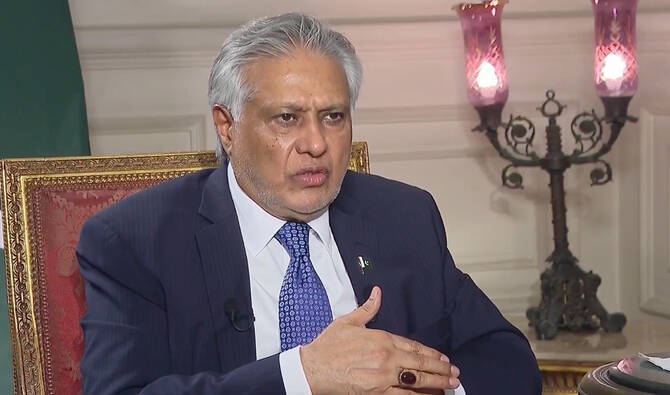

ISLAMABAD: Deputy Prime Minister and Foreign Minister Ishaq Dar said on Monday the US-Iran agreement brokered by Pakistan envisages free movement of commercial shipping through the Strait of Hormuz during a 60-day negotiation period, outlining Islamabad’s understanding of the accord following the first round of negotiations in Switzerland.
The comments come after US and Iranian negotiators gathered in the European state under the framework of the Islamabad Memorandum of Understanding, a Pakistan-mediated agreement signed earlier this month after weeks of conflict between Washington and Tehran.
The talks produced a roadmap toward a final agreement within 60 days and established mechanisms to support implementation of the accord, including arrangements aimed at ensuring continued maritime traffic through the strategic waterway during the negotiation period.
“According to my interpretation, there should be no fee,” Dar told Al Arabiya English when asked about the future status of shipping through the Strait of Hormuz.
“No matter what you call it, service fee, toll or fee, whatever it is, or service charges,” he continued. “Our understanding is there should be nothing.”
The deputy prime minister said Pakistan’s understanding was that conditions in the strategic waterway should return to those prevailing before the conflict erupted on Feb. 28.
“At least for 60 days, there is free movement,” he added. “According to our information, the ships are moving, both sides.”
The Strait of Hormuz, through which a significant share of global oil exports passes, became a focal point of concern during the conflict after Iran moved to restrict shipping, triggering fears of disruptions to global energy supplies and trade.
Dar said shipping traffic was already resuming.
His comments came as US President Donald Trump said the strait was now “totally open” to shipping, while US Vice President JD Vance said negotiations in Switzerland had laid the foundation for a broader agreement between Washington and Tehran.
The US Treasury on Monday announced a temporary suspension of sanctions on Iranian oil exports through Aug. 21, citing Tehran’s commitment to free transit through the strait and its agreement to allow inspectors from the International Atomic Energy Agency (IAEA) to return.
Dar, however, said sanctions relief remained one of the key issues yet to be resolved.
“Right now, no sanctions immediately being lifted, which means no assets are being unfrozen,” he said.
“This is one of the main areas they will be dealing with: nuclear and sanctions.”
Iranian Foreign Minister Abbas Araghchi said separately that oil and petrochemical exports had been waived from sanctions and that some frozen assets would be released, while Iranian officials described the Switzerland meeting as a positive first step.
Dar said Pakistan and Qatar had worked closely throughout the crisis to facilitate diplomacy between the two sides.
“We have been in touch with everybody,” he said, adding that Qatar had made intensive efforts alongside Pakistan to persuade both parties to engage in negotiations.
The Pakistani deputy prime minister said Islamabad had maintained extensive diplomatic contacts throughout the conflict.
“Since 28th of February, I have talked with my colleagues almost 150 times,” he said.
“This is a sincere diplomatic effort we made, and God has been very kind. Sense prevailed and parties realized that dialogue and diplomacy is the way forward.”
Pakistan and Qatar said in a joint statement after Sunday’s talks that a high-level committee had agreed on a roadmap toward a final US-Iran deal within 60 days, while technical negotiations would continue in Switzerland this week.
The mediators also announced the creation of a communication channel to prevent incidents and miscommunication in the Strait of Hormuz and support safe passage for commercial shipping.