

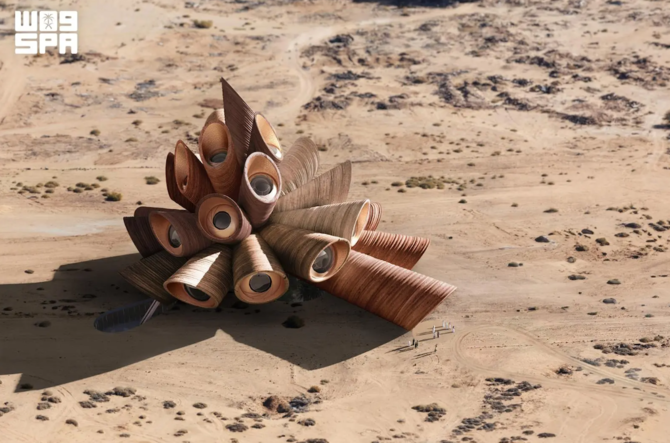

RIYADH: The design of a major astronomical discovery and tourism project in AlUla has been approved by the Royal Commission for AlUla’s board of directors, the Saudi Press Agency reported on Wednesday.
AlUla Manara will be a world-class observatory with a visitor and research center located 70 km north of the ancient city in Saudi Arabia’s northwest.
Its design was inspired by the region’s natural geology with futuristic architectural elements, and will use locally sourced sandstone cladding for its exterior.
The structure is located in an area with clear skies due to low levels of light pollution, between the Harrat Uwayrid Reserve and the Gharameel site.
RCU will work in partnership with the Saudi Space Agency, King Abdulaziz City for Science and Technology and the SETI Institute to position AlUla Manara as a center for scientific advancement.
The project is expected to attract a diverse range of research and development initiatives, while also offering stargazing experiences and enriching astro-tourism.
AlUla Manara will house a main telescope with a diameter of four meters, in addition to two further telescopes measuring two meters each, placing it among the largest observatories in the world.
There will be a range of different spaces housing a diverse collection of exhibits, including replicas inspired by famous space telescopes and satellites, alongside dedicated experimental areas, exhibition halls, research centers, observation platforms and spaces for stargazing and contemplation.
RCU’s efforts also reflect a strong environmental commitment through measures aimed at reducing light pollution, including the adoption of outdoor lighting regulations across AlUla that govern light intensity and direction while minimizing glare and unnecessary light spill.
These measures aim to preserve the clarity of the night sky and support environmental balance and wildlife conservation.
SPA reported that this approach demonstrated the commission’s commitment to safeguarding dark skies as both a natural and cultural heritage asset, while advancing astro-tourism and scientific research within a sustainable environment.


