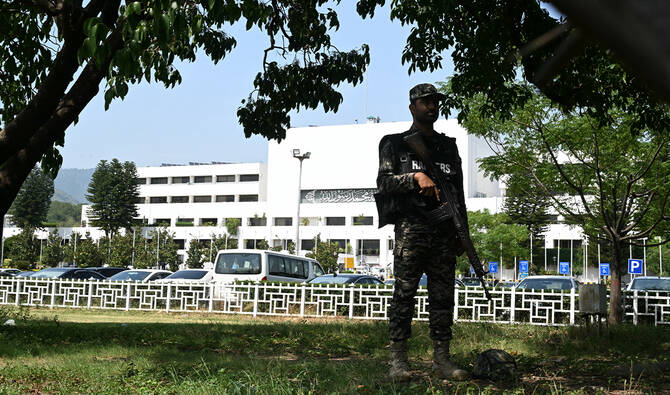

ISLAMABAD: Pakistan has increased its defense budget by around 18 percent to Rs3 trillion ($10.8 billion) for the next fiscal year, Finance Minister Muhammad Aurangzeb announced on Friday, citing the government’s commitment to maintaining national security amid a rapidly evolving regional threat environment.
The increase comes a year after Pakistan and India engaged in their most serious military confrontation in decades. The brief conflict in May 2025 involved missile strikes, drone attacks and aerial combat, sparking fears of a wider conflict between the two nuclear-armed neighbors before a ceasefire ended hostilities.
Presenting the federal budget in parliament, Aurangzeb described national defense as one of the government’s foremost responsibilities and announced an allocation of Rs3 trillion for the armed forces.
“Country’s defense is most important obligation for the government,” he said. “To fulfil this national obligation Rs3000 billion will be allocated.”
Pakistan’s defense allocation will rise from Rs2.55 trillion ($9.2 billion) in the outgoing fiscal year to about $10.8 billion in FY2026-27, though it remains significantly below neighboring India’s defense budget of roughly $86 billion.
A senior Pakistani government official, speaking on condition of anonymity, said the increase reflected both the changing nature of warfare and the country’s evolving security requirements.
“India’s military modernization allocation alone exceeds Pakistan’s entire defense budget,” the official told Arab News.
“The additional funding reflects the changing nature of modern warfare, which increasingly relies on drones, precision-guided missiles, cybersecurity, electronic warfare capabilities and advanced air defense systems,” he said.
The official said rising fuel prices, salaries, ammunition costs and the expense of imported military equipment had also contributed to higher expenditures, adding that the objective was to maintain a credible deterrent rather than expand military strength.
Defense analysts say Pakistan continues to face security challenges on multiple fronts, including tensions with India, instability along the Afghan border and a persistent militant threat.
“Indian defense budget is almost eight times bigger than Pakistan despite this year’s proposed defense budget increase,” said Syed Muhammad Ali, an Islamabad-based security analyst.
“Increasing Pakistani defense budget was essential to maintain peace and security in the region in an environment of massive Indian military buildup, high-tech acquisition spree, aggressive force posture, hostile Afghanistan and lingering terrorist threat,” he added.
Ali said India’s military procurements had accelerated since the 2025 conflict and argued that Pakistan could not ignore threats emanating from India, Afghanistan and militant groups simultaneously.
“Pakistani armed forces are undergoing a process of technological transformation by gradually reducing manpower toward a highly sophisticated force posture and technology intensive capabilities required for rapidly changing character of warfare and multi-domain operations,” he said.