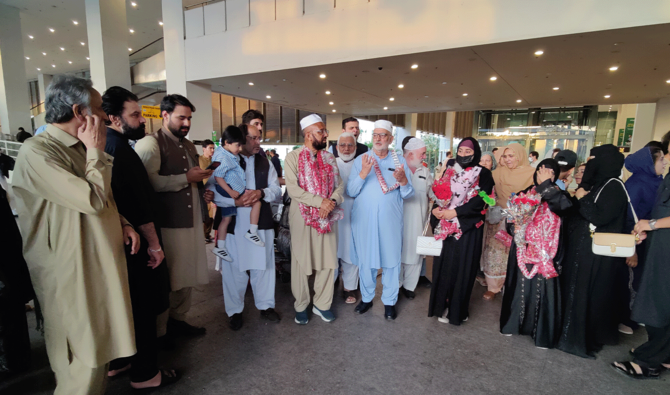

ISLAMABAD: The crowd gathering outside Islamabad International Airport this week, carrying flower garlands and arriving in convoys of decorated vehicles, looked much like a South Asian wedding procession. But these families were not waiting for a bride or groom. Instead, they were eagerly watching the arrivals gate for relatives returning from Hajj, Islam’s annual pilgrimage to Makkah that draws millions of Muslims from around the world, welcoming them home after weeks spent at some of the faith’s holiest sites.
For many Pakistanis, the pilgrimage does not end upon landing.
Across the country, the departure and return of Hajj pilgrims are often marked by traditions that transform a deeply personal act of worship into a community event, drawing relatives, neighbors and friends who gather to seek prayers, celebrate the journey and share what they see as a source of blessing.
Among those waiting at the airport was Asher Qureshi, surrounded by relatives who had come to receive his parents on an incoming Pakistan International Airlines (PIA) flight.
“My paternal uncle has come along with me, and many other close relatives have also come,” he said, gesturing toward the crowd, including his aunts and cousins, gathered at the airport.
“We will take the pilgrims home and give them a warm welcome.”
The emotional scenes marked the end of a journey that holds profound significance for Muslims around the world.
Hajj, one of the five pillars of Islam, is a religious obligation for every Muslim who is physically and financially able to perform it at least once in a lifetime. Each year, millions of pilgrims converge on Makkah and Madinah in Saudi Arabia to perform rituals that trace their origins back centuries.
For many Muslims, the pilgrimage represents the fulfilment of a lifelong dream and years of saving. In Pakistan, that sense of achievement is often shared by entire families and communities.
This year, nearly 179,000 Pakistanis performed Hajj, including Asher’s parents, who were among the pilgrims returning this week.
“It is Allah’s grace that He has called us multiple times,” Imran Qureshi, Asher’s father, said. “We were blessed with the opportunity to visit His House and the Prophet’s Mosque, and we spent a very beautiful time there.”
He was speaking at his residence in Rawalpindi, where dozens of relatives and well-wishers had gathered to congratulate the family.
“Specifically, the arrangements made by the Saudi government were excellent,” he said, also expressing appreciation for the reception he received upon returning home.
His wife, Tayyeba Imran, who had performed Hajj before, said the experience remained overwhelming no matter how many times one visited.
“Shivers run through you, and your body gets goosebumps. The whole body starts trembling, thinking: ‘When my eyes first fall upon it, I don’t know what I will do, I don’t know what will happen.’”
She was referring to the Holy Kaaba, the black cube-shaped structure at the center of the Grand Mosque in Makkah and the focal point of Muslim prayer around the world.
“But such is the sight of Allah’s House, such is His grandeur, that when you go with humility and your first gaze falls upon it, the words escape your mouth: Allah-u-Akbar, Allah-u-Akbar, Allah-u-Akbar.”
For many Pakistanis, however, the homecoming itself carries a significance of its own.
Returning pilgrims often spend weeks receiving visitors who come to offer congratulations, hear stories from the journey and receive dates and bottles of Zamzam water, drawn from the well in Makkah that is revered by Muslims around the world, brought back from Saudi Arabia.
“Friends, companions and relatives, out of sheer joy, first come to see us off when we are leaving for Hajj,” Qureshi said.
“When we return, their joy is boundless because we are coming back after visiting the House of Allah and the Prophet’s Mosque.”
“They believe that whatever prayer they ask us to make for them will be accepted, that Allah Almighty will grant it.”
The tradition stretches back generations, according to relative Anjum Hafeez Qureshi.
“This is the culture of entire Pakistan,” he said, recalling a time when pilgrims often traveled by sea from Karachi before air travel became commonplace.
“People from the neighborhood would accompany pilgrims to the railway station on foot, reciting naats [devotional poetry in praise of the Prophet Muhammad (PBUH)], as they walked together arm in arm,” he said.
Though travel has become easier, he said, the enthusiasm remains unchanged.
“Even today, you must have seen at the airport that fifty people had come to receive a single pilgrim,” he said.
“It increases mutual love and creates a longing in other people’s hearts to go for Hajj themselves,” he added.
For Tayyeba, the welcome itself carries a special emotional weight.
“Since a person has returned after performing worship, people have a profound desire to meet them because those eyes have seen the House of Allah,” she said.
“People wish to meet such individuals, to look into the eyes that have seen the Kaaba and to kiss the hands that have touched it.”
The scene creates a surreal atmosphere.
“You feel as though you are floating in the air, not even walking on the ground,” she said.