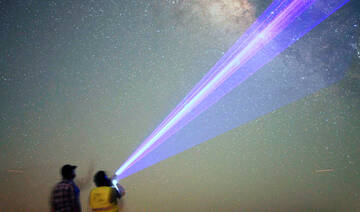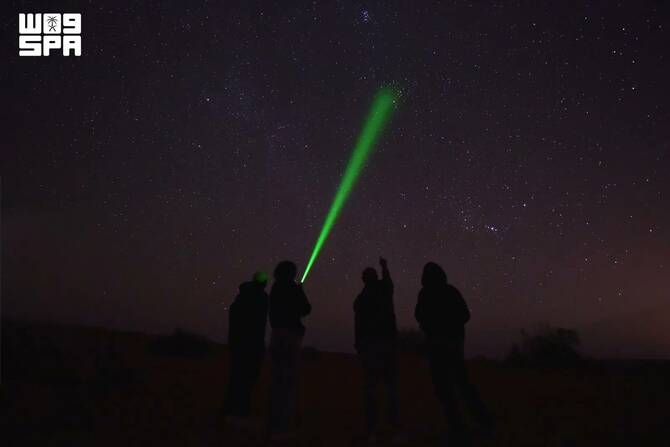
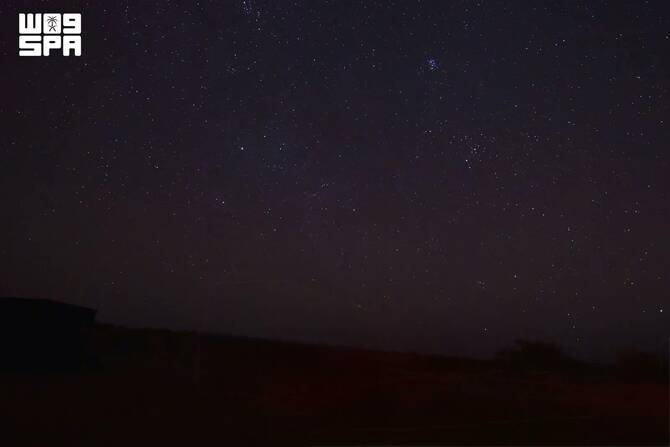

RIYADH: Skywatchers, astrophotographers and astronomy enthusiasts are expected to flock to the Imam Turki bin Abdullah Royal Reserve, as the skies above the 91.5 sq. meter site are set to witness a number of astronomical events in June.
The vast desert landscape and low light pollution levels of the Kingdom’s second-largest terrestrial nature reserve provide ideal conditions for observing celestial phenomena.
A conjunction of Venus and Jupiter was observed on June 9, while June 16-18 will see the Moon align with Venus, Jupiter, and Mercury in one of the month's most notable celestial displays, the Saudi Press Agency reported.
On June 19, the Moon will be in conjunction with the star Regulus, followed by the summer solstice on June 21. Other highlights include a conjunction of Mercury and Jupiter on June 25, the Moon’s conjunction with Antares on June 27, Mars appearing near the Pleiades star cluster on June 28, and a Full Moon on June 30.
Such events promote interest in astronomy while highlighting the reserve’s appeal as a destination for ecotourism and astronomical tourism in the Kingdom.
Describing it as a major achievement for both ecotourism and astronomical tourism, Abouazza El-Mhamdi, an associate professor in the physics and astronomy department at King Saud University, told Arab News: “It provides an ideal Saudi location for adequate earth-based telescopes, enabling sensitive observations of a variety of astronomical events, stars and galaxies.
“At the same time, it establishes the Imam Turki bin Abdullah Royal Reserve as a premier global destination for stargazing and astro tourism, supporting sustainable economic growth.”
The dual benefit demonstrates a successful model where the reserve’s appeal as a destination for ecotourism and astronomical tourism directly advances scientific discovery as well as responsible tourism, he added.
The reserve received a “dark sky” listing in December last year from DarkSky International, the global body committed to tackling light pollution in urban and rural areas.
Welcoming the accreditation, official reserve spokesperson Ahmed Al-Qarni told Arab News: “It’s a new achievement in the journey of protecting nature and astronomy in Saudi Arabia. The adoption of the Great Nafud Desert in Imam Turki bin Abdullah Royal Reserve by the international DarkSky association, as the largest site in the Middle East, (represents) a culmination of a precise scientific path, and another step that enhances the Kingdom’s position as a leading destination in sustainability, nature protection, and astronomical tourism.”