


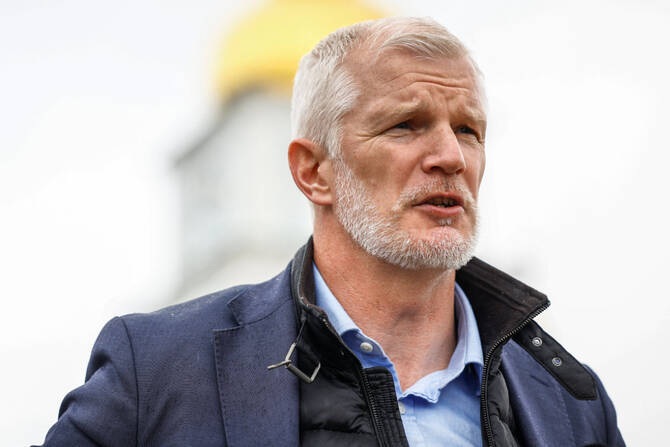

LONDON: Britain’s defense secretary and armed forces minister resigned Thursday in a dramatic dispute over military spending, dealing a fresh blow to Prime Minister Keir Starmer as he faces mounting pressure from within his governing Labour Party.
Defense Secretary John Healey announced his resignation, arguing that the government’s long-delayed Defense Investment Plan (DIP) fails to provide sufficient funding for the armed forces amid growing global security threats. Hours later, Armed Forces Minister Al Carns also quit, along with Healey aide Pamela Nash, widening the crisis at the Ministry of Defense.
The departures come less than a week before a closely watched parliamentary by-election that could further fuel speculation about Starmer’s political future.
In a resignation letter posted on X, Healey said Starmer and the Treasury had failed to commit the resources needed to defend Britain.
“You have been unable, and the Treasury has been unwilling, to commit the resources that the nation needs to defend the country at this time of rising threats,” Healey wrote.
He said he had warned Starmer that he could not support a defense settlement that failed to adequately fund Britain’s military.
Healey disclosed that the spending plan would raise defense expenditure to only 2.68% of gross domestic product by 2030, a figure he said fell “well short of what is required for defense and the country at this dangerous time.”
The government has repeatedly delayed publication of the 10-year investment strategy, originally expected in late 2025. The latest postponement has frustrated military leaders and defense industry executives seeking clarity on future procurement and force modernization plans.
In his resignation letter, Carns said he decided to quit after “it has become clear to me that the change I had pushed for is not going to come.”
“While I had no hand in the Defence Investment Plan, that distance does allow me to say plainly that it is not built for the threat we face. It is neither transformative enough nor sufficiently funded. We are asking our Armed Forces to operate in a more dangerous world on a budget written for a calmer one.
“We owe those who serve the UK the kit to do the job and the loyalty to stand by them when it's done. We are failing on both,” Carns wrote on the platform X.
Starmer appoints new defense chief
Starmer quickly appointed former army officer Dan Jarvis as defense secretary, moving him from a junior role in the Home Office.
“My first duty is to keep the British people safe,” Starmer said. “This Labour Government is delivering the largest sustained increase in defense spending since the Cold War.”
The prime minister has pledged to increase defense spending to 2.5% of GDP from next year, rising to 3% if Labour wins the next general election, expected in 2029, before eventually reaching 3.5% by 2035.
However, critics argue that timetable is too slow given Russia’s war in Ukraine, tensions involving Iran, and growing pressure from the United States for European allies to shoulder more of NATO’s defense burden.
Healey, who has served as defense secretary since Labour returned to power in July 2024, played a leading role in coordinating support for Ukraine, developing post-war security arrangements, and helping organize maritime security efforts aimed at safeguarding shipping routes through the Strait of Hormuz.
NATO Secretary-General Mark Rutte described Healey as someone he respected greatly, while acknowledging that governments across the alliance face difficult choices in balancing defense and domestic spending priorities.
The resignations intensify political uncertainty surrounding Starmer, whose government has struggled with poor local election results and growing internal dissent. Former Health Secretary Wes Streeting resigned last month, while Greater Manchester Mayor Andy Burnham has indicated he would enter any future Labour leadership contest.
Conservative leader Kemi Badenoch seized on the turmoil, saying Starmer’s premiership was “falling apart.”
Defense analysts said Healey’s departure creates immediate challenges for the government, including securing ministerial stability and finally publishing the long-awaited defense strategy before the NATO summit in Turkiye on July 7.


