


NEW YORK CITY: The Arab Group at the UN on Wednesday warned of escalating regional tensions, and condemned attacks by Iran against Gulf Arab states and Jordan.
It also strongly criticized Israel for its military actions in Gaza, Lebanon and Syria, and called for a renewed diplomatic push across the Middle East.
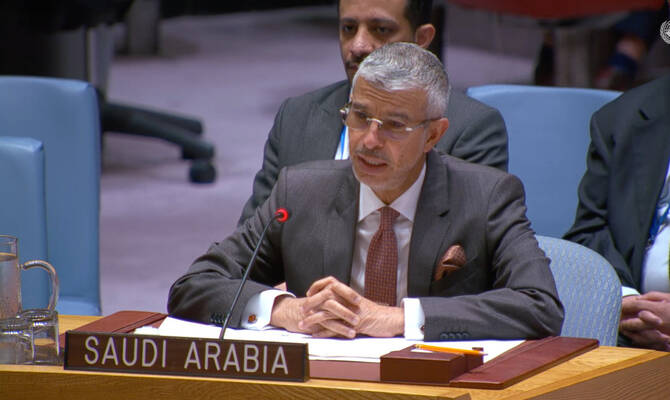
Speaking on behalf of the group, the Saudi ambassador to the UN, Abdulaziz Alwasil, said the region was facing “dangerous escalation and hostile acts” that threaten international and regional security, and underscore the need for mediation and preventive diplomacy.
He said recent Iranian attacks targeting several Gulf Arab states and Jordan constituted violations of international law, the UN Charter and the principles of good neighborliness.
The Arab Group “reaffirms its rejection of any acts whose effect would be to undermine the security of states, threaten their stability or expose their peoples and capabilities to danger,” Alwasil said.
Civilian infrastructure and maritime routes must be protected to ensure freedom of navigation and global trade, he added, and strategic waterways, straits and harbors are vital to the global economy, energy security and international supply chains.
The ambassador was speaking at the UN headquarters in New York during a high level meeting of the Security Council that convened to discuss the conflict in the Middle East. It was presided over by Gustavo Petro, the president of Colombia, which holds the presidency of the council this month.
The Arab Group reaffirmed its commitment to the UN Charter, including respect for sovereignty, territorial integrity, non-interference in the internal affairs of other nations, and the peaceful settlement of disputes.
Alwasil also highlighted its support for international efforts to revive political processes. He pointed in particular to Security Council Resolution 2817. The resolution, which condemns Iranian attacks against its neighbors in the region and threats to international shipping in the Strait of Hormuz, was backed by 136 UN member states in March, which Alwasil said reflected the global support for diplomacy and the peaceful resolution of disputes.
He welcomed ongoing diplomatic initiatives that aim to ease regional tensions, and praised Pakistan for its role in efforts to promote dialogue and encourage political solutions.
On the issue of the conflict between Israelis and Palestinians, Alwasil said the Palestinian cause remained “the central issue of the Arab world.” Lasting peace depends on ending the Israeli occupation and enabling Palestinians to exercise their right to self-determination, he added, through the establishment of an independent state based on 1967 borders, with East Jerusalem as its capital, in line with UN resolutions and the Arab Peace Initiative.
He rejected all policies that attempt to change the demographic composition of the occupied Palestinian territories, including the expansion of Israeli settlements and the forced displacement of Palestinians. Alwasil described such actions as violations of Security Council Resolution 2334, adopted in December 2016, which describes Israeli settlement activity as a violation of international law.
He also warned against any attempt to alter the historical and legal status quo in Jerusalem, particularly at Al-Aqsa Mosque, and said the ongoing military actions and restrictions on humanitarian access in Gaza had created a “grave and intolerable humanitarian emergency.”
Civilians in the territory were being deprived of basic services and protections, he added as he called for the full implementation of Security Council Resolution 2803 on the Gaza peace plan, including its provisions relating to a ceasefire, humanitarian access, nonoccupation, nonannexation and nondisplacement.
Alwasil noted that the existing ceasefire agreement in Gaza had been achieved through mediation efforts by Egypt, Qatar, the US and Turkiye. He said this was evidence of the important role of diplomacy in efforts to achieve political solutions to disputes.
The region’s crises cannot be resolved by military means, he added, they require coordinated international action based on dialogue, mediation, respect for international law and efforts to address the root causes of conflict.
Regarding the situation in Lebanon, Alwasil condemned continuing Israeli military activity in the country. He expressed his condolences over the deaths of Lebanese army personnel during the conflict between Israel and Hezbollah, and called for Lebanon’s sovereignty and armed forces to be protected.
He asked for the intensification of international efforts to help end the conflict, ensure humanitarian access and support political processes that can lead to peace and stability, while welcoming US mediation efforts and Lebanese-led initiatives that aim to end the hostilities.
On Syria, he condemned Israeli incursions as violations of the country’s sovereignty and international law. He urged Israel to fully comply with the 1974 disengagement agreement, and demanded the withdrawal of its forces from positions occupied during recent advances, as well as the occupied Syrian Golan.
Alwasil said the international community bears a shared responsibility for the promotion of dialogue, cooperation and confidence-building measures.
“Lasting peace is not achieved through force but through genuine political will, diplomacy and respect for international law,” he said as he reaffirmed the commitment of the Arab Group to working with the UN and other partners in pursuit of a stable, secure and prosperous Middle East.


