
BEIRUT: Lebanon remains committed to negotiations with Israel and will not use force to disarm the Iran-backed Hezbollah, a Lebanese official told Arab News, as Israel expanded its military operations deeper into Lebanese territory ahead of a round of talks in Washington.
Israeli airstrikes on Monday reached areas beyond the Zahrani River, with Israel stating that it would target “terrorist sites in Beirut’s southern suburb,” while accusing Hezbollah of repeated ceasefire violations.
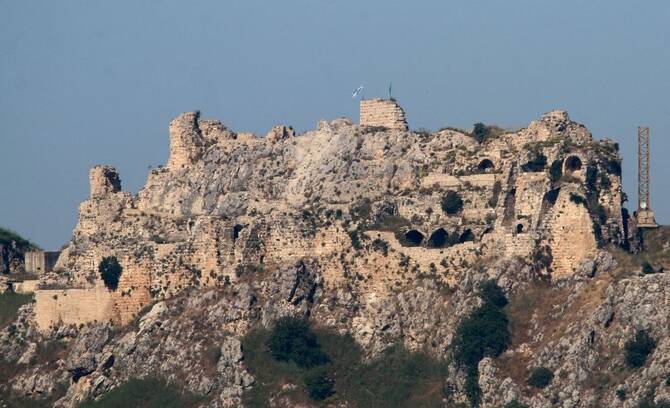
Lebanon has entered a new phase of military escalation after the Israeli military announced over the weekend that it had taken control of the strategic Lebanese position of Beaufort Castle, known as Qalaat Al-Shaqif.
The escalation comes as Lebanon and Israel prepare for a fifth round of US-sponsored diplomatic negotiations in Washington on Tuesday and Wednesday, raising questions whether the diplomatic track can withstand mounting pressure on the ground.
An official Lebanese source told Arab News that the latest Israeli escalation may be linked to Beirut’s rejection, during military discussions at The Pentagon last week, of an Israeli demand that the Lebanese army immediately move to disarm Hezbollah.
The source said: “This insistence is dragging Lebanon into an internal conflict with unpredictable consequences.”
The source added that the Lebanese government had already taken “significant decisions” regarding Hezbollah’s weapons and military wing and was implementing those decisions in a “pragmatic and measured manner.”
Though Israel and the US accuse Lebanon of failing to act on the issue of Hezbollah’s disarmament, the source said both countries were aware that the approach they had advocated had not succeeded in resolving the matter.
The source added: “Israel itself, which has destroyed homes and burned villages south of the Litani River, was unable to halt Hezbollah’s attacks. How can the Lebanese army achieve this, given its limited military capabilities and the sensitivities of Lebanon’s internal situation?”
The source confirmed that rockets and drones targeting Israeli forces operating in southern Lebanon, and Israeli settlements, were not being launched from areas south of the Litani River, where the Lebanese army has already deployed and worked to remove more than 80 percent of the weapons.
“Lebanon remains committed to negotiations, as the Lebanese state has no alternative,” the official said.
The capture of Beaufort Castle on Sunday raised concerns that the situation on the ground was shifting in ways that could pave the way for expanded military operations deeper into southern Lebanon.
Observers saw the move as an attempt to shape conditions on the ground before Tuesday’s political negotiations, giving Israel greater leverage at the negotiating table.
Meanwhile, observers have noted that Hezbollah is also seeking to demonstrate its ability to exert pressure through attacks that have extended beyond the border area and into Israeli territory.
Ali Al-Amin, editor-in-chief of media platform Janoubia, told Arab News that the fall of Beaufort Castle to the Israeli army highlighted Hezbollah’s vulnerability.
No battle was fought over the site, and no clashes were reported.
However, Hezbollah MP Hassan Fadlallah described the castle as merely an archaeological site and downplayed its military significance.
“The castle, historically built as a defensive military site, overlooks southern Lebanon and faces toward Palestine,” he explained.
Nevertheless, a Lebanese military source told Arab News that control of Beaufort Castle allowed the Israeli army to advance toward Ali Al-Taher Hill, which overlooks the entire Nabatieh region.
The military source said: “Israeli forces would then be able to control, through fire, sight, and surveillance, the Marjeyoun Plain, Nabatieh, and the settlements of the Galilee Panhandle, as well as monitor the Litani River from south to east.
“This would open the way for the Israeli army to move toward the mouth of the Zahrani River, effectively controlling the area between the Litani and Zahrani. It would push the missile threat away from the border by a distance of 25 to 40 km.”
If Israeli forces succeeded in reaching Ali Al-Taher Hill, residents could expect pressure from multiple directions, the source added.
“If the Israeli advance continues from Dbayn toward Blat and Wadi Barghaz, it could threaten one of the most important links between southern Lebanon and the Bekaa Valley, a key logistical and geographical artery in the region,” the source said.
“Any further advance toward Jabal Al-Rayhan and the Iqlim Al-Tuffah region would shift operations to what is considered the third and final line of defense deep in the south.”
Israeli forces used Beaufort Castle, which stands about 700 meters above sea level, as a base during their previous occupation of southern Lebanon that ended in 2000.
The reoccupation of the site has raised fears of an occupation, the scope of which is difficult to predict.
It has reinforced Israel’s military grip over the southern and northern banks of the Litani River.
Al-Amin told Arab News: “We are not witnessing any real battles being waged by Hezbollah, and the party’s defenses appear largely ineffective against the Israeli army, which continues its destruction, incursions, and occupation.”
The UN Security Council is expected to hold an emergency meeting, at France’s request, to discuss developments in the war in Lebanon following Israel’s occupation of Beaufort Castle.
A Lebanese Foreign Ministry source told Arab News that Lebanon was working on lobbying during the UN session.
French Foreign Minister Jean-Noel Barrot confirmed to his Lebanese counterpart Youssef Rajji “France’s solidarity with Lebanon and its firm commitment to the country’s full sovereignty.” He reaffirmed Paris’ support for direct negotiations as the only path toward a permanent and sustainable resolution to the crisis.